On this page
Last Updated on October 1, 2026 by Muhammad Toqeer
Look at the indicator lights before you touch anything. On a modern sealed booster they separate three completely different problems, and they do it from across the room.
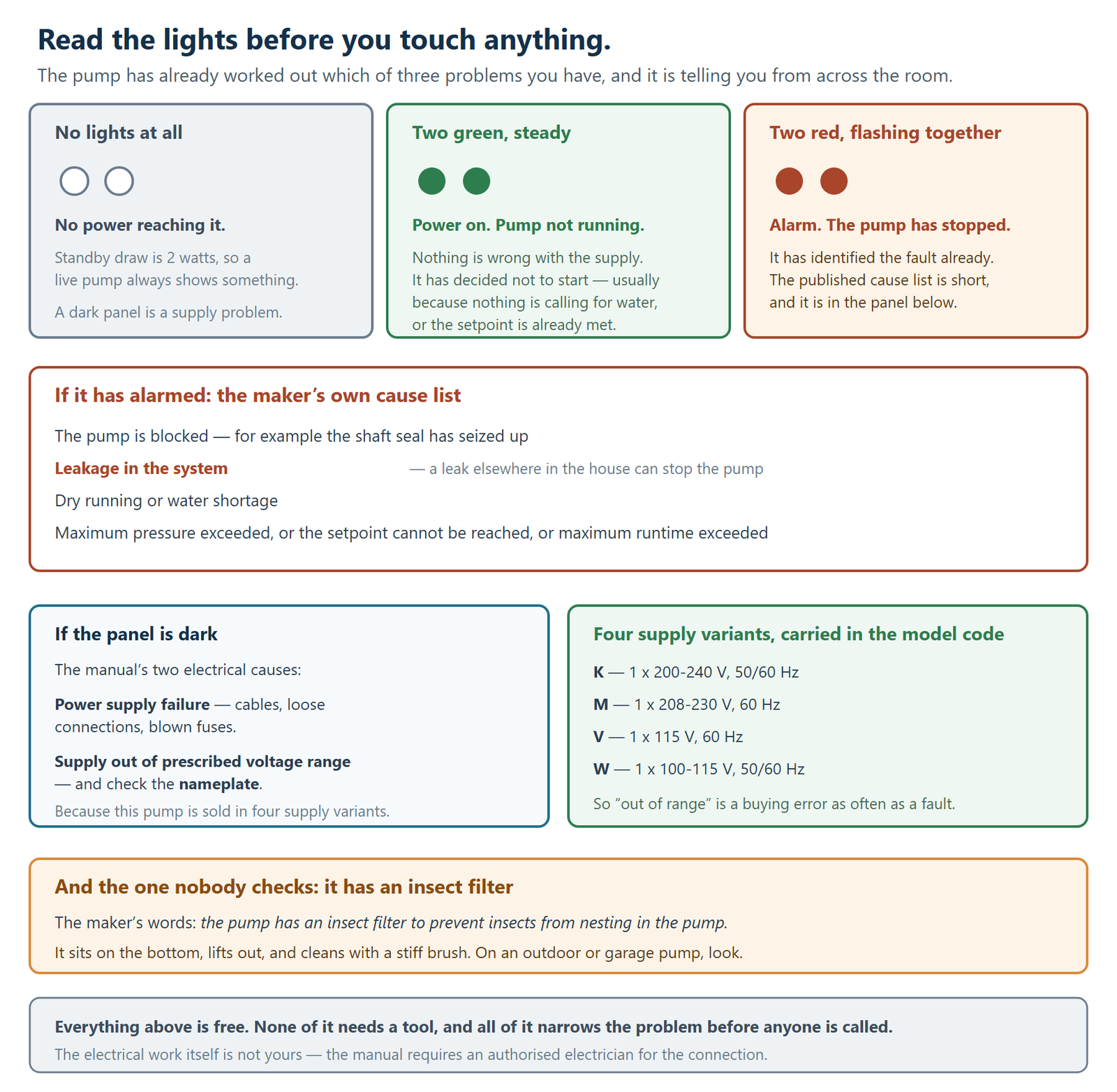
Two green lights steady means the power is on and the pump is deliberately not running. Two red flashing together means it has already identified a fault and stopped. No lights at all means no power is reaching it — and since the pump draws two watts on standby, a dark panel is a supply problem rather than a sleeping pump.
Three states, no tools, and most people skip straight past them.
The three states, in the manufacturer’s own words
Grundfos publishes the light language for the SCALA2, and it is unusually clear:
“Two opposite green indicator lights permanently on. The power is on. The pump is not running.”
“Two opposite green indicator lights running in the direction of rotation of the pump. The power is on. The pump is running.”
“Two opposite red indicator lights flashing simultaneously. Alarm. The pump has stopped.”
Work out which of those you have and you have already halved the problem.
One-minute test: stand in front of the pump and watch it for thirty seconds while somebody opens a tap. Green steady that starts chasing round means the pump is fine and was simply idle. Green steady that stays steady with water running is a different matter. Red flashing needs no tap at all.
If the panel is dark
This is a supply problem, and the manual gives two causes.
“a) Power supply failure. Switch on the power supply. Check the cables and cable connections for defects and loose connections and check for blown fuses in the electrical installation.”
“b) The power supply is out of prescribed voltage range. Check the power supply and the pump nameplate.”
That second one is worth dwelling on, because it is a buying error at least as often as a supply fault. The SCALA2 is sold in four supply variants, and the model code carries them:
| Code | Supply |
|---|---|
| K | 1 × 200-240 V, 50/60 Hz |
| M | 1 × 208-230 V, 60 Hz |
| V | 1 × 115 V, 60 Hz |
| W | 1 × 100-115 V, 50/60 Hz |
A 230-volt pump on a 115-volt outlet is not broken. It is the wrong pump, and the maker’s instruction — check the nameplate — is telling you to rule that out before anything else.
One-minute test: read the nameplate and read the outlet. If they disagree, stop there.
And the electrical work itself is not a homeowner job. Grundfos is explicit that “the electrical connection must be carried out by an authorised electrician”, and specifies an earth leakage circuit breaker with a tripping current below 30 mA on a permanent installation.
If two green lights are steady
The supply is fine and the pump has chosen not to run. That is usually correct behaviour rather than a fault.
The ordinary reason is that nothing is asking for water — the setpoint is satisfied and the system is holding pressure, which is exactly what it should do.
So test it with demand. Open a tap properly, not a trickle, and watch. A pump that starts is a pump that was never broken.
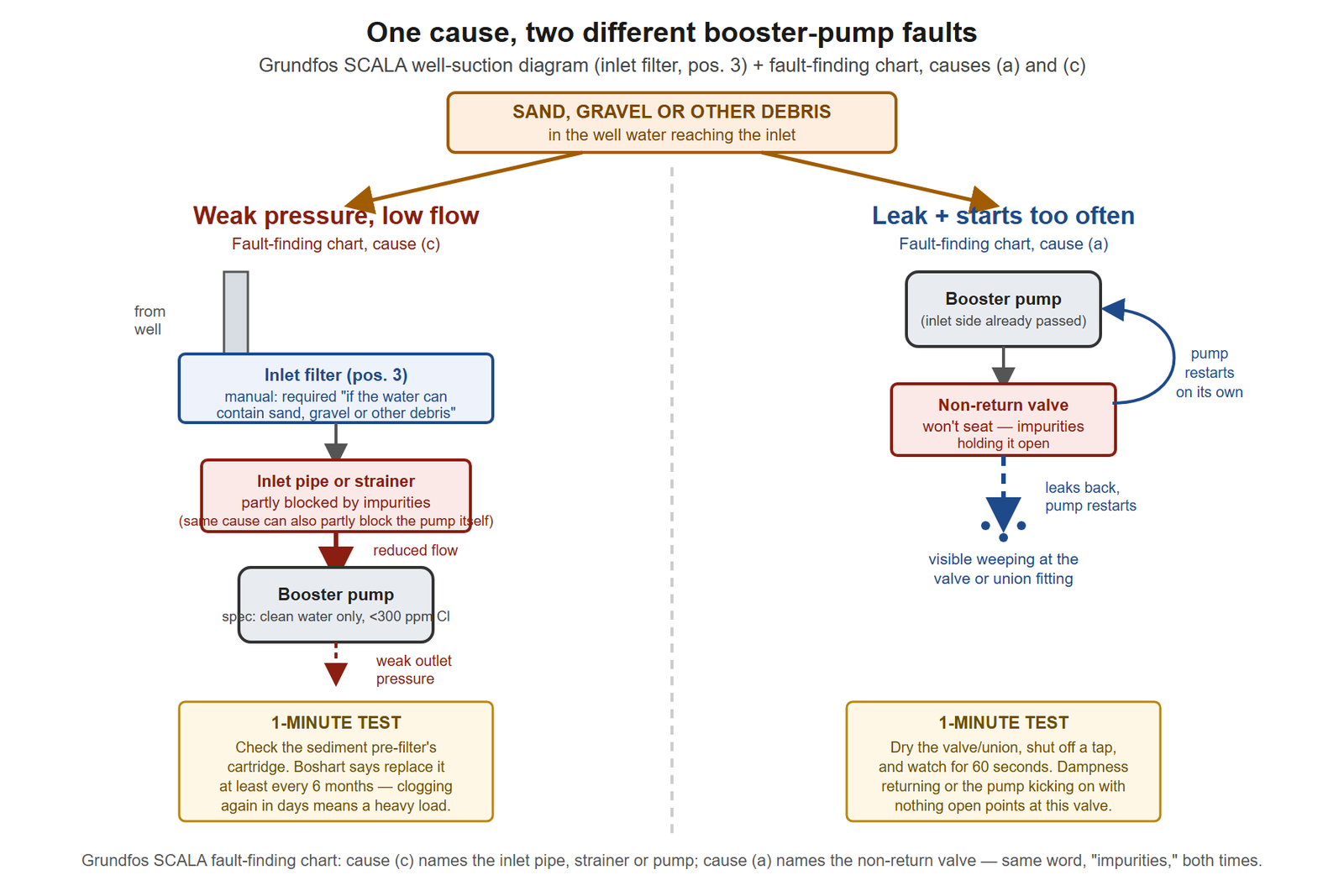
If it stays steady with water genuinely flowing, that is where it becomes a fault, and the sensible next step is to look at the pressure readings rather than the pump — a booster that runs and achieves nothing and a booster that will not start can both come back to the inlet.
If two red lights are flashing
The pump has stopped itself and it already knows why. The published cause list is short:
- The pump is blocked — for example the shaft seal has seized up
- Leakage in the system
- Dry running or water shortage
- The maximum pressure has been exceeded, or the setpoint cannot be reached
- The maximum runtime has been exceeded
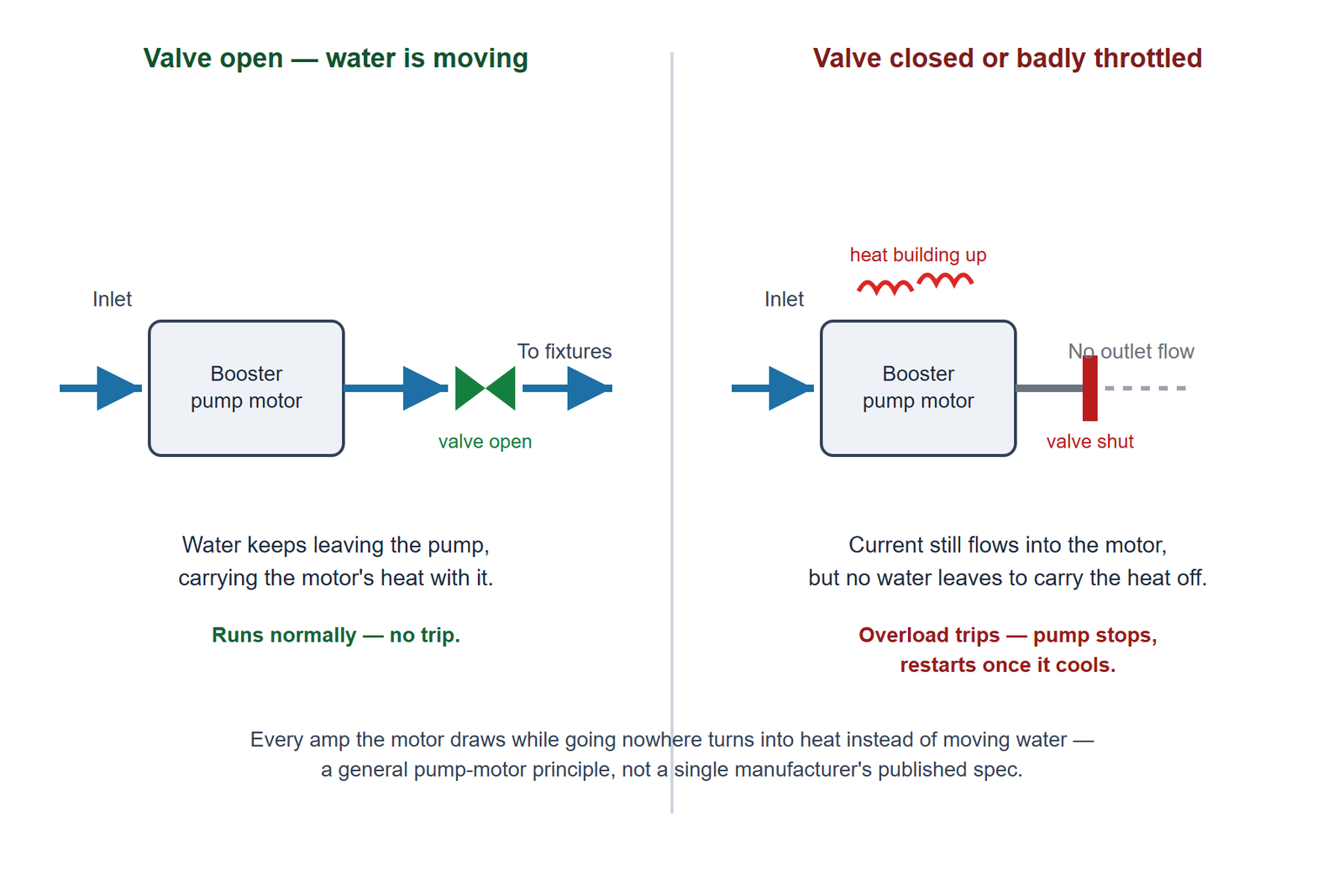
Notice the second one, because it is the one that surprises people. A leak somewhere else in the house can stop your booster pump. A system that never holds pressure keeps the pump running until it hits its runtime limit, and then it shuts down and alarms.
So a pump that has alarmed is sometimes reporting the plumbing rather than itself.
One-minute test: turn everything off and watch the pressure. If it falls with nothing running, the pump is not your problem.
And a dry-run alarm is not permanent. The unit attempts three restarts within the first sixty seconds, then a further set, and repeats the cycle after 24 hours — so a pump that seems dead may simply be between attempts.
The cause nobody checks
It has an insect filter.
“The pump has an insect filter to prevent insects from nesting in the pump. The filter is placed on the bottom and can easily be removed and cleaned with a stiff brush.”
A part whose published purpose is keeping insects out of the machine. On an outdoor installation, in a garage, or anywhere warm and sheltered, that is a real and free thing to look at — and it explains a class of “it just stopped working” that no electrical test will ever find.
While you are there, the manual also notes the pump is “maintenance-free, but we recommend that you check and clean the inlet and outlet non-return valves once a year or as needed” — and that it must not be exposed to frost.
What this is not
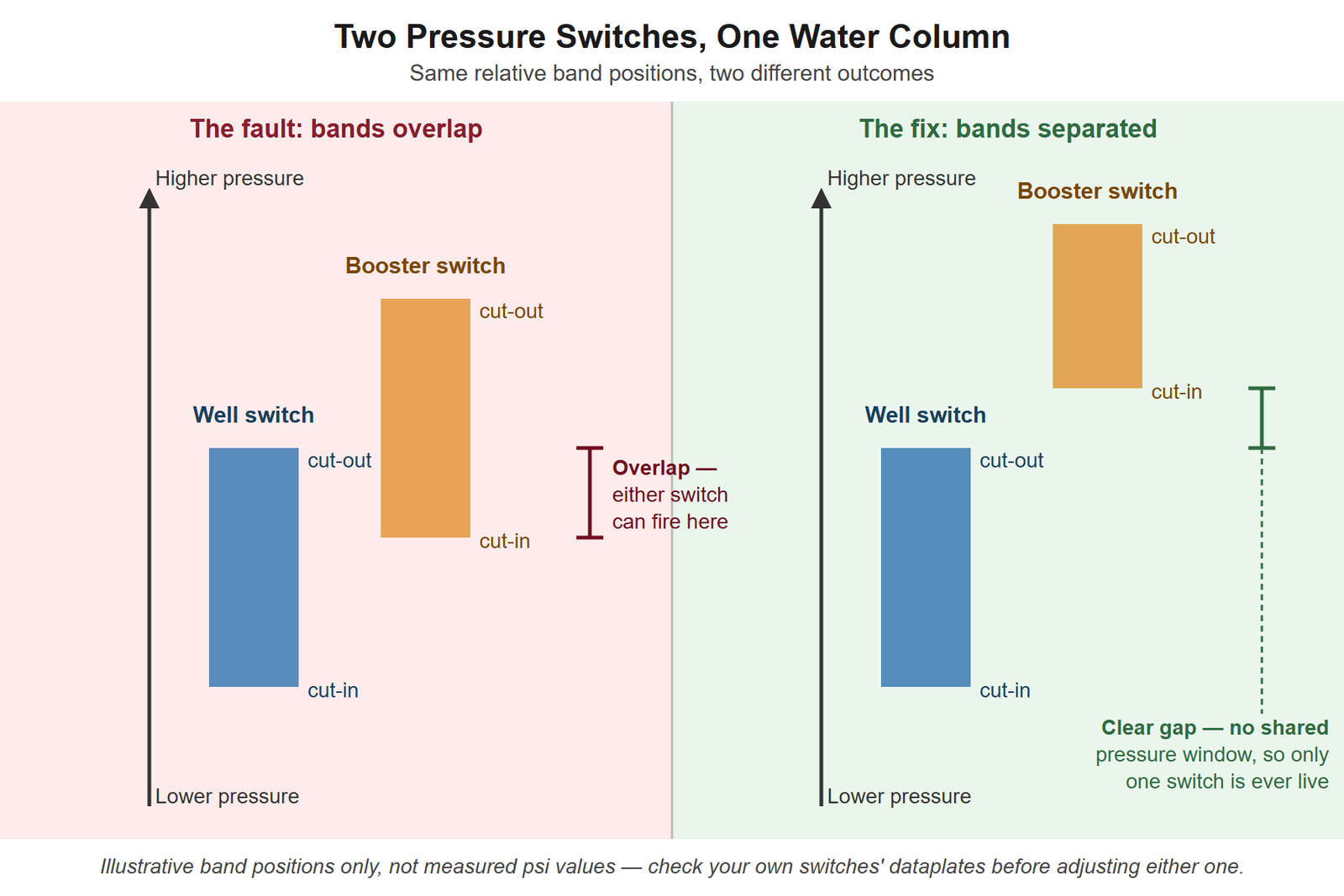
It is not a pump that keeps starting and stopping. That is cycling, and its first cause is the low-pressure cutoff doing its job.
It is not a pump that runs steadily without raising the pressure. Different symptom, different ceiling.
And it is not a reason to bypass the cutoff. The low-pressure cutoff is a code requirement with a public-health purpose, and a pump that will not start because the cutoff has operated is a pump protecting the water main.
When this needs a pro
Every part of the electrical side. The manufacturer requires an authorised electrician for the connection, and these pumps sit in damp places.
Anything inside the pump. They are sealed; the owner-serviceable parts the manual names are the priming plug, the insect filter and the non-return valves. Nothing else.
A repeated alarm. The restart behaviour is deliberate, and a unit cycling through it is reporting a condition that has not gone away.
Anything to do with the low-pressure cutoff, which is a code-required device with a specified position and setting.
What you can do yourself: read the lights, read the nameplate, open a tap, and look at the insect filter. Four observations, no tools — and between them they tell whoever you call which of three problems they are coming to.
And if it turns out the pump is simply not up to the house, the comparison worth reading puts boost and flow side by side rather than leading with horsepower.
FAQ
Why is my booster pump not turning on?
Start with the lights. Two green steady means the power is on and the pump has deliberately not started, usually because nothing is calling for water. Two red flashing means it has alarmed and stopped. No lights means no power is reaching it at all.
What do the lights on a Grundfos SCALA2 mean?
Two opposite green lights permanently on means power on and pump not running. Two green lights chasing in the direction of rotation means it is running. Two red lights flashing simultaneously is an alarm and the pump has stopped.
My booster pump has power but will not start — what now?
Open a tap properly and watch. If it starts, nothing was wrong; it was holding a satisfied setpoint. If it stays idle with water genuinely flowing, the next thing to look at is the inlet pressure rather than the pump.
Can a leak somewhere else stop my booster pump?
Yes, and it is on the manufacturer’s own alarm list. A system that never holds pressure keeps the pump running until it exceeds its maximum runtime, at which point it shuts down and alarms.
Does a booster pump reset itself after a dry-run alarm?
It tries. The unit attempts three restarts within the first sixty seconds, then a further set, and repeats the cycle after 24 hours. A pump that looks dead may be between attempts rather than finished.
Why would insects stop a booster pump?
Because there is a filter fitted specifically to keep them out, which means the manufacturer considers it a real failure mode. It sits on the bottom of the pump, lifts out, and cleans with a stiff brush.