On this page
Last Updated on October 28, 2026 by Muhammad Toqeer
A water-powered backup has no battery, no charger and no runtime limit. It uses your mains pressure to drive an ejector, so it runs for as long as the outage lasts.
Its entire performance rests on one number you probably do not know: your water pressure. And the two manufacturers who make these pumps quote that number on opposite sides of the same pressure drop — which is why their headline figures look comparable and are not.
That is what this page is about.
Why don’t the two brands’ flow figures line up?
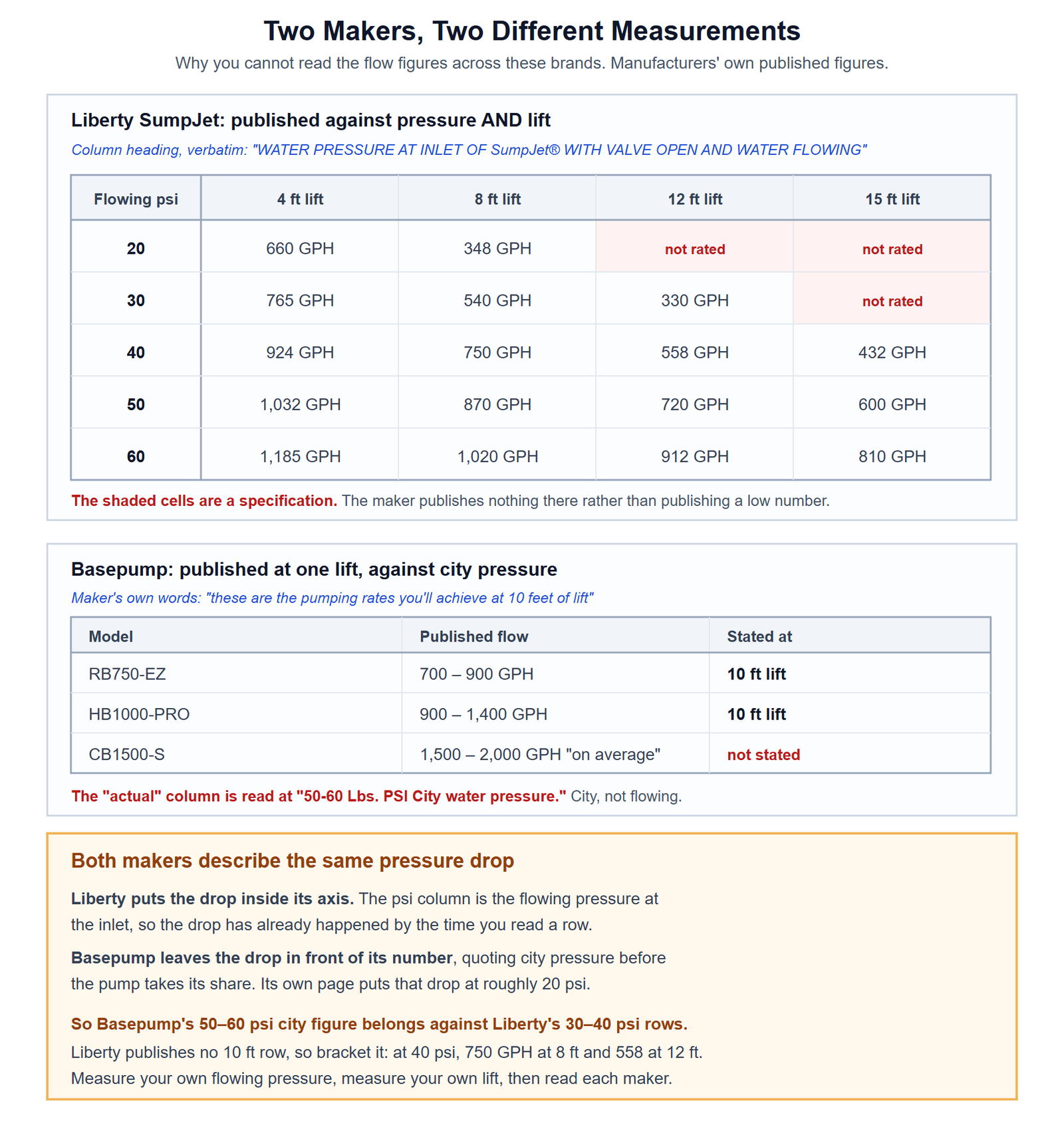
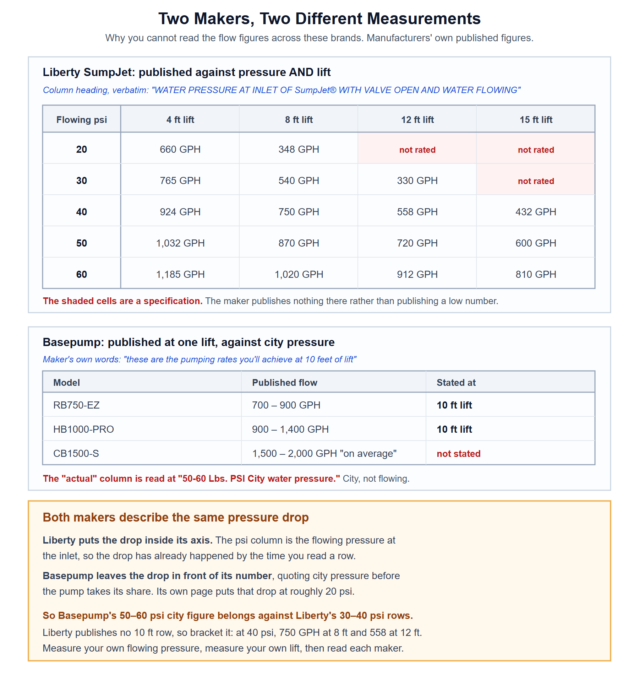
Liberty prints its measurement basis on the face of the table. The pressure column is headed “WATER PRESSURE AT INLET OF SumpJet® WITH VALVE OPEN AND WATER FLOWING”.
Read that twice, because it is the whole article. That is pressure measured while the pump is working — flowing pressure, not the static reading a gauge gives on a quiet house.
Basepump quotes the other side of it. Its current page states the lift plainly — “these are the pumping rates you’ll achieve at 10 feet of lift” — and its “actual” column is read at “50-60 Lbs. PSI City water pressure”. City pressure, before the pump takes its share.
Neither maker is hiding anything. They are describing the same physics from opposite ends, and Basepump says so itself: comparing a rival’s pump, its page restates that rival’s figure at “about 30 PSI (50 PSI minus a roughly 20 PSI pressure drop), not at 50 PSI.”
So Liberty’s “50 psi” and Basepump’s “50–60 psi city” are not the same 50 psi. Liberty’s is after the drop. Basepump’s is before it. Stack them in one column and you have compared two different measurements.
How do you compare them fairly?
Move one of them onto the other’s basis, and use the maker’s own 20 psi figure to do it.
Basepump’s 50–60 psi city numbers belong against roughly Liberty’s 30–40 psi rows, because that is where 50–60 psi of city pressure ends up once the pump is flowing.
And Liberty publishes no 10 ft row, so Basepump’s 10 ft figure has to be read against a bracket rather than a single number. At 40 psi flowing, Liberty gives 750 GPH at 8 feet and 558 GPH at 12 feet. Ten feet sits somewhere between those two, and this page will not pretend to a number the manufacturer did not print.
That is the honest comparison, and it is the one no round-up makes.
What do the gaps in the table mean?
They are the most useful part of it.
At 20 psi flowing, Liberty publishes a figure at 4 feet and at 8 feet — and nothing at 12 feet or 15 feet. At 30 psi it publishes down to 12 feet and nothing at 15.
Those cells are not omissions. The manufacturer is not rating the pump there. A table that said “80 GPH at 15 feet on 20 psi” would be a worse document than one that says nothing at all.
Beneath the table the manual adds: “For optimal performance minimum recommended operating pressure is 30 psi. Use of an RP (RPZ) may lower operating pressure.”
So the floor is 30 psi, not the 20 you will see in retail listings. The manual states it twice: “Minimum water pressure = 30 psi (207 kPa) with the valve open. (less pressure may not eject water from your basement)” and “Maximum water pressure = 100 psi (690 kPa) with the valve closed.”
Plenty of shops list this pump as accepting “20 to 100 psi”. That is the bottom row of the table being read as a specification — and that row is only rated to 8 feet of lift.
What pressure do you actually have?
Measure it before you buy either of these. A hose-bib gauge costs very little, and this is the only figure on the page that is about your house rather than the pump.
Take two readings, not one. Static, with nothing running. Then again with a tub tap wide open. The gap between them is your version of that 20 psi drop, and the second reading is what Liberty’s table is written against.
If your flowing reading is under 30 psi, neither of these pumps is your answer, and no amount of model-shopping changes it. A battery unit is the product for that house — and that is a different buying decision with its own trap.
If you are on a well, stop here. A well makes its pressure with an electric pump, and in a power cut that pump is the thing that has stopped. These work on municipal supply only.
How much water does it use?
About one gallon in for every two gallons out. Liberty states it plainly: “The SumpJet® will use approximately 1 gallon of water to remove 2 gallons of sump water, depending on elevation.”
That ratio is the real cost of the design. A long storm with a wet pit is a measurable water bill, paid in exchange for a pump that never runs flat.
The six, and what each one publishes
Two manufacturers, six models, all confirmed on sale on 29 October 2026. Nothing below is taken from a reseller listing.
Liberty SumpJet SJ10 — the one that publishes a full table
Water-powered, 3/4 inch factory push-fit inlet. Flow is published across four lifts and five flowing pressures rather than as a single number — at 40 psi it removes 924 GPH at 4 feet, 750 at 8 feet, 558 at 12 feet and 432 at 15 feet. Accepts 30 psi minimum with the valve open to 100 psi maximum with the valve closed. Ships with a foot valve installed, so no discharge check valve is needed. Internal check valve certified to ASME A112.18.3-2002 and ASME A112.18.1/CSA B125.1.2005. SSPMA Certified, UPC listed. Three-year warranty.
Who it is for: anyone who wants to work out what they will actually get. It is the only model here you can look up at your own pressure and your own lift, because it is the only one that publishes a grid instead of a band.
The honest drawback: the table also shows you where it runs out, and there is no 10 ft row, so a mid-height lift has to be bracketed. It has no alarm.
Liberty SumpJet SJ10A — the same pump with the alarm fitted
Identical performance to the SJ10, supplied with the alarm rather than as an option.
Who it is for: anyone whose pit is not somewhere they walk past weekly. A backup that fails silently is a backup you discover during the flood.
The honest drawback: it is the same pump. The ALM-P1 adds an alarm to a plain SJ10 later, so this is a packaging choice and not a performance one.
Basepump RB750-EZ — the smallest, with the installation kit
Water-powered siphon ejector, described by the maker as a “siphon ejector system that creates a vacuum source using municipal city water pressure as its motive force”. Published 700 – 900 GPH at 10 feet of lift, with the maker’s own “actual” figure given as 750 GPH at 50–60 psi city pressure. Water alarm included — relay output, 9 V battery, 85 dB. “No moving parts to break and no maintenance required.” “Standard float design can fit into a 12 inch diameter sump pit.” Five-year warranty, the longest here.
Who it is for: a small pit on solid city pressure, where the five-year warranty and the included alarm matter more than a performance grid.
The honest drawback: one lift, one band. You get a number at 10 feet and nothing either side of it, so a 15 ft lift is a guess in a way it is not with Liberty’s table.
Basepump RB750-EZ-V — the same pump with vented backflow protection
Same 700 – 900 GPH at 10 feet, supplied with a vented dual check valve rather than the plain arrangement.
Who it is for: anyone whose inspector or local code wants vented backflow protection on the supply, which on this kind of installation is common.
The honest drawback: it is the same pump, and the vented valve is not a substitute for the RP/RPZ device the codes may still require. Ask before you buy, not after.
Basepump HB1000-PRO — the middle model
900 – 1,400 GPH at 10 feet, with the maker’s “actual” figure given as 1,100 GPH at 50–60 psi city pressure. Same five-year warranty and included alarm. Also sold as HB1000-PRO-V with the vented dual check valve.
Who it is for: a pit taking more water than the RB750’s band covers, on a house with pressure to spare.
The honest drawback: the published band is now 500 GPH wide. The maker’s own “actual” figure of 1,100 sits in the middle of it, which tells you the ends of that range are conditions rather than promises.
Basepump CB1500-S — the largest
“1,500 to 2,000 Gallons per Hour (GPH), on average.” Also sold as CB1500-S-AVB with an atmospheric vacuum breaker fitted. Same warranty.
Who it is for: a genuinely high-inflow pit, or a building rather than a house.
The honest drawback: this is the vaguest figure on the page. The maker gives an average and lists supply, pipe condition and lift as the things that move it, without printing a grid — and it points buyers at a separate city-water test to check their supply is even sufficient. Do that test before ordering.
Side by side
| Model | Published flow | Stated at | Pressure basis | Alarm | Warranty |
|---|---|---|---|---|---|
| Liberty SJ10 | Grid: 4/8/12/15 ft × 20–60 psi | Four lifts | Flowing, at the inlet | Optional | 3 yr |
| Liberty SJ10A | Same grid | Four lifts | Flowing, at the inlet | Included | 3 yr |
| Basepump RB750-EZ | 700 – 900 GPH | 10 ft | City pressure, 50–60 psi | Included | 5 yr |
| Basepump RB750-EZ-V | 700 – 900 GPH | 10 ft | City pressure, 50–60 psi | Included | 5 yr |
| Basepump HB1000-PRO | 900 – 1,400 GPH | 10 ft | City pressure, 50–60 psi | Included | 5 yr |
| Basepump CB1500-S | 1,500 – 2,000 GPH “on average” | — | — | Included | 5 yr |
The “pressure basis” column is the one that should decide this purchase, and it is the column no other comparison carries. Do not read across the flow column between the two brands — those cells were measured on opposite sides of the drop.
What about freezing?
This is the feature nobody mentions, and it is designed in.
The SumpJet’s foot valve has a removable poppet. The manual: “Where freezing discharge pipes are a problem, simply unscrew the strainer screen, remove the poppet and spring, and replace the strainer. The SumpJet® will now allow water to flow back into the pit, eliminating discharge pipe freezing.”
That is a deliberate trade, not a modification. You give up the foot valve holding the column of water, and you get a discharge line that cannot freeze solid because it drains back every cycle.
Worth knowing if your discharge has frozen before, which is the failure that makes a backup pump pointless at exactly the moment you need it.
Which one should you buy?
Three numbers decide it, and two of them are about your house.
One — your flowing pressure. Under 30 psi and neither pump qualifies. Between 30 and 40, only Liberty’s floor is cleared. Above that, both are candidates.
Two — your lift. Measure from the pit water line to the highest point of the discharge. This is the number that makes Liberty’s grid usable and Basepump’s single 10 ft figure a bracket of its own, and the sizing article walks through measuring it.
Three — your inflow. If you have not run the fill test, do that first. It is the only way to know whether any of these move enough water for your pit.
Then: if you want to know what you are getting at your exact lift, the SJ10 or SJ10A. If your lift really is around ten feet and you want the longest warranty with an alarm in the box, the RB750-EZ or HB1000-PRO.
And if you are still deciding whether a second pump is the right answer at all, that question comes before this page.
And if the pump you already have is misbehaving, those are different problems with different answers. A pump running without emptying the pit is usually losing to inflow rather than failing, which is the case a backup actually solves. A pump humming without starting has already ruled out its whole supply side, and that is a repair question rather than a buying one.
When does this need a pro?
The backflow device, always. Liberty’s manual is unambiguous: “As per the Uniform Plumbing Code and per the Plumbing Codes of some states, including the State of Michigan, installation of this product requires the use of an RP (RPZ) backflow protection device.” Its internal check valve is described as “nominal backflow protection” — the maker’s own word, and it is not the RPZ.
The discharge arrangement. “The discharge of the water-powered sump pump must not to be connected to the primary sump pump”, nor directly to the municipal drain. An air gap of at least 1 inch, or discharge outside with the pipe end 6 to 24 inches above ground or flood level.
Water hammer. “The SumpJet® utilizes a quick acting valve which, per UPC, requires the use of an approved water pressure absorbing device.” A quick-closing valve on a mains tap needs an arrestor.
What you can do yourself: take both pressure readings, measure your lift, note your pit diameter, and run the fill test. Four numbers, and they narrow this page to one row — or send you back to the pillar to reconsider the whole arrangement.
A few details worth knowing before anyone quotes you: the supply needs a dedicated shut-off valve within 6 feet of the pump; no copper sweating within 18 inches of the body; PTFE tape only, no pipe dope; “DO NOT USE A GARDEN HOSE” on the supply, with 3/4 inch pipe recommended for full performance; and the bottom of the pump housing should sit about 12 inches above the level at which your normal pump turns on. These are clear-water pumps and must not see hot water, sewage or debris.
FAQ
How much water pressure does a water-powered sump pump need?
Liberty states a minimum of 30 psi with the valve open and a maximum of 100 psi with the valve closed, measured at the inlet while water is flowing. Basepump quotes its rates against 50–60 psi of city pressure. Measure yours with a tap running as well as static, because the flowing reading is the lower one and it is what the pump actually sees.
Why do the two brands’ flow figures look so different?
Because the pressures are quoted on opposite sides of the same pressure drop. Liberty’s psi column is already the flowing pressure at the inlet, while Basepump quotes city pressure before the pump takes its share. Basepump’s own page puts that drop at roughly 20 psi, so its 50–60 psi city figures belong against Liberty’s 30–40 psi rows, not Liberty’s 50.
How much water does a water-powered backup sump pump use?
Roughly one gallon of supply water for every two gallons removed from the pit, depending on elevation. That ratio is the trade for a pump with no battery and no runtime limit, and it is worth costing if you are metered.
Can you use a water-powered sump pump on a well?
No. A well system makes its pressure with an electric pump, so in a power cut the thing producing your pressure has stopped. These work on municipal supply only.
Do you need a check valve with a water-powered sump pump?
Not on the discharge of the SumpJet, which ships with a foot valve installed. You do need backflow protection on the supply side, and the Uniform Plumbing Code and some states require an RP or RPZ device — the internal check valve is described by the maker as nominal protection only.
Will the discharge line freeze?
It can, like any discharge line. The SumpJet’s foot valve has a removable poppet specifically for this: take out the poppet and spring and water drains back into the pit after each cycle, which stops the line freezing solid at the cost of the foot valve’s holding function.
Can a water-powered pump be your only sump pump?
No. These are backup units for clear water and are not rated as a primary pump. The manual also requires the housing to sit about a foot above the level at which the normal pump switches on, which only makes sense alongside a primary.