On this page
Last Updated on November 5, 2026 by Muhammad Toqeer
Before any of this works, one condition has to be true: no water can be arriving in the pit.
Every test on this page compares the water level before and after the pump runs. If groundwater is still coming in, the level is being changed by two things at once and the comparison means nothing. That is the reason check valve tests so often give a confusing answer — not because the tests are hard, but because they were run during a wet week.
So the first step is to establish that the pit is quiet. Watch the level for ten minutes with the pump off. If it does not move, you can test. If it is creeping up, come back in a dry spell.
Once that is settled, there are two different failures to look for, and they are opposites.
What are the two failures?
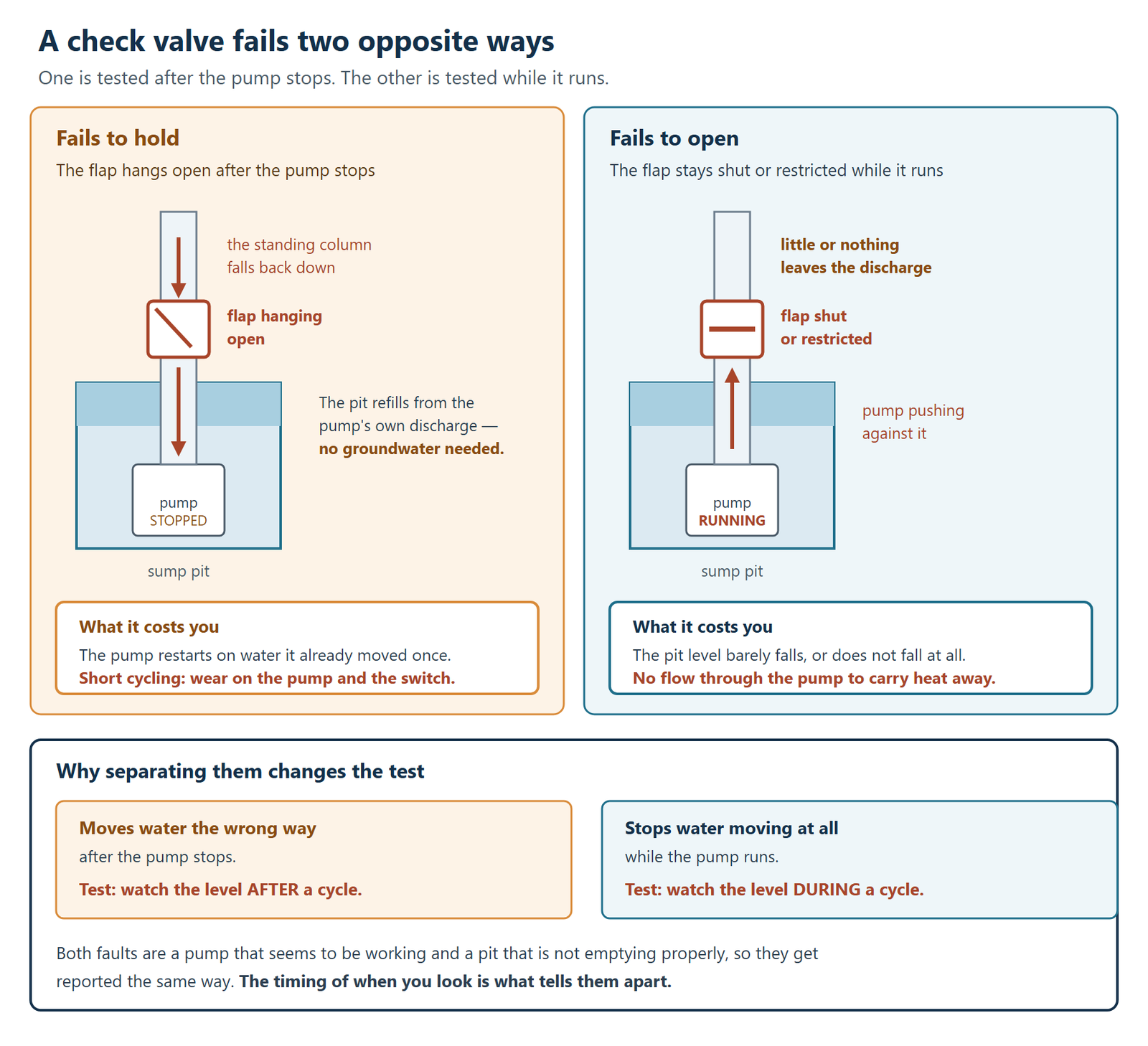
A check valve exists to do one thing: hold the water in the discharge pipe after the pump stops, so it does not fall back into the pit. It fails in two directions.
| Fails to hold | Fails to open | |
|---|---|---|
| When it shows | After the pump stops | While the pump runs |
| What you see | Level creeps up with no inflow | Level barely falls |
| What it causes | Short cycling | No flow, and overheating |
| How you test it | Watch the level after a cycle | Watch the level during a cycle |
These need different tests, which is why “test the check valve” is not one instruction.
How do you test whether it holds?
This is the common failure and the easier test.
- Confirm the pit is quiet — ten minutes, level unmoving, pump off.
- Note the water level. Use something you can see again: a mark on the liner, the top of a block, a piece of tape.
- Let the pump run a full cycle and shut off on its own float.
- Mark the new, lower level immediately.
- Watch for five minutes without touching anything.
| What you see | What it means |
|---|---|
| Level stays where the pump left it | The valve holds. |
| Level rises a little, then stops | Normal. The short length of pipe above the valve drains. |
| Level rises steadily toward the start level | The valve is not holding. |
| Level rises enough to restart the pump | Not holding, and the pump is now cycling on its own water. |
Row three is the finding. The water coming back is the column the pump just lifted, and the taller your discharge run, the more of it there is. On a tall run this can be enough to restart the pump on its own, which is exactly what sump pump short cycling looks like from above — so if you have been chasing short cycling, this test is the one worth running first.
How do you test whether it opens?
The rarer failure, and it shows up during the cycle rather than after it.
- Confirm the pit is quiet, as before.
- Trigger the pump by lifting the float or adding water.
- Watch the pit level while it runs, and watch where the discharge comes out if you can see it.
| What you see | What it means |
|---|---|
| Level falls steadily, water leaves the outlet | The valve opens. |
| Level falls very slowly, little water leaving | Restricted — valve, or something else in the line. |
| Level does not fall, pump running | Nothing is getting through. Stop the pump. |
If nothing is getting through, switch the pump off. A submersible pump relies on water moving through it to carry heat away from the motor. A pump running against a closed outlet is heating up with no way to shed it.
A stuck-shut check valve is only one reason for this, though, and it is not the most likely one. A sump pump running but not pumping is more often an airlock, a blocked intake or a failed impeller — so a no-flow result points you at that list rather than ending the investigation.
Is the banging noise a sign of a bad valve?
Usually the opposite. This is worth stating plainly because it sends people to buy valves they do not need.
The thud or bang when the pump stops is the water column reversing and slamming the valve shut. That noise is the valve doing its job. A valve that made no noise at all might simply be letting the column through.
What the noise can indicate is a valve that closes abruptly on a long or rigid run, which is a water hammer problem rather than a valve failure — and sump pump banging noise covers what actually reduces it. Replacing a working valve because it is loud generally produces a quieter version of the same bang.
What if the result is ambiguous?
Two situations muddy this, and both are worth naming.
You cannot get a quiet pit. In a wet season, with a high water table, the level never stops moving. There is no reliable version of this test under those conditions. You can still learn something from the no-flow test, because that one only needs the level to fall, but the hold test has to wait.
There are two pumps sharing one discharge. Then the valve arrangement itself decides what the test means, because water can return past a second pump’s path. One check valve serving two pumps is a configuration with its own rules, and testing it as though it were a single-pump setup gives a misleading answer.
When should you just replace it?
A check valve is a cheap part in a discharge line you have to open either way, so the economics are not finely balanced.
Replace it rather than testing further when:
- The hold test shows the level returning steadily
- The valve is original to a pump you are already replacing
- The discharge is open for any other reason
- You cannot see or reach the valve to inspect it, and the symptoms point at it
Replacing a sump pump check valve is a short job, and which valve to fit depends on the pipe, the orientation and how quietly you need it to close.
When does this need a pro?
- The discharge is glued solid with no union. Opening it means cutting, and refitting means getting the alignment right first time.
- The pit is deep enough that reaching the valve means getting into it.
- Two pumps, one discharge, and you are not certain how it is piped.
- The pump overheated during the no-flow test. That pump needs assessing, not just the valve.
- The level never settles, which may be a groundwater problem rather than a pump problem at all.
FAQ
How do I know if my sump pump check valve is bad?
Run the pump until it shuts off on its own, mark the water level, and watch it for five minutes with no water arriving in the pit. A small initial rise as the pipe above the valve drains is normal. A level that climbs steadily back toward where it started means the valve is not holding the column.
Why does my sump pit refill right after the pump stops?
Because the water the pump just lifted is coming back down the discharge pipe. A check valve should hold that column in place. When it fails to seal, the pit refills from the pump’s own discharge and the pump restarts on water it has already moved.
Does a loud bang mean the check valve is failing?
Generally the reverse. The bang is the water column reversing and slamming the valve closed, which means the valve is sealing. A loud closure on a long or rigid discharge run is a water hammer issue rather than a failed valve, and replacing the valve usually just makes the same noise again.
Can I test a check valve while the pit is filling with groundwater?
Not the hold test, no. That test compares the level before and after a cycle, and incoming groundwater changes the level independently, so the result means nothing. Watch the level for ten minutes with the pump off first — if it is creeping up, wait for a dry spell.
What happens if a check valve sticks closed?
The pump runs but nothing leaves the discharge, so the pit level does not fall. That also removes the flow the motor depends on to carry heat away, so the pump should be switched off rather than left running. A stuck valve is one cause of no flow, but a blocked intake, an airlock or a failed impeller are all more common.
Should I test the check valve or just replace it?
If the hold test already shows the level returning, replace it — it is a cheap part and the line has to be opened either way. Testing is most worth doing when you are trying to decide whether the check valve or something else is behind short cycling, because that tells you whether opening the discharge will help at all.