On this page
Last Updated on October 28, 2026 by Muhammad Toqeer
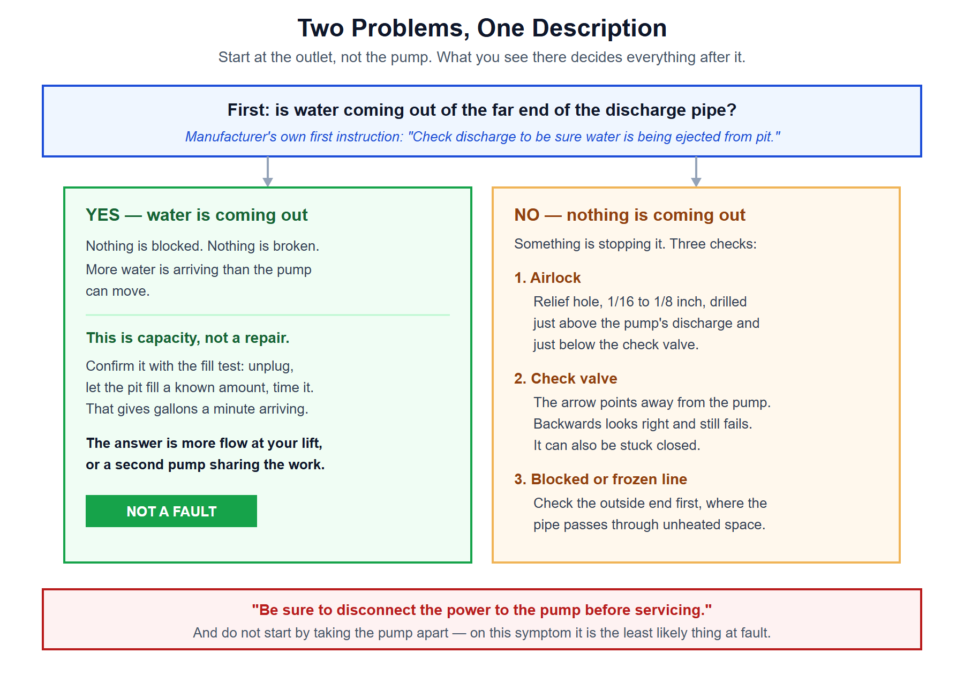
Go outside and look at the end of the discharge pipe. Everything else depends on what you see there.
“Running but not pumping” describes two completely different problems, and they share nothing — not a cause, not a fix, not even whether anything is broken. Most troubleshooting lists bundle them into one set of ten causes and leave you working through all of them.
One look sorts it. The manufacturer’s own first instruction is exactly that: “Check discharge to be sure water is being ejected from pit.”
Is water coming out of the discharge?
This is the whole diagnosis, and it takes a minute.
If water is coming out and the pit still will not empty, nothing is blocked and nothing is broken. More water is arriving than the pump can move. That is a capacity problem, and no amount of taking the pump apart will change it.
If no water is coming out, something is stopping it, and there are three things to check in order.
Do not skip this step and start with the pump. The two branches below have nothing in common, and starting in the wrong one wastes an afternoon during the one storm when you do not have an afternoon.
Water is coming out — so why is the pit not emptying?
Because the pump is losing a race, not failing a test.
A pump moving its rated flow into a pit taking more than that will run continuously and the water will still rise. The pump is working exactly as designed. This is the case people most often misread as a failure, because the symptom — running, not emptying — looks identical from the top of the pit.
Confirm it with the fill test. Unplug the pump, let the pit fill a known amount, and time it. That gives you gallons a minute arriving, which is the number the whole problem turns on.
Then the answer is capacity, and there are only two shapes it takes: a pump that moves more at your lift, or a second pump sharing the work. In a storm with a power cut in it, the second pump is the one that matters — and a water-powered backup has no battery to run flat.
No water is coming out — what is stopping it?
Three checks, in the order they take to do.
Is it an airlock?
The pump spins against trapped air and moves nothing. It sounds like it is working, because electrically it is.
The fix is a drilled relief hole, and it has a published size and position: “Drill 1/16″ to 1/8″ anti-airlock hole in pipe just above pump’s discharge and just below check valve.”
Both halves of that matter. Above the pump’s discharge, and below the check valve — a hole on the wrong side of the valve does nothing, and most advice says “drill a weep hole” without telling you either the size or where.
The hole will squirt a little water back into the pit on every cycle. That is the trade, and it is the correct behaviour rather than a fault.
Is the check valve stuck — or backwards?
A check valve has a direction arrow on the body, and the manufacturer’s instruction is to read it: “Check valve usually has an arrow on it indicating water flow.” It should point away from the pump, toward the discharge.
Fitted backwards, it produces this exact symptom while looking perfectly installed. That is why it is worth two seconds of looking before anything is unbolted.
And if the arrow is right, it can still be “stuck closed” — the other thing the manufacturer tells you to inspect for.
Is the line blocked or frozen?
Check the outside end, not the pit end. A discharge line running through unheated space is the most common place for this to go wrong, and in winter it is the first thing to suspect rather than the last.
A frozen discharge has its own article, because the fix is different from a blockage and the prevention is different again.
What should you not do?
Do not reach into the pit with the pump plugged in. The manufacturer states it plainly: “Be sure to disconnect the power to the pump before servicing.”
Do not take the pump apart first. On this symptom the pump is the least likely thing at fault, and several manufacturers explicitly direct owners not to disassemble their pumps at all.
Do not drill the relief hole below the pump’s discharge or above the check valve. The position is part of the specification.
When does this need a pro?
Anything that means entering the pit, beyond reaching in with the power off.
Re-plumbing the discharge, including fitting or turning a check valve, if that is not work you are set up to do.
A capacity answer. Adding a second pump to an existing discharge is a real plumbing decision with its own rules, and getting it wrong gives you two pumps fighting each other.
What you can do yourself: look at the outlet, run the fill test, read the arrow on the check valve, and check the outside end of the line for ice. Four checks, no tools, and they place the problem in one of the two branches above.
FAQ
Why is my sump pump running but not pumping water?
Look at the far end of the discharge pipe first. If water is coming out, the pump is working and more water is arriving than it can move, which is a capacity problem. If no water is coming out, the likely causes are an airlock, a check valve stuck closed or fitted backwards, or a blocked or frozen discharge line.
What is an airlock in a sump pump?
Air trapped at the pump’s outlet that the impeller spins against instead of moving water. The published remedy is a relief hole of 1/16 to 1/8 inch drilled into the pipe just above the pump’s discharge and just below the check valve, which lets the trapped air escape.
Which way should a sump pump check valve point?
Away from the pump, toward the discharge. The valve body usually carries an arrow showing the direction of flow. Fitted the wrong way it will stop the pump discharging while looking correctly installed, which makes it worth checking before anything is taken apart.
Will a weep hole make my sump pump less efficient?
It returns a small amount of water to the pit on each cycle, which is the cost of not airlocking. A hole within the published 1/16 to 1/8 inch range is sized so that trade stays small.
My pump is pumping but the water keeps rising — is it broken?
Probably not. A pump running continuously while the level rises is usually being out-paced by inflow rather than failing. Run the fill test to measure how much water is arriving, then compare it with the pump’s flow at your actual lift rather than its headline figure.
Should I take the sump pump apart to check the impeller?
Not as a first step, and on many models not at all — several manufacturers direct owners not to disassemble the pump and to use an authorised service centre. Disconnect the power first in any case, and work through the discharge-side checks before suspecting the pump.


