On this page
Last Updated on November 1, 2026 by Muhammad Toqeer
Most pressure switches are ordered on one number — 30/50, 40/60 — and that is the number least likely to be wrong. The part number also carries the horsepower class, the enclosure rating and whether the switch has a low-pressure cutoff. Get those wrong and a switch with the correct pressure band still fails, or fails to protect the pump.
Which pressure switches are worth comparing?
Two manufacturers cover almost every residential well in North America, and they divide the job differently. Square D’s Pumptrol range splits horsepower by a type letter; Boshart’s medium-duty range handles more horsepower in a single body and publishes a wider field-adjustment window.
Every figure below is from the manufacturer’s own published documentation.
| Switch | Factory band | Motor rating | Notable detail | Honest limitation |
|---|---|---|---|---|
| Square D 9013FSG2J20 | 20–40 psi | up to 1.5 hp at 115 V, 2 hp at 230 V | NEMA 1 enclosure, 1/4″ NPSF | FS type is rated below 1.5 hp — not a 2 hp switch |
| Square D 9013FSG2J21 | 30–50 psi | same FS class | The most commonly stocked band | Same horsepower ceiling as above |
| Square D 9013FSG2J24 | 40–60 psi | same FS class | Suits a higher-pressure system | Higher pressure does not raise the motor rating |
| Square D 9013FSG2J21M4 | 30–50 psi | same FS class | Adds the low-pressure cutoff | Needs a manual reset after it trips |
| Square D FYG type | per pressure code | below 2 hp | The step up from FS | Different type letter, easy to miss on an invoice |
| Boshart PS02MD-3050 | 30–50 psi | 2 hp at 115 V, 3 hp at 230 V | Cut-in adjustable 10–45 psi, cut-out 25–65 | Medium duty — more switch than a 1/2 hp pump needs |
| Boshart PS02MD-4060 | 40–60 psi | same, 24 A at 115 V / 17 A at 230 V | Cut-in 20–55, cut-out 35–75 | Field adjustment must stay inside the published window |
| Boshart PS02MD-5070 | 50–70 psi | same | Cut-in 30–70, cut-out 45–90 | Above most residential system pressures |
Sources: the Square D water pressure switch catalogue and Boshart’s PS02MD medium-duty specification sheet, both opened directly. Confirm current supply before ordering — the catalogue numbers above are selection candidates, not a stock check.
What does the part number actually tell you?
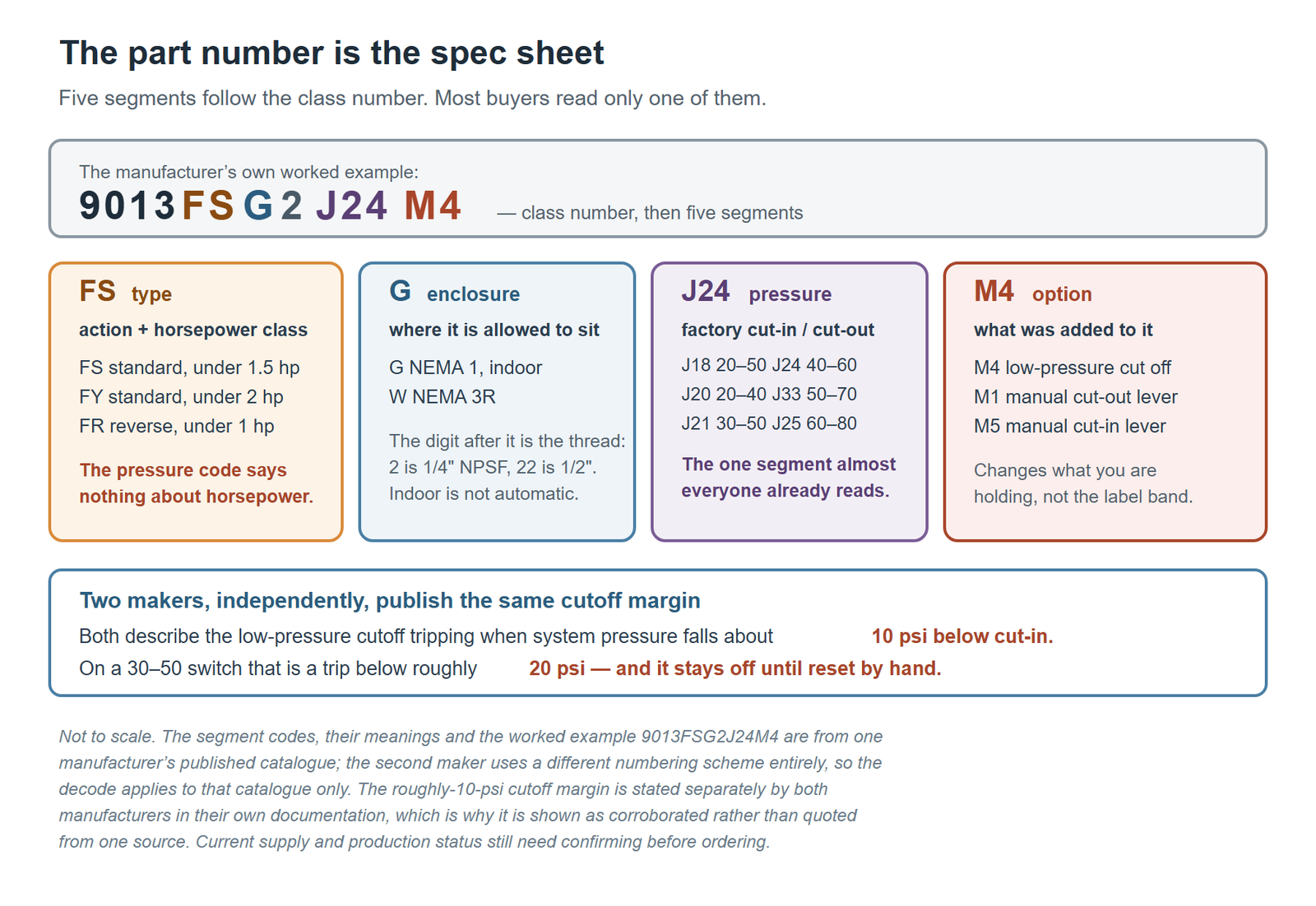
This is where the real selection happens, and almost no buying page covers it. Square D publishes its own worked example — 9013FSG2J24M4 — and every segment is a separate decision.
The type letters are the horsepower class. `FS` is standard action with adjustable differential, rated below 1.5 hp. `FY` is the same action rated below 2 hp. `FR` is reverse action, below 1 hp. The pressure code says nothing about horsepower, so a reader matching 40/60 to 40/60 can still land a switch under-rated for the motor.
The enclosure letter is a site decision. `G` is NEMA 1 — general purpose, indoor. `W` is NEMA 3R. A general-purpose indoor enclosure is not automatically right for an exposed wellhead or a wet pit, and the letter is the only thing that tells you which you are buying.
The connection digit is the thread. `2` is 1/4″ NPSF internal; `22` is 1/2″.
The pressure code is the factory band, and this is the part everyone already reads: J18 is 20–50, J20 is 20–40, J21 is 30–50, J24 is 40–60, J33 is 50–70, J25 is 60–80, and J99 is a custom setting.
The suffix is the modification. `M4` is the low-pressure cutoff. `M1` is a maintained manual cut-out lever. `M5` is a maintained manual cut-in lever for reverse action. There are others — pulsation plugs, slip-on terminals — that change what you are holding without changing the pressure band on the label.
Square D names the four its stores usually carry: FSG2J20CP, FSG2J21CP, FSG2J24CP and FSG2J21M4CP.
Will the switch actually carry your motor?
Check this before the pressure band, because it is the failure that burns contacts.
Square D’s FS class is rated up to 1.5 hp at 115 V or 2 hp at 230 V, and the catalogue adds the sentence that settles most residential cases: “Most residential pumps are 1.5 hp or less.” For anything above that class, the type letter has to change to FY.
Boshart’s medium-duty range starts higher. The PS02MD is documented for direct control of 2 or 3 hp submersible or jet pumps depending on the pump’s voltage — 2 hp at 115 V and 3 hp at 230 V, drawing 24 A and 17 A respectively. Above that, Boshart’s own sheet says the switch becomes a pilot: “Can also be used as pilot switches to send a signal to a magnetic contactor to control 3 HP and higher pumps (Not for Low Pressure Cut-Off).”
That bracketed exclusion matters. A pilot arrangement and a low-pressure cutoff do not combine, because the switch is no longer the thing interrupting the motor.
Do you need the low-pressure cutoff?
It is dry-run protection, and both manufacturers describe it the same way — which is unusual enough to be worth trusting.
Square D, on the M4 option: “The M4 option will turn the pump off if system pressure falls greater than 10 psi below the cut in pressure. On a 30 – 50 psi switch, the low pressure cut off would actuate below 20 psi and the system would have to be manually reset to start the pump.”
Boshart, on its low-pressure cut-off models: the switch shuts off when “pressure drops about 10 PSI below the cut-in pressure. If this happens the system will require a manual re-start.” Its sheet names the three causes it is there for — the water level dropping below the pump intake, a system leak, or the pump being unable to keep up with demand.
Two independent makers publishing the same roughly-10-psi margin is the strongest signal on this page. It also sets the expectation correctly: this is a device that stops the pump and stays stopped. If somebody in the house will not know why there is no water, that is a reason to think about it, not a reason to skip it.
How far can a switch be adjusted after it is fitted?
Further than most people realise, and less far than the springs suggest.
Boshart publishes an allowable adjustment window per model rather than a single setting. The PS02MD-3050 ships at 30–50 but is adjustable to a cut-in anywhere from 10 to 45 psi and a cut-out from 25 to 65, with a differential range of 15–30 psi. The 4060 moves to 20–55 and 35–75. The sheet is explicit that field adjustment is allowed “however, they must fall within the parameters in the Allowable Pressure Range Adjustment chart.”
Both makers describe the two nuts the same way. The large spring moves cut-in and cut-out together; the small spring moves cut-out only, which is to say it sets the differential. Square D puts it as: “Turn the smaller differential nut down for higher cut-out pressure (clockwise) which increases the differential between cut in and cut out.”
If the switch on the wall is close to right, adjusting it is often the better first move than replacing it.
What else is on the sheet that nobody quotes?
Three things from Boshart’s documentation that do not appear on retail listings:
- Maximum allowable pressure is 220 psi, well above any residential band, which is the margin the body is built to rather than the range it is set to.
- Terminal blocks take up to #10 AWG cable. On a long run to a wellhead, the cable size is decided by the distance, and the switch has to physically accept it.
- NSF/ANSI 61 and 372 certified, and CSA and UL 508 listed. Certification to the lead-content standard is a real distinction on a part that sits in a potable system.
When this needs a pro
Wiring a pressure switch is line-voltage work on a circuit feeding a motor, and both manufacturers say so on the first line of their own documentation. Boshart’s sheet opens with it: installation wiring “should be done by a qualified electrician”, sealed with proper conduit connectors.
Get an electrician or well contractor if the switch is hardwired without a disconnect, if the contacts are pitted or welded, if the breaker trips when the switch closes, or if the system uses a contactor and you are not certain whether the switch is controlling the motor or only the pilot circuit. If the pump is running but the water is not recovering, the switch is probably not the fault — that is a different diagnosis.
FAQ
Can I put a 40/60 switch on a system that had 30/50?
Only if the tank’s pre-charge is changed to match and the pump can actually reach the higher cut-out. The switch does not create pressure; it decides when the pump is asked for it. Raising the band on a pump already working near its ceiling produces a pump that runs and never satisfies the switch.
Is a higher-pressure switch a stronger switch?
No. The pressure code and the horsepower class are separate segments of the part number. A 60–80 psi switch in the FS type is still rated below 1.5 hp.
What happens when the low-pressure cutoff trips?
The pump stops and stays stopped until somebody resets it by hand. Both makers describe the trip point as roughly 10 psi below cut-in — on a 30/50 switch, below about 20 psi.
Does the switch need to match the pump brand?
No. It matches the motor’s voltage and horsepower, the system’s pressure band and the enclosure the location needs. Those are on the part number, not the pump’s badge.
Why does my switch chatter when the booster runs?
That is usually two controls fighting rather than one failing switch, and it has a booster on a well system has its own rules.