On this page
Last Updated on November 5, 2026 by Muhammad Toqeer
The setting is not a preference. It is a number that has to be compatible with three other things, and raising it costs you something measurable.
Two ranges cover almost every domestic well in the country: 30/50 and 40/60. The pump starts at the first number and stops at the second, and both ranges share the same 20 psi differential.
The usual advice is that 40/60 gives you better pressure, which is true, and that it is therefore better, which is not. Raising the range takes water out of every tank cycle, and you can work out exactly how much before you touch anything.
So this page gives you the arithmetic, the three compatibility checks, and a straight answer about when the change is worth making.
What does raising the setting actually cost?
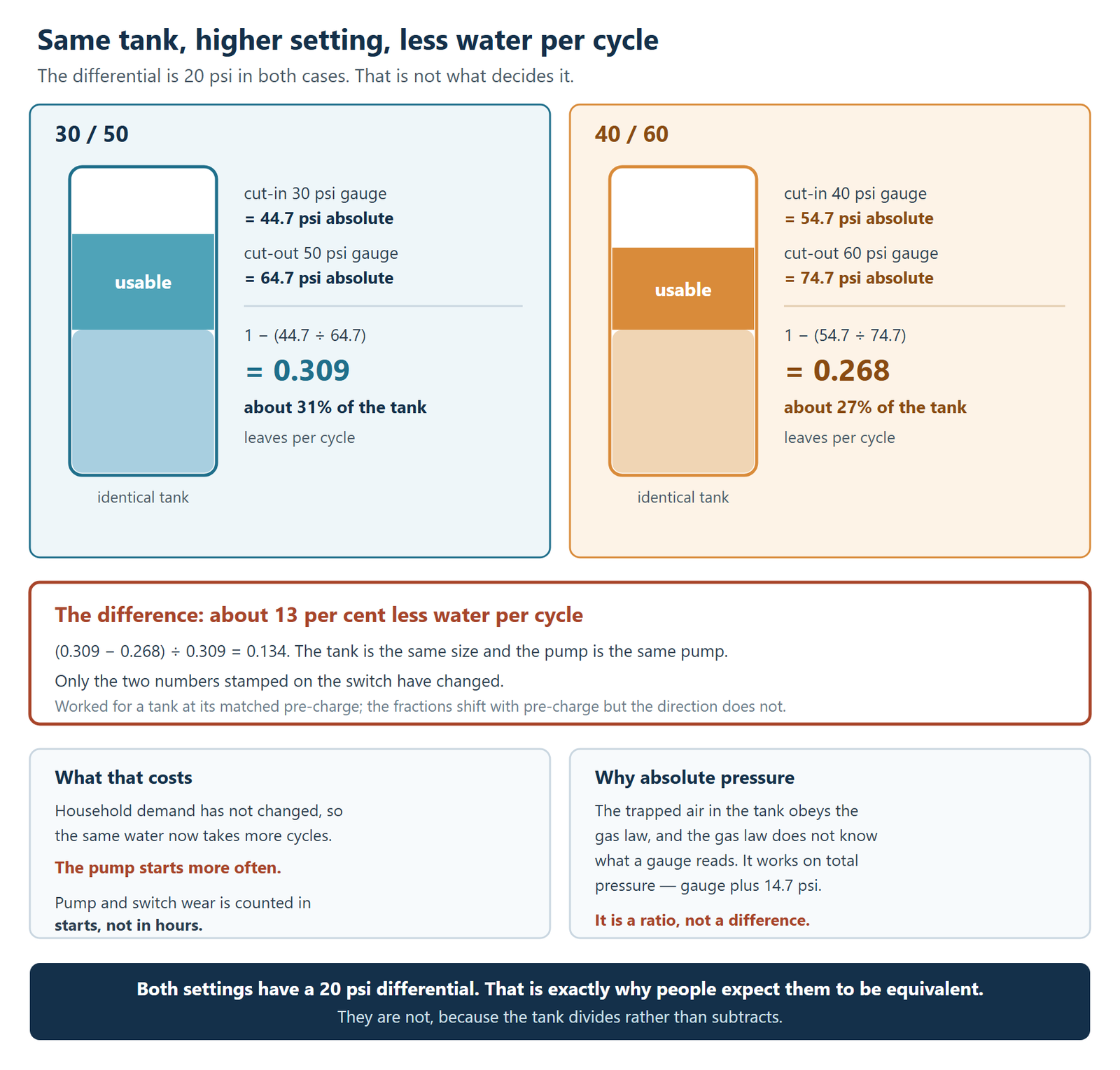
A pressure tank delivers water because trapped air expands as the pressure drops. How much water you get out of a given tank between cut-out and cut-in depends on the ratio of those two pressures, not the difference between them.
And that ratio has to be worked in absolute pressure — gauge pressure plus the 14.7 psi of atmosphere already there — because it is the air inside the tank doing the work, and air obeys the gas law.
At 30/50:
- Cut-in 30 + 14.7 = 44.7 psi absolute
- Cut-out 50 + 14.7 = 64.7 psi absolute
- Usable fraction = 1 − (44.7 ÷ 64.7) = about 0.31
At 40/60:
- Cut-in 40 + 14.7 = 54.7 psi absolute
- Cut-out 60 + 14.7 = 74.7 psi absolute
- Usable fraction = 1 − (54.7 ÷ 74.7) = about 0.27
The same tank gives you roughly 13 per cent less water per cycle at 40/60 than at 30/50.
This is why the identical 20 psi differential does not make the two settings equivalent. Both ranges span 20 psi; the higher one spans it at a point where the air has less room to expand.
What that 13 per cent buys you in wear: household demand has not changed, so the pump starts more often to deliver the same water. Pump and switch life are counted in starts, not hours. If the system is already starting more than you would like, short cycling has its own causes worth checking first — but raising the range will make any of them worse.
What has to be compatible?
Three things, and all three are checkable before you adjust anything.
1. The pressure tank’s air precharge. The tank’s precharge is normally set 2 psi below cut-in. A tank running 28 psi for a 30/50 system is wrong for 40/60 — it needs 38. A tank left at the old precharge after a setting change delivers far less water than either calculation above, because the bladder bottoms out early. Setting the tank air charge is part of this job, not an optional extra.
2. The pump’s ability to reach the new cut-out. A pump has to be able to make 60 psi at the depth it is set at and still have something left over. One that is comfortable at 50 and marginal at 60 will run and run looking for a cut-out it cannot reach. That failure looks exactly like a switch that will not cut off, and it is caused by the setting, not the switch.
3. The plumbing. Higher standing pressure finds weaknesses. Old galvanised pipe, tired compression fittings, a washing machine hose at the end of its life — all of them see 60 psi instead of 50, all the time.
When is 40/60 the right answer?
There are real reasons, and they are specific rather than general.
Fixtures well above the switch. Every 2.31 feet of height costs roughly 1 psi. A second-floor shower in a house with the tank in the basement may be losing 10 psi or more to height alone before anything else. This is the strongest reason, and it is arithmetic you can do.
Equipment with a stated minimum inlet pressure. Some appliances, filters and tankless units specify a minimum, and if the system drops to 30 at cut-in, that minimum is being missed for part of every cycle.
A long run from the tank to the house. Friction in a long buried line takes pressure that was present at the tank.
Pressure that is genuinely inadequate at the fixtures, not just unimpressive. If low water pressure on a well has been diagnosed and the cause is the setting rather than a restriction, then the setting is the right thing to change.
When should you leave it alone?
Most of the time, and specifically:
- The system works and you are changing it on principle. The 13 per cent is a real cost for no gain.
- The pump is old, or you do not know its capability at its set depth. You would be finding out the hard way.
- The tank is small or its precharge is unknown. Raising the range on a tank already short of drawdown turns a working system into a cycling one.
- The plumbing is old galvanised or has known weak fittings.
- The problem is a restriction, not a setting. A clogged filter, a partly closed valve or a restricted pressure switch nipple all present as low pressure, and none of them is cured by asking the pump for more.
The honest default: match what the system was set up for. A new switch arrives preset at one of these two ranges and that preset is usually what you want — which switch to fit is a separate question from what to set it to.
Can you use a setting other than these two?
You can, and it is rarely a good idea on a domestic well.
The two standard ranges exist because switches are manufactured and factory-set to them, pressure tanks are specified against them, and anyone who works on your system later will assume one of them. A 35/55 system works fine and surprises everybody who meets it.
The differential itself — the 20 psi gap — is adjustable on most switches, and widening it increases drawdown and reduces starts. But it also means a bigger pressure swing at the tap, and it is the adjustment most likely to be set wrongly, since the two adjustment nuts do different things and neither is labelled.
When does this need a pro?
- You do not know the pump’s capability at its set depth. That is the check that decides whether 40/60 is even possible, and it needs the pump’s curve and the well’s data.
- The tank precharge cannot be set, or the tank will not hold a charge. That is a failed bladder, and no setting fixes it.
- The plumbing is old galvanised. Raising system pressure on it is a decision with consequences in the walls.
- There is a pressure-sensitive appliance — a tankless heater, a treatment system, a constant-pressure controller — with its own requirements.
- The system is a constant-pressure or variable-speed setup. Those do not use a conventional two-point switch and none of this applies.
FAQ
Should I set my well pressure switch to 30/50 or 40/60?
Match what the system was built around unless you have a specific reason to change. The strongest reason to move up is fixtures well above the tank, since roughly 1 psi is lost per 2.31 feet of height. The cost is that the same tank delivers about 13 per cent less water per cycle at 40/60, so the pump starts more often.
Does changing to 40/60 reduce my pressure tank’s capacity?
It reduces how much water the tank delivers per cycle, yes — about 13 per cent less from the same tank. The tank’s physical size has not changed, but usable drawdown depends on the ratio of absolute cut-in to absolute cut-out pressure, and that ratio is less favourable at the higher range.
What should the pressure tank precharge be?
Normally 2 psi below the pump’s cut-in pressure, so 28 psi for a 30/50 system and 38 psi for 40/60. This is the step most often missed when a setting is changed, and leaving the old precharge in place costs far more drawdown than the setting change itself.
Will a higher pressure setting damage my plumbing?
It will not damage sound modern plumbing, which is rated well above these pressures. It does expose existing weaknesses to a permanently higher standing pressure, so old galvanised pipe, tired compression fittings and ageing appliance hoses are the things to consider before raising it.
Why does my pump never shut off after I raised the setting?
Most likely because the pump cannot reach the new cut-out at the depth it is set at. It runs looking for a pressure it cannot produce. That presents as a switch fault but is caused by the setting, and the fix is to put the range back to what the pump can achieve.
Can I use a setting like 35/55 instead?
It will work, but the two standard ranges exist because switches are factory-set to them, tanks are specified against them, and anyone servicing the system later will assume one of them. A non-standard setting adds no benefit and guarantees confusion.


