On this page
- Is the pressure actually below the switch's start setting?
- What does a click without a pump start tell you?
- Could a low-pressure safety have locked it out?
- Can the gauge fall while the switch still senses pressure?
- Should you adjust the springs to make it start?
- When does the switch need replacing?
- When this needs a pro
Last Updated on October 27, 2026 by Muhammad Toqeer
If your well pump does not start as pressure falls, the pressure switch is only one possible cause. Lost power, a blocked sensing connection and a low-pressure lockout can look the same. First record the gauge reading and whether you hear a switch click. Keep the cover on; electrical confirmation belongs to a qualified technician.
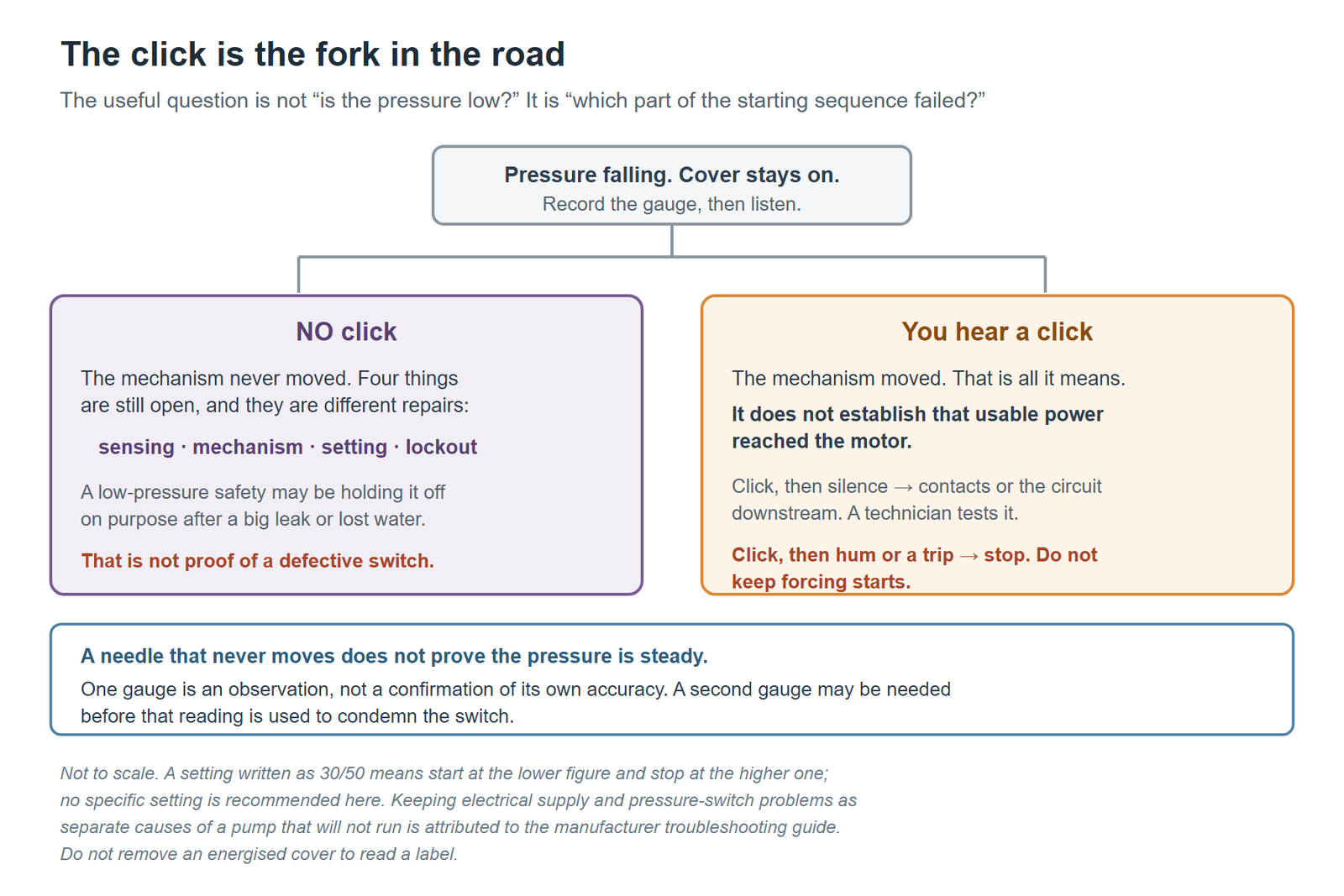
The useful question is not “Is the pressure low?” It is “Which part of the starting sequence failed?”
Is the pressure actually below the switch’s start setting?
Find the normal cut-in setting in your installation records or a safely visible label. A setting written as 30/50 means start at the lower pressure and stop at the higher one. Do not remove an energized cover to find the label.
One-minute check: while someone opens a cold-water faucet, watch the installed gauge from a dry location. Note whether the needle moves, whether a click occurs, and whether water pressure recovers. Stop the observation if the pump sounds distressed or a breaker trips.
A needle that never changes does not prove that system pressure is constant. A technician may need a second gauge before using that reading to condemn the switch. A single gauge is an observation, not an independent confirmation of its own accuracy.
What does a click without a pump start tell you?
It tells you the mechanism moved. It does not establish that usable power reached the motor.
| Observation | What it narrows down | Next step |
|---|---|---|
| No click as indicated pressure falls | Sensing, mechanism, setting or lockout needs checking | Record the pressure and call for diagnosis |
| Click, then silence | Contact condition or the downstream electrical circuit remains possible | Technician tests the circuit |
| Click, then hum or protective trip | Do not keep forcing starts | Shut off the pump and arrange service |
| Pump starts, but water does not recover | This has moved beyond a simple no-cut-in complaint | Have the supply and pump performance checked |
One-minute check for lost supply: look at the external disconnect and breaker position without opening electrical enclosures. A breaker that is off may explain the silence, but it does not explain why it tripped. Do not repeatedly reset a protective device.
The [manufacturer troubleshooting guide][1] includes electrical supply and pressure-switch problems among separate causes of a pump that will not run. Replacing the switch before separating those branches can leave you with exactly the same fault.
Could a low-pressure safety have locked it out?
Some switches intentionally stay off after pressure drops too far. That behavior can protect a system after loss of water or a major leak; it should not be treated as proof of a defective switch.
For example, Schneider Electric documents the M4 low-pressure-cutoff option on its Square D 9013 F family as entering a maintained-off state when pressure falls 10 psi below cut-in.[2] That statement applies to that option, not every switch with a lever.
One-minute check: find the complete installed part number and note any external lever or reset instructions. If it is a protected model, tell the technician when pressure was lost and whether the well recently ran short of water. Follow only the exact installed model’s reset procedure after its underlying cause has been addressed.
Never hold electrical contacts together with a tool. A restart obtained by defeating protection is not a repair.
Can the gauge fall while the switch still senses pressure?
A restricted sensing connection is another branch to investigate. The pressure at the gauge and the pressure reaching the switch diaphragm may not respond together when the small passage is obstructed.
One-minute check: record whether starting is delayed, whether it changes after heavy water use, and whether the system has a history of sediment or iron deposits. Those observations justify checking the passage; they do not prove it is clogged.
Confirmation requires power isolation, verification that the circuit is dead and safe release of water pressure before parts are removed. Ask the well technician to inspect the sensing connection as well as the switch. A new switch on an obstructed connection can inherit the old problem.
Should you adjust the springs to make it start?
Not before diagnosis. Adjustment changes operating thresholds; it does not restore missing power or repair a blocked pressure passage.
The manufacturer’s [adjustment instructions][3] distinguish the range setting from the differential setting on adjustable two-post switches. Their existence is not a reason to turn either nut at random. Record the original settings before a qualified person changes anything.
Tank precharge must also match the system. [Pentair’s instructions][4] specify a precharge 2 psi below cut-in for the covered arrangement, measured with no water pressure. Measuring air pressure while the tank remains pressurized is not that test. Follow the actual tank and control manuals where they differ.
If the real symptom is rapid repeated starting, use the separate well-pump short-cycling article. If the pump starts but never stops, see pressure-switch cut-out diagnosis.
When does the switch need replacing?
Replacement becomes justified when testing identifies failed contacts, a failed mechanism or a nonserviceable sensing component. Match the pressure range, electrical motor rating and any required protective option; matching the threaded connection alone is insufficient.
If the switch itself is confirmed faulty, the catalogue number decides the replacement, not the pressure band alone — the horsepower class and the enclosure are separate segments of it.
When this needs a pro
Anything requiring an open electrical cover, voltage testing or removal of a pressure-containing fitting needs appropriate training. Call promptly after repeated trips, burning smells, intermittent starts or a suspected loss of water at the well. Bring the gauge observations and full model number: they are more useful than another reset.
[1]: https://redlionproducts.com/media/3849/troubleshooting-guide.pdf [2]: https://www.se.com/us/en/faqs/FA91634/ [3]: https://www.se.com/ca/en/faqs/FA121330/ [4]: https://www.pentair.com/content/dam/extranet/web/nam/pentair/manuals/u80-129-adjusting-well-pump-pressure-switches-instructions.pdf