On this page
Last Updated on October 6, 2026 by Muhammad Toqeer
Watch the water level at the moment the pump stops. If it jumps straight back up, that is the column in the discharge pipe coming back — and one manufacturer names it exactly that way: “back-flow of water from discharge pipe.”
Two manufacturers publish causes for this symptom, and between them there are only two: the check valve and the switch. Neither lists the pump.
In every published cause the pump is doing precisely what it was told to do. It is being asked to start again, either because the water it just removed has returned, or because the switch is telling it to. That reframe is worth having before you go shopping for a new pump.
What the two manufacturers actually list
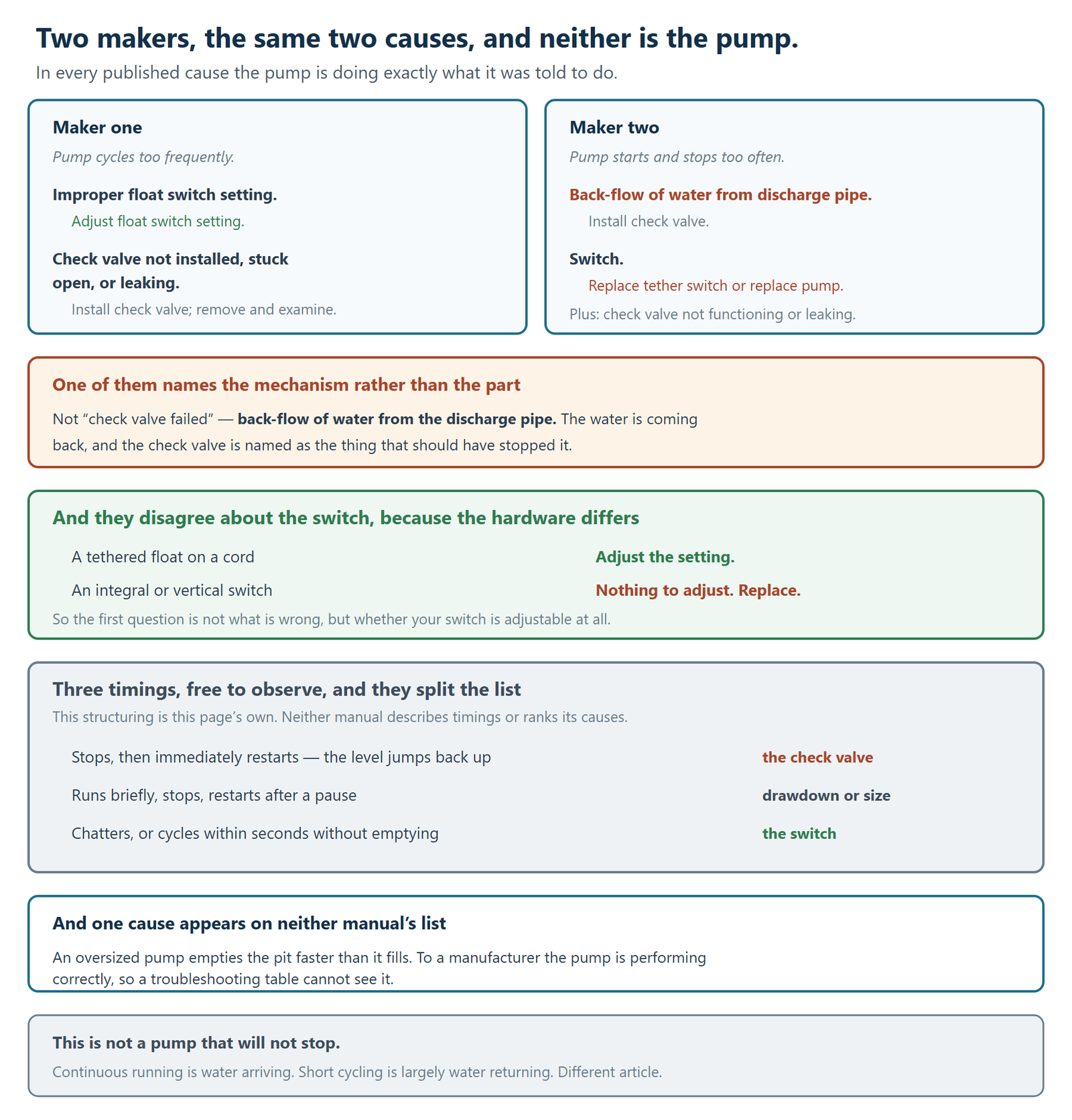
**Liberty, under “Pump cycles too frequently”:**
– “Improper float switch setting.“ — “Adjust float switch setting.” – “Check valve not installed, stuck open, or leaking.“ — “Install check valve; remove check valve and examine for freedom of operation and proper installation.”
**Wayne, under “Pump starts and stops too often”:**
1. “Back-flow of water from discharge pipe“ — “Install check valve” 2. “Switch“ — “Replace tether switch or replace pump” 3. “Check valve not functioning properly or leaking“ — “Remove and examine check valve for proper installation and free operation. Replace check valve if necessary.”
Two charts, two wordings, the same two culprits.
And notice how the second one is phrased. It does not say the check valve failed. It says back-flow of water from the discharge pipe — naming the thing that is happening, with the check valve as what should have prevented it.
Three timings, and they do the sorting for you
Neither manual describes what the cycling sounds or looks like, and neither ranks its causes. The split below is this page’s own structuring of their lists — but it costs nothing and it works from the top of the stairs.
It stops, and immediately starts again
Watch the level in the pit at the instant the pump shuts off. If it leaps back up, water is returning down the discharge pipe.
That is the check valve — missing, stuck open, installed backwards, or no longer sealing. The pump is then moving the same water repeatedly, which is why the cycles are short and achieve nothing.
One caution, because it is easy to misread: a small amount of water always comes back. The pipe above the valve drains when the pump stops, and you will hear it. The fault is not that water returns. It is that enough returns to start the pump again.
Replacing the valve has a published shortcut worth trying first — the manufacturer’s own remedy for a partly clogged valve is to cycle the level up and down before removing anything.
It runs briefly, stops, and starts again after a pause
The level went down properly and then refilled. This is not a backflow problem — the pit is simply being emptied faster than it fills, and there is not much water being moved per cycle.
That is drawdown, or pump size. The depth between the on and off levels is what sets how often a pump starts, and widening a pit buys the same reduction in starts as deepening it.
This is also the one cause neither manual lists, and there is a good reason: an oversized pump is performing exactly to specification. A troubleshooting table cannot see a selection fault.
It chatters, or cycles within seconds without emptying
The switch. The on and off points are too close together, or the float is catching and releasing.
And here the two manufacturers part company — which turns out to be about your hardware rather than a disagreement.
Whether you can adjust it depends on what switch you have
| Switch type | Published remedy |
|---|---|
| Tethered float on a cord | “Adjust float switch setting.” |
| Integral or vertical switch | “Replace tether switch or replace pump.” |
A tethered float is adjustable, and the adjustment is the length of cord between the float and its tie point. That length sets the on-off differential, and the maker publishes the chart — a 3-inch tether against a 5.5-inch pumping range at one end, a 17-inch tether against 25 inches at the other.
A pump with the switch built into it has nothing to adjust, which is why the second remedy goes straight to replacement.
One-minute check, and it decides the whole afternoon: look at the switch. A float hanging on a cord means this may be a free adjustment. A float riding a rod on the pump body, or no visible float at all, means it is a part.
What this is not
It is not a pump that will not stop. A pump running continuously is a question about water arriving — sources in the house, groundwater, or a discharge recirculating back to the pit — and a float stuck in the on position.
Short cycling is largely the opposite: water returning rather than water arriving. The two symptoms feel similar from upstairs and have almost no causes in common.
And it is not a noise problem, even though more cycles means more of the sound you dislike.
What the cycling is costing you
Every start is the hardest moment in a motor’s life, and a pump short cycling is doing that many times more often than it was designed to.
So this is worth fixing even when it is not an emergency — not because the basement is at risk tonight, but because the thing that is going to fail eventually is being asked to start far more often than it should.
When this needs a pro
Anything involving the check valve on a discharge under pressure. There is a procedure and a standing column of water to deal with, and the connection type decides whether it is a part or a repipe.
Changing a pit’s drawdown. That is excavation or a different basin, not an adjustment.
Deciding whether the pump is oversized. It needs the inflow rate, not a guess, and that is a measurement.
Anything electrical, including swapping a switch on a pump that is not piggyback-wired.
What you can do yourself: stand at the pit through two full cycles and note which of the three timings you have, then look at whether the float hangs on a cord. Two observations, no tools — and between them they place you on the manufacturers’ own list and tell you whether the fix is a setting or a part. If none of the three fits, the pit and the pump may need looking at as one system.
FAQ
Why does my sump pump keep turning on and off?
Two manufacturers publish the same two causes: the check valve and the switch. One names the mechanism outright as back-flow of water from the discharge pipe — the water the pump just removed is returning, so it starts again. Neither lists the pump itself as a cause.
How do I know if it is the check valve?
Watch the level the instant the pump stops. If it jumps straight back up, that is the column in the discharge pipe returning. A small amount always comes back as the pipe above the valve drains — the fault is enough coming back to restart the pump.
Can I adjust how often my sump pump starts?
It depends on the switch. For a tethered float, one manufacturer’s remedy is simply to adjust the setting, and the cord length between float and tie point sets the differential. For an integral or vertical switch the remedy given is to replace the switch or the pump, because there is nothing to adjust.
Is short cycling the same as a sump pump running constantly?
No, and they have almost no causes in common. Continuous running is about water arriving — sources in the house, groundwater, or discharge recirculating back. Short cycling is largely about water returning down the discharge pipe, plus the switch setting.
Can an oversized sump pump cause short cycling?
Yes, and it is the one cause that appears on neither manufacturer’s list — because to the manufacturer the pump is performing exactly as specified. It empties the pit faster than it refills, so it stops and restarts shortly after. A troubleshooting table cannot see a selection fault.
Does short cycling damage a sump pump?
Every start is the hardest moment in a motor’s life, and short cycling multiplies the number of them. It is worth correcting even when nothing is flooding, because it shortens the life of the part you most need working during a storm.


