On this page
Last Updated on October 3, 2026 by Muhammad Toqeer
Order by your basin’s model number, not by measuring across the pit. Every cover in this guide is specified against named basins, and the figure that decides whether it fits — a 19-1/2 inch bolt circle — is not one a tape measure across the top gives you.
Then check who is making the sealing claim. The residential code requires a gas-tight, removable cover, so that claim is the whole reason you are buying. On the manufacturer’s own product pages, only the two radon domes carry one. The three flat covers publish materials, dimensions and fittings — and no gas, radon or odor claim at all.
Retailers describe those same flat covers as “gas, radon and odor tight”. That is not proof they fail; an absent claim is not a failed test. It means get the claim in the manufacturer’s words, because the code is what you are satisfying.
Where the sealing claim actually appears
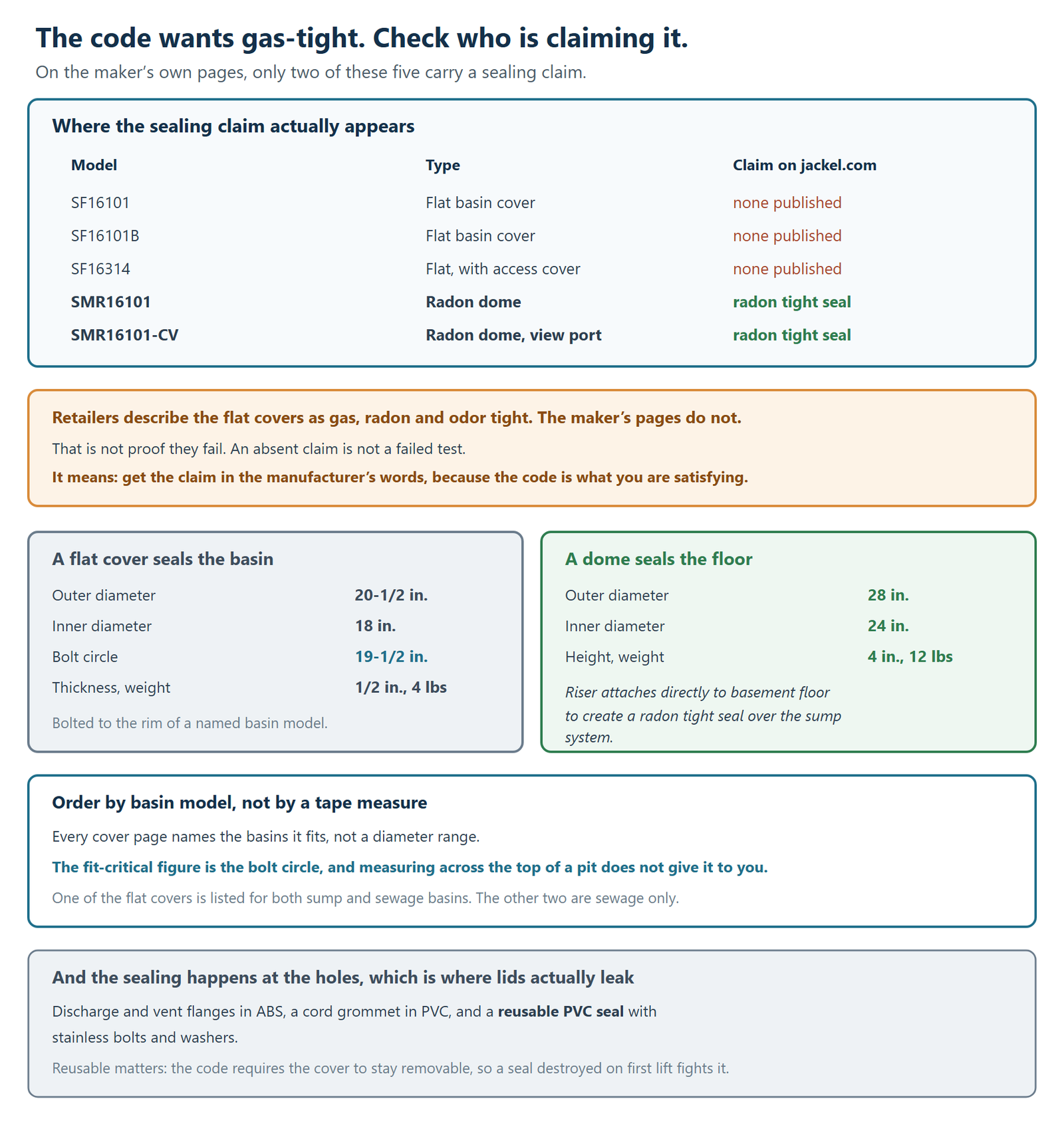
Five covers, checked on the manufacturer’s own pages:
| Model | Type | Sealing claim on the maker’s page |
|---|---|---|
| SF16101 | flat basin cover | none published |
| SF16101B | flat basin cover | none published |
| SF16314 | flat, with access cover | none published |
| SMR16101 | radon dome | “radon tight seal” |
| SMR16101-CV | radon dome, acrylic view port | “radon tight seal” |
To be fair to the flat covers, they publish a PVC seal, PVC cord grommet, ABS discharge and vent flanges and stainless steel bolts and washers — which is the hardware a sealed lid is made of. The manufacturer simply does not put the words on the page.
And to be fair to the retailers, their wording may well be accurate and taken from literature not published online.
The practical instruction is the same either way: if you are fitting a cover to satisfy the code, ask the supplier to point you at the manufacturer’s own statement. One email settles it.
The two types seal completely different things
This is the distinction nobody explains, and it changes what you should be shopping for.
A flat cover seals the basin. It bolts to the rim: 20-1/2 in. outer diameter, 18 in. inner, 19-1/2 in. bolt circle, 1/2 in. thick, 4 lbs.
A dome seals the floor. In the maker’s own words:
“Riser attaches directly to basement floor to create a radon tight seal over the sump system.”
At 28 in. outer diameter, 24 in. inner, 4 in. high and 12 lbs, it is a different object entirely — it goes over the hole rather than onto the rim.
Which matters enormously if your pit rim is the problem. A rim that is chipped, out of round, cast awkwardly into the slab, or simply a different basin from anything a cover is listed against cannot be sealed by a flat cover at all — and the dome route exists precisely for that case. It is also described as being “for use in a passive radon mitigation system or to retro-fit an existing basement sump system.”
One-minute check: look at the rim of your pit. If it is a clean moulded lip on a manufactured basin, a flat cover is your route. If it is a rough concrete edge or a damaged rim, it is a dome.
The five worth knowing
SF16314 — the flat cover listed for both sump and sewage
Jackel SF16314 — “For use with models SF20 and SF22A sump basins in basement sump systems and models SF30BA and SF30PR sewage basins in sewage ejector systems.” 20-1/2 in. OD, 18 in. ID, 19-1/2 in. bolt circle, 1/2 in. thick, 4 lbs. HDPE structural foam cover and access cover, ABS flange, PVC grommet, PVC seal, stainless steel bolts and washers. “Discharge and vent flanges included along with access cover and cord grommet.”
Who it is for: the default choice, and the only one of the three flat covers listed for sump basins as well as sewage. The access cover is the feature — it lets you look in without unbolting the whole lid.
The honest drawback: no gas, radon or odor claim is published on its page, and the access cover is one more joint to seal.
SF16101 — the plain sewage-basin cover
Jackel SF16101 — “For use with models SF30BA and SF30PR sewage basins in sewage ejector systems.” Same 20-1/2 / 18 / 19-1/2 in. geometry, 1/2 in. thick, 4 lbs, HDPE structural foam, ABS flange, PVC grommet and seal, stainless hardware. “Discharge and vent flanges included along with cord grommet.”
Who it is for: a sewage basin where you do not need an access hatch.
The honest drawback: sewage basins only on its own page, no access cover, and no sealing claim published — which on an ejector basin, where the seal is the only thing holding sewer gas back, is the one you most want in writing.
SF16101B — the same geometry with a reusable seal called out
Jackel SF16101B — “For use with models SF30BA and SF30PR sewage basins.” 20-1/2 in. OD, 18 in. ID, 19-1/2 in. bolt circle, 1/2 in. thick, 4 lbs, HDPE structural foam, PVC seal, stainless steel bolts and washers.
Who it is for: a straight replacement on the same basins, where the reusable seal is the point — the code requires the cover to be removable, and a seal you destroy on first lift works against that.
The honest drawback: this is the model retailers most often describe as “8 bolt, gas, radon and odor tight”, and neither the bolt count nor the sealing claim appears on the manufacturer’s page. Both are worth confirming before you rely on either.
SMR16101 — the radon dome, for when the rim is not the answer
Jackel SMR16101 — “The Original Radon Sump Dome.” 28 in. OD, 24 in. ID, 26-1/2 in. bolt circle, 4 in. high, 12 lbs. HDPE structural foam cover and riser, ABS or PVC flange, PVC grommet, PVC reusable seal, stainless bolts and washers. “Discharge and vent flanges included along with cord grommet.” The riser attaches directly to the basement floor.
Who it is for: a passive radon mitigation system, a retrofit over an existing sump, or any pit whose rim cannot be sealed.
The honest drawback: it is three times the weight and takes a 28 in. footprint on your floor. It is also a floor-sealing job rather than a basin-sealing one, which is a different kind of work.
SMR16101-CV — the same dome, with a window
Jackel SMR16101-CV — identical dimensions and materials, with the access cover in acrylic rather than HDPE.
Who it is for: anyone who seals a pit and then wants to keep an eye on it. It is the only cover on this list you can see through, which answers the standing objection to sealed lids.
The honest drawback: acrylic in a basement is a scratch-and-haze material, and a window you cannot see through is just a weaker panel.
Side by side
| Model | Fits | OD / ID / bolt circle | Profile | Access | Maker’s sealing claim |
|---|---|---|---|---|---|
| SF16314 | SF20, SF22A sump · SF30BA, SF30PR sewage | 20-1/2 / 18 / 19-1/2 in. | 1/2 in., 4 lbs | HDPE cover | none published |
| SF16101 | SF30BA, SF30PR sewage | 20-1/2 / 18 / 19-1/2 in. | 1/2 in., 4 lbs | — | none published |
| SF16101B | SF30BA, SF30PR sewage | 20-1/2 / 18 / 19-1/2 in. | 1/2 in., 4 lbs | — | none published |
| SMR16101 | seals to the floor | 28 / 24 / 26-1/2 in. | 4 in. high, 12 lbs | HDPE | radon tight seal |
| SMR16101-CV | seals to the floor | 28 / 24 / 26-1/2 in. | 4 in. high, 12 lbs | acrylic | radon tight seal |
All five are current catalogue items on the manufacturer’s own site, checked 3 October 2026. This guide is single-brand, because Jackel was the only manufacturer whose own product pages could be read this session — that is a limitation of the research, not a verdict on anyone else.
The sealing happens at the holes
Which is exactly what this site already found. A cover with a ragged hole cut for the cord is not gas-tight, and the penetrations are where sealed lids leak.
So read the included-components line rather than the headline. Every cover here lists discharge and vent flanges and a cord grommet, and the materials are published separately: ABS flanges, PVC grommet, PVC seal, stainless steel bolts and washers.
Pro note: the seal being reusable is the spec that keeps you compliant over time. The code wants the cover removable — you will be taking it off to service the pump — and a one-shot gasket turns every service visit into a choice between resealing properly and not.
And a cover changes more than radon. A sealed pit stops the pit humidifying the basement, it is part of the answer when a pit smells, and it changes how much of a dehumidifier’s output comes straight back.
How to choose, in order
First, what basin do you have? The model number is usually moulded into the rim or the side. That single fact picks your cover, because these are specified against basins rather than against measurements.
Second, can your rim be sealed at all? Clean moulded lip, flat cover. Damaged, out of round, or site-formed concrete, dome.
Third, do you need to see in? The SF16314’s access cover for a flat installation, the -CV’s acrylic window on a dome.
Fourth, get the sealing claim in writing from the manufacturer if the cover is going in to satisfy a code requirement.
And last, check what penetrations you actually have — discharge, vent, pump cord, float cord, alarm cord. A pit with a battery backup or an alarm float has more cords through the lid than a basic installation, and every one of them needs a grommet rather than a hole.
And the cover is not the whole system. Whether the pit, the pump and the discharge are right in the first place is the prior question — a sealed lid on an undersized pit seals an undersized pit.
When this needs a pro
Anything on a sewage basin. The seal is the only thing between the basement and sewer gas, and that is not a trial-and-error job.
Fitting a dome. It seals to the floor, which means working on the slab around the pit.
Any pit where the cover has to carry weight or sits where people walk.
And if the pit does not match any basin model, which is common in older houses with site-formed pits — that is a measuring and fabrication problem rather than a shopping one.
What you can do yourself: find the basin’s model number, count the cords and pipes going through the lid, and look at whether the rim is clean. Three things, no tools — and they narrow this list to one part number.
FAQ
Does a sump pit need a cover?
Yes. The residential code requires any installed sump pump to have a gas-tight, removable cover, mechanically fastened in place. That requirement, with the code citation, is covered in full on this site’s page about open pits and basement humidity.
Are sump pit covers actually gas-tight?
Check who is claiming it. On the manufacturer’s own product pages, the radon domes state a radon tight seal and the flat basin covers publish no gas, radon or odor claim at all — though retailers describe them as gas, radon and odor tight. If the cover is going in to satisfy the code, get the claim in the maker’s words.
How do I know what size sump pit cover I need?
By the basin’s model number, not by measuring. These covers are specified against named basins, and the fit-critical dimension is the bolt circle — 19-1/2 inches on the flat covers here — which measuring across the top of a pit will not give you.
What is the difference between a sump cover and a radon dome?
What they seal against. A flat cover bolts to the rim of the basin at 20-1/2 inches outer diameter and half an inch thick. A dome is 28 inches across and 4 inches high, and its riser attaches directly to the basement floor to seal over the whole sump system — which is the route when the rim itself cannot be sealed.
Where do sealed sump lids leak?
At the penetrations. Every pipe and cord through the lid is a hole, and a cover with a ragged cut-out for a cord is not gas-tight regardless of what the lid is made of. That is why these covers ship with discharge and vent flanges and a cord grommet, and why the count of cords you have matters.
Can I still get at the pump with a sealed cover?
Yes, and the code requires it — the cover has to be removable. Two things help: a reusable seal, so taking the lid off does not destroy the gasket, and an access cover, which one flat model and both domes include. One dome has that access cover in acrylic, so you can see in without opening anything.


