On this page
Last Updated on September 29, 2026 by Muhammad Toqeer
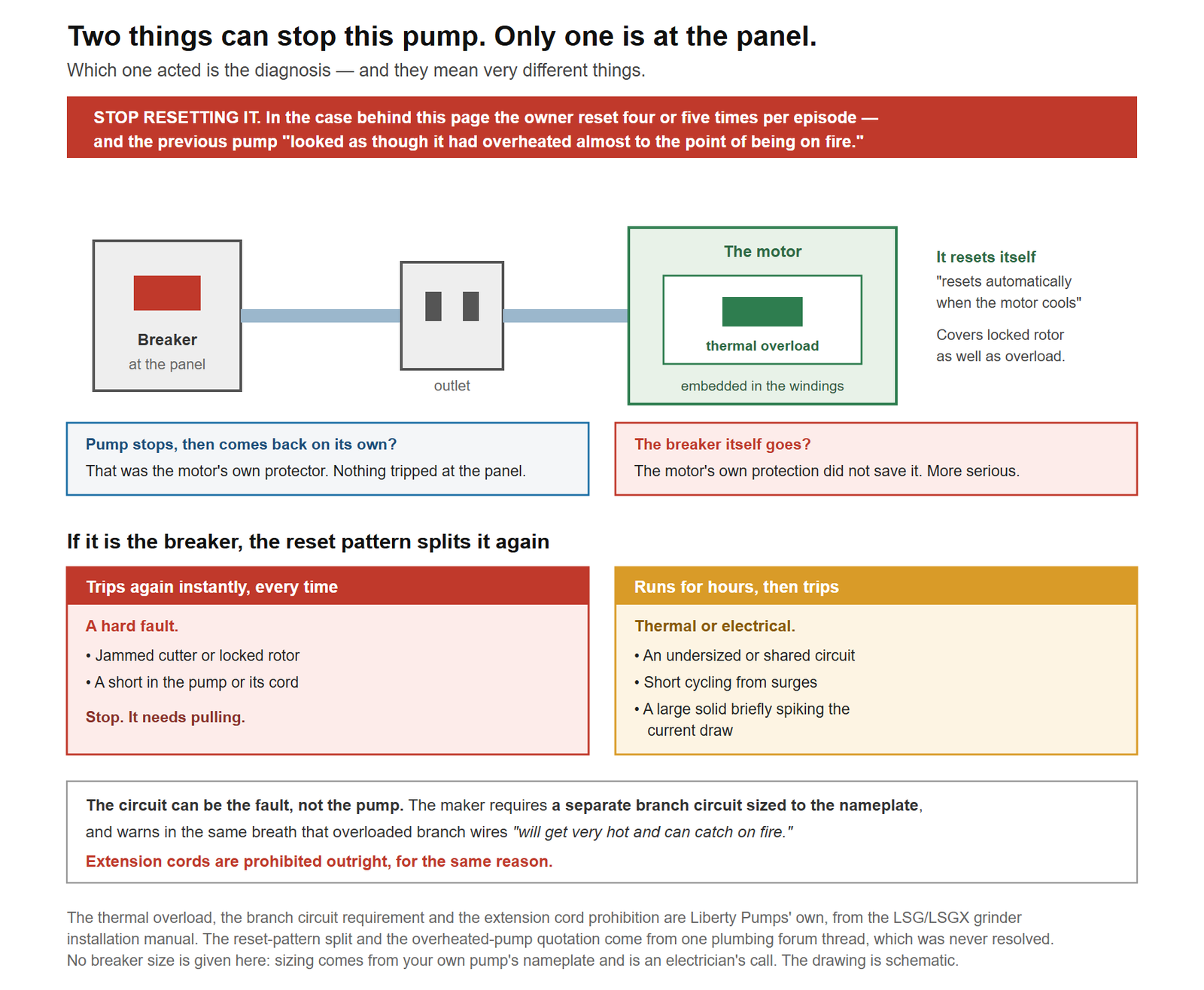
A residential grinder pump has two protective devices, and only one of them is the breaker. The motor carries a thermal overload embedded in its own windings, which shuts the pump down if it overheats and resets itself when the motor cools.
So a pump that stops and comes back on its own has not tripped anything at the panel. If the breaker itself goes, the motor’s own protection did not save it — which is a more serious event, and a different conversation.
Before the diagnosis: stop resetting it
This is the part that costs people a pump.
A homeowner on Terry Love’s forum described resetting the breaker four or five times per episode to get the pump going again. Of the previous pump — replaced after a couple of years — they wrote:
“looked as though it had overheated almost to the point of being on fire”
That is the direction this goes. And the manufacturer’s own manual is blunt about the wider risk: overloaded branch circuit wires “will get very hot and can catch on fire.”
A breaker that trips is a device doing its job. Reset it once to see what happens. After that you are not diagnosing, you are overriding.
Two protective devices
Liberty’s grinder manual describes the one inside the motor:
“A thermal overload protector is embedded in the stator windings. This is connected in series and wired to shut down the pump if overheating occurs. The overload switch resets automatically when the motor cools.”
And what it covers:
“Single-phase pump models are protected from locked rotor and running overloads by a thermal overload (thermostat) integrally mounted to the motor”
Locked rotor as well as overload. So on a healthy installation, a jam should stop the motor internally before it ever reaches the panel.
Which gives you a free piece of information:
- The pump goes quiet and later starts again with nothing touched → the internal protector. Something is making the motor work too hard or run too hot, but the protection chain is intact.
- The breaker at the panel goes → the fault got past the motor’s own protector, or the circuit is the problem rather than the pump.
If the breaker goes: read the reset pattern
One more split, and it is the useful one.
It trips again the instant you reset it, every time
A hard fault. A jammed cutter, a locked rotor, or a short in the pump or its cord. The current is enormous and immediate.
A jammed cutter is the same mechanism that stops any pump dead — and it has a published current signature on well pumps that is worth understanding.
Stop here. The pump has to come out, and that is not a homeowner job on a sewage system.
It runs for hours, then trips, and resets cleanly
Thermal or electrical, and this is the case in the forum thread. Three things worth having checked:
An undersized or shared circuit. The manufacturer requires “a separate, properly fused and grounded branch circuit, sized for the voltage and amperage requirements of the pump, as noted on the nameplate.” If the grinder shares a circuit with anything, or the breaker sits close to the pump’s nameplate amps, it can trip on inrush with a perfectly healthy pump.
Short cycling. Frequent starts are what wear a pump out. A washing machine dumping into the pit produces bursts of short cycles, which a plumber on that thread thought “could easily be at least part of your short-pump-life problem.” The same wear mechanism is worth understanding on a pump that runs too often generally.
A large solid, briefly. The manufacturer names this itself: “large solids passing through the pump can temporarily increase current draw.” A momentary spike, nothing actually broken — which is exactly what an intermittent trip looks like.
The circuit can be the fault, not the pump
Worth separating out, because it is the possibility people never consider and the one they cannot fix themselves.
The manual requires a dedicated circuit sized from the nameplate, and warns in the same paragraph that overloaded branch wires “will get very hot and can catch on fire.”
And extension cords are prohibited outright:
“Do not use an extension cord to power the product. Extension cords can overload both the product and extension cord supply wires.”
If your grinder is on an extension lead, that is the first thing to change — and it is an electrician’s job, not a longer cord.
This article gives no breaker size. The correct one comes from your own pump’s nameplate, and choosing it is an electrician’s call rather than something to take from a web page.
About the flushable wipes
You will probably be told wipes did it. It is worth holding that up to the light, because the disagreement in the source thread is instructive.
The homeowner was told “use of flushable wipes had jammed up the pump, causing it to eventually burn up.” Another poster pushed back:
“Hair should not plug a grinder pump. A good grinder pump should be able to grind up a diaper (but you shouldn’t test it with a diaper).”
Both have a point, and the tension is the useful bit. A grinder is specifically the machine sold as able to cut this material — that is what distinguishes it from an ejector. So if wipes stopped yours, the question is why the cutter no longer cuts them: a worn cutter, or a pump undersized for what the household actually sends down.
None of which makes wipes safe to flush. Whatever the grinder manages to cut still has to travel every pipe downstream, and “flushable” describes how it leaves the bowl rather than where it ends up.
When this needs a pro
A breaker that trips again immediately. Hard fault, and every reset makes it worse.
Anything requiring the pump to come out of the pit. A jammed cutter cannot be cleared from the outside, and the pit is a gas seal.
All of the electrical side — the circuit, the breaker, an extension cord, anything at the outlet. Line voltage in a damp basement, on a circuit the manufacturer says must be dedicated.
A pump that has been reset repeatedly. Tell whoever comes out how many times. It changes what they check, and whether the motor is still worth saving.
What you can do yourself: note whether the pump returns on its own or needs the panel, time how long it runs before tripping, check whether it is on its own circuit and whether there is an extension cord in the chain. All of it from outside the pit.
And if what is in the pit turns out to be a standard ejector pump rather than a grinder, published full-load amps run from 8.5 to 11 across common models — worth checking against the circuit before ordering.
FAQ
Why does my grinder pump keep tripping the breaker?
Either a hard fault — a jammed cutter, locked rotor or a short — or something thermal and electrical, such as an undersized or shared circuit, frequent short cycling, or a large solid briefly raising the current. The reset pattern tells you which: instant trips mean a hard fault.
My grinder pump stops and then starts again by itself. Is that the breaker?
No. Single-phase grinders have a thermal overload embedded in the motor windings that shuts the pump down when it overheats and resets automatically once it cools. Nothing tripped at the panel — but something is making the motor run hot.
How many times can I reset the breaker?
Once, to see what happens. After that you are overriding a protective device rather than diagnosing anything, and an overheating motor is what you are protecting.
Can a grinder pump be on the same circuit as something else?
The manufacturer requires a separate branch circuit sized to the pump’s nameplate and warns that overloaded wires can catch fire. Extension cords are prohibited outright.
Do flushable wipes really jam grinder pumps?
A grinder is the machine designed to cut them, so if wipes stopped yours it points at a worn cutter or an undersized pump. That is not permission to flush them — whatever the grinder cuts still has to get through every pipe after it.
What size breaker does a grinder pump need?
Whatever your pump’s nameplate specifies, on its own dedicated circuit. It is not a figure to take from a web page, and getting it wrong in either direction is a fire or nuisance-tripping risk.