On this page
Last Updated on September 20, 2026 by Muhammad Toqeer
Twenty-five feet of ordinary 5/8 inch garden hose takes a 1,350 GPH pump down to about 636 GPH — lying flat on the floor, lifting nothing at all. That is 47% of the number on the box, lost to the hose alone.
Then the part nobody says: the length is the smaller half of the problem. Diameter costs far more, and the arithmetic is lopsided enough that a hundred feet of fat hose beats twenty-five feet of thin hose on the same pump.
What the hose actually costs
Here is the same WAYNE WaterBUG — published at 1,350 GPH — against three hoses and three lengths, with no vertical lift in the system at all:
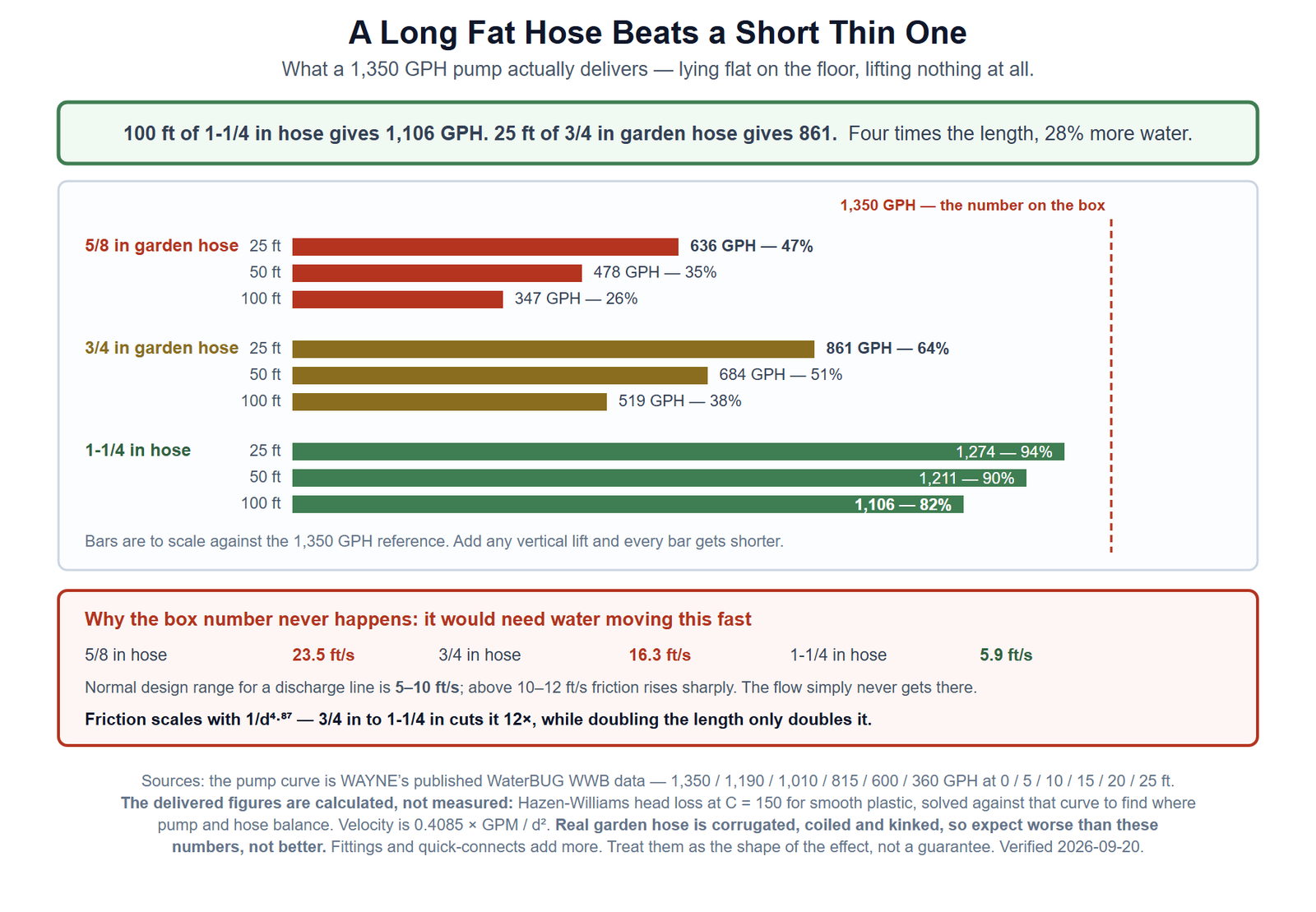
| Hose | 25 ft | 50 ft | 100 ft |
|---|---|---|---|
| 5/8 in garden hose | 636 GPH (47%) | 478 (35%) | 347 (26%) |
| 3/4 in garden hose | 861 GPH (64%) | 684 (51%) | 519 (38%) |
| 1-1/4 in discharge hose | 1,274 GPH (94%) | 1,211 (90%) | 1,106 (82%) |
Read the two bold figures against each other, because they are the article:
100 feet of 1-1/4 inch hose delivers 1,106 GPH. Twenty-five feet of 3/4 inch garden hose delivers 861. Four times the length, and 28% more water.
And the 5/8 inch row is the one most people are actually in. The pump’s outlets are 3/4 inch and fit a standard garden hose — but the hose hanging on most garage walls is 5/8 inch inside, not 3/4. Against that hose, the 100-foot fat run delivers 74% more than a 25-foot thin one.
Why diameter beats length so heavily
Friction in a pipe does not scale with diameter gently. It scales with roughly 1 / d⁴·⁸⁷.
That exponent is doing something almost unreasonable:
- Going from 3/4 inch to 1-1/4 inch divides friction by 12.
- Doubling the length multiplies it by 2.
So a single step up in hose size is worth about six doublings of length. Put the other way round: twenty-five feet of 3/4 inch hose costs three times as much head as a hundred feet of 1-1/4 inch hose. If you have a choice between running a short thin hose and a long fat one, the long fat one wins, and it is not close.
This is also why “just use a longer hose to reach further away” is fine advice and “just use the hose I already own” usually is not. Distance is cheap. Bore is expensive.
One-minute test: read the moulded text on the hose itself, near the coupling. Garden hose is marked with its inside diameter, and 5/8 in and 3/4 in look identical coiled on a wall. Which one you own is worth more than how long it is.
The rated flow cannot physically pass through the supplied hose
This is the part that explains why nobody has ever measured the number on the box.
Push 1,350 GPH through a garden hose and ask how fast the water would have to travel:
| Hose ID | Water velocity at 1,350 GPH |
|---|---|
| 5/8 in | 23.5 ft/s |
| 3/4 in | 16.3 ft/s |
| 1-1/4 in | 5.9 ft/s |
Normal design practice for a discharge line is 5 to 10 ft/s, and published guidance notes that above roughly 10 to 12 ft/s friction climbs sharply. Only the 1-1/4 inch column is in the sane range.
It gets starker with the high-flow pumps. A WAYNE RUP160 is rated 3,100 GPH and ships with a 3/4 inch garden hose adapter in the box — at its rated flow, that adapter implies 37.5 ft/s. The buying guide makes the point in plain terms: fit the adapter and you have not bought a 3,100 GPH pump. This is the number behind that sentence.
So what happens in practice? The flow simply never reaches the rated figure. It falls until the friction the hose demands plus whatever you are lifting equals the head the pump can actually make at that flow. Where those two meet is your real number, and that crossing point is what the table above reports.
It also means the friction figures you may see quoted for these hoses — over 100 feet of head per 100 feet of 3/4 inch hose at rated flow — are not losses you suffer. They are a demand the pump cannot meet, which is why it never tries.
What to actually do about it
Use the biggest discharge the pump has. If it has a 1-1/4 inch port, use 1-1/4 inch hose. The adapter in the box is there for convenience, not performance.
One-minute test: look at the fitting on your pump. If the discharge is 1-1/4 inch and you have screwed a garden hose adapter into it, that one fitting outweighs every other choice in the run — everything downstream of it is a rounding error by comparison.
If you must use a garden hose, use the shortest one that reaches — but reroute rather than coil. A coiled surplus is full length as far as the water is concerned, plus bend losses. And a kink is worse than any of this, which is one of the first things to check when a pump runs but moves no water.
Do not step down in the middle of the run. The narrowest section sets the flow for the whole hose. Twenty feet of 1-1/4 inch into ten feet of garden hose is a garden hose system with an expensive first act.
Count the fittings. Every quick-connect, adapter and sharp bend adds loss that none of the figures above include.
And remember this sits on top of the lift, not instead of it. Hose friction and vertical rise add together into one number — which is the one the manufacturer’s curve is actually indexed to, and why the flow you get is always below the flow you were sold. Where the hose finally ends matters too, for a different reason: put it too close to the house and the water comes back.
How these numbers were worked out
Worth stating plainly, because they are calculated rather than measured and you should know how much weight to put on them.
The pump curve is WAYNE’s published data for the WaterBUG — 1,350 / 1,190 / 1,010 / 815 / 600 / 360 GPH at 0 / 5 / 10 / 15 / 20 / 25 feet. The hose losses use the Hazen-Williams equation at C = 150, the standard value for smooth plastic. The two were solved against each other to find the flow at which the pump’s output matches what the hose and lift demand.
Three honest caveats:
- Real garden hose is worse than the model. Hazen-Williams at C = 150 describes smooth bore. Actual hose is ribbed, coiled, sometimes kinked and often older than it looks. Expect to do worse than these figures, not better.
- Fittings are not included. Quick-connects, adapters and tight bends all add.
- The pump curve was interpolated between its six published points.
Treat the table as the shape of the effect and the relative ordering — both of which are solid — rather than as a promise about your particular hose. The conclusion that matters is not “you will get 636 GPH”; it is “the bore of your hose is worth more than anything else you can change.”
For the background on how these pumps are rated in the first place, the utility and transfer pumps guide covers why the headline GPH is measured at zero head.
When this needs a pro
Not much here is dangerous — but two things are worth flagging.
If you are tempted to reduce the hose to raise the pressure, don’t. This is not a garden sprinkler. A smaller outlet on a fixed-speed pump raises head and drops flow, and on a pump being cooled by the water it is moving, sustained low flow is a route to overheating rather than to a faster job.
If the run has to climb and travel a long way, the answer may genuinely be a different class of pump rather than a better hose. That is a sizing question rather than a hose question.
FAQ
How much flow do you lose with a longer hose?
Less than you lose to a narrower one. On a 1,350 GPH pump with no lift, 1-1/4 inch hose gives about 1,274 GPH at 25 feet and 1,106 at 100 feet — a 13% drop for four times the length. Going from 1-1/4 inch to 5/8 inch garden hose at 25 feet drops it to about 636.
Does hose diameter matter more than hose length?
Substantially. Friction scales with roughly 1/d⁴·⁸⁷, so stepping from 3/4 inch to 1-1/4 inch cuts it by about twelve times, while doubling the length only doubles it. A hundred feet of 1-1/4 inch hose moves more water than twenty-five feet of 3/4 inch.
Why doesn’t my utility pump deliver its rated GPH?
Because the rating is measured at zero head with nothing attached, and no garden hose can pass that flow. At 1,350 GPH, a 3/4 inch hose would need water travelling at 16.3 ft/s against a normal design range of 5 to 10. The flow drops until the pump and the hose balance.
Can I use a garden hose on a utility pump?
Yes, and most people do — just know the cost. Expect roughly half the rated flow through 25 feet of ordinary 5/8 inch hose before you lift anything. If the pump has a 1-1/4 inch discharge, using its full port instead is the single biggest improvement available.
Does coiling the hose reduce flow?
Yes, twice over. Coiled hose is still its full length as far as friction is concerned, and the bends add loss on top. Run it out rather than leaving the surplus wound up.


