On this page
Last Updated on September 9, 2026 by Muhammad Toqeer
Empty the pump’s tank. If the air conditioning comes back within a minute or two, a float switch tripped and you have found the fault. The floor is dry, the breaker never tripped and the thermostat may look perfectly normal — because this is the protection working, not the system failing.
There is no error code for it. That is the whole reason this one is so hard to place: the equipment simply stops and tells you nothing.
Empty the tank first
Before checking anything else, look in the condensate pump’s reservoir. If it is full to the top, that is almost certainly your answer.
One-minute test: unplug the pump, lift the lid or siphon the water out with a turkey baster or a shop vac, and plug it back in. If the cooling starts again shortly afterwards, the high-water switch had tripped and has now reset itself.
Two things that test tells you at once. It confirms the diagnosis, and it starts a clock — which matters more than it sounds.
Then watch how long it lasts
The common residential pumps hold half a gallon, and a three-ton air conditioner produces somewhere around 0.3 to 0.9 gallons an hour depending on how humid it is. So an empty tank buys you roughly 30 to 100 minutes of run time before it is full again.
If the system trips a second time inside the hour, the pump is not emptying the tank and nothing has been fixed. If it runs the rest of the day, whatever blocked it was temporary — a float that was stuck and freed itself when the water moved, most often.
That number is the difference between “it’s fine now” and “it will do this again tonight”.
There are two float switches, and they are not the same device
This is where most of what you will read goes wrong. Nearly every article on an air conditioner shutting down over condensate is about a drain pan switch, and that is a different thing in a different place.
- The drain pan or drain line switch. Sits in the air handler’s pan or in the drain line itself. It trips because the drain is blocked. Trane’s description of the cause: “the drain line or drain pan can become clogged with dirt, debris, mold growth, or even spider webs.”
- The pump’s own high-water switch. Sits inside the condensate pump’s reservoir — as InspectAPedia puts it, “as the water level rises inside this small reservoir a float switch located there is lifted by the rising water.” It trips because the pump is not emptying the tank.
Both stop the cooling. Clearing a drain line does nothing for a pump that has stopped pumping, and replacing a pump does nothing for a blocked drain. Checking the tank first is what separates them, which is why it comes before everything else.
What you saw tells you which wire it is in
The switch is not doing anything clever. It sits in series with the low-voltage control wiring and opens a circuit. Which circuit decides what you observe.
InspectAPedia describes the usual method: “The red 24VAC wire from the thermostat is cut or ‘interrupted’ and the wire end from the thermostat is connected to the COM terminal at the condensate pump.”
An HVAC tech’s rule for which wire to use, and it maps onto the two switches above: “If the float switch is on the outlet of the evaporator drain, only break the ‘Y’ circuit. If it’s in the condensate pump or if the furnace drain shares a trap with the evaporator, break the ‘R’.”
R is the 24-volt supply feeding the entire control circuit. Y is the cooling call alone. So the same fault produces two completely different pictures:
| Switch wired into | What you see |
|---|---|
| R | Nothing runs at all. On a thermostat powered from R, the screen is blank. |
| Y | Thermostat normal, fan may run, outdoor unit never starts. Air, but nothing cold. |
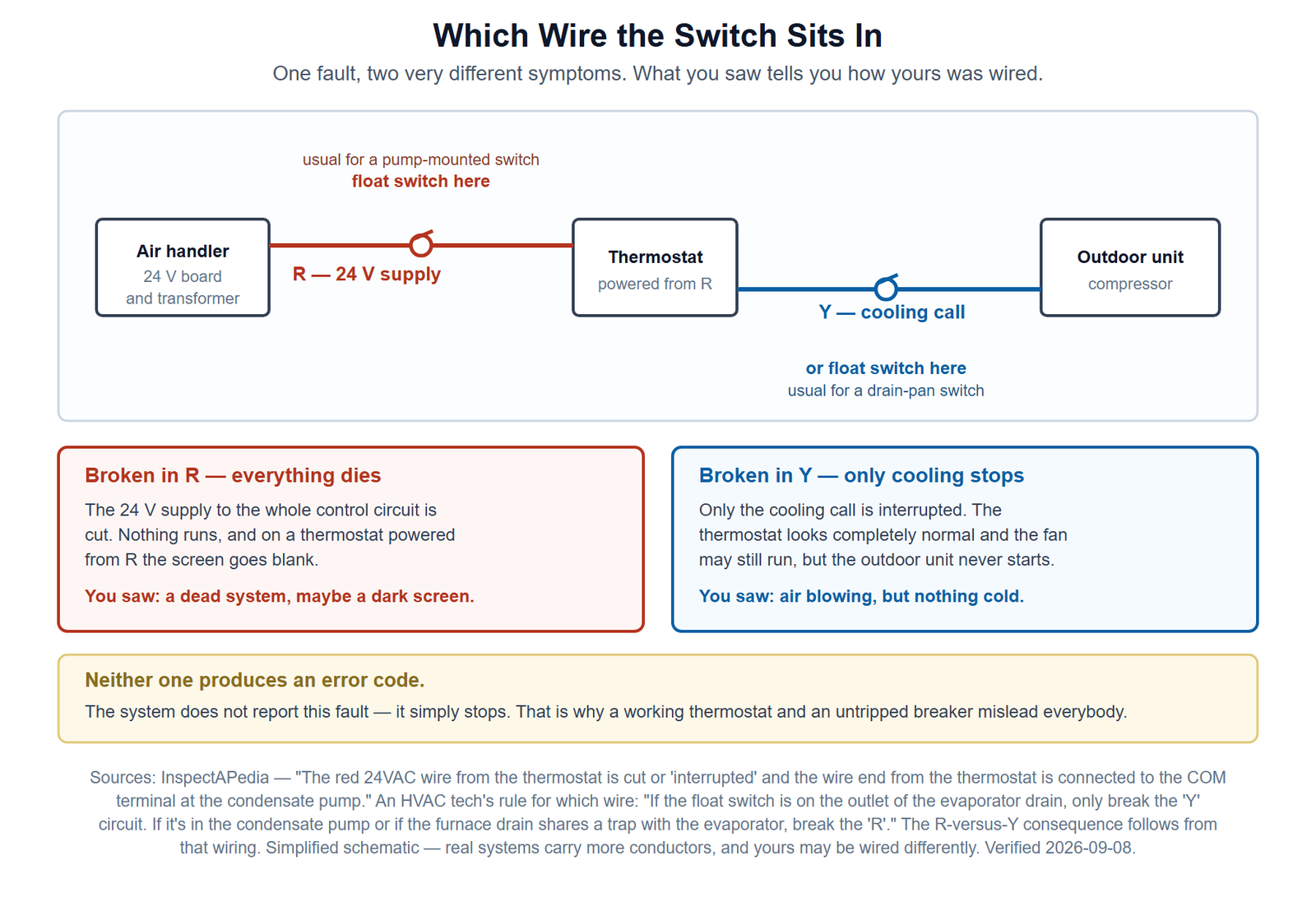
A blank thermostat is the one nobody guesses. It looks like a dead thermostat or a power problem, and people replace batteries and reset breakers for an afternoon before anyone looks in a plastic box on the floor.
For completeness, Trane describes what a tripped pan switch stops: “it will shut the outdoor compressor and condenser fan down. It will also shut down the supply fan.”
Why there is no warning
Worth saying plainly, because it is the reason this costs people a service call.
An HVAC tech, on exactly this: “One would think that they would have a simple way to add a condensate safety switch and have it give a code to the thermostat when tripped but they don’t.”
Modern equipment reports flame faults, pressure switch faults and sensor faults with a blink code or a screen message. This one produces nothing. The circuit opens, the equipment sees no call, and everything behaves exactly as if you had never asked for cooling.
So a working thermostat and an untripped breaker prove less than they seem to. Neither rules this out.
If the leads were connected, shutdown was the intent
One small thing that settles an argument you may have with yourself about whether the switch is misbehaving.
Little Giant’s catalog describes the overflow switch on its pumps as “dual function NO and NC operation (set to NO from factory for equipment shutdown connection)”, supplied with “two 5″ switch lead wires”.
Out of the box, it is configured to shut equipment down. If somebody wired those two leads in, this behaviour is what they were choosing. The switch is not faulty for doing it — and on many pumps the leads are never connected at all, which is a different problem with a much wetter ending.
Now find out why the tank filled
Resetting it is not fixing it. Something stopped a pump that had been keeping up until now, and that is its own diagnosis:
- The pump hums but no water leaves — a blocked line, a check valve, or water falling back.
- The pump does not start at all, or a float is stuck in the down position.
- The pump was fine and the discharge is frozen or blocked outside.
The broader picture of what a failure looks like in each direction is in what happens if a condensate pump fails, and the condensate pumps guide covers how the parts fit together.
When this needs a pro
Emptying a tank is fine. Going near the wiring is where it stops.
InspectAPedia is blunt about the limit, and it is worth repeating exactly: “the high water level switch can ONLY be wired to a Class II low voltage circuit” and “Never connect these low voltage wires to a line voltage (120VAC or 240VAC) circuit.” Those two leads are 24-volt control wiring. They do not go anywhere near the pump’s power cord.
Call a tech if the tank refills within the hour after emptying it, if the system stays dead with an empty tank, or if you cannot find a pump at all — in which case you may be looking at a pan switch and a blocked drain instead.
Never tape the float down or bridge the two leads to get the cooling back. It works, for a few hours, and then the water goes on the floor with nothing left to stop it.
FAQ
Why does my AC shut off when the condensate pump is full?
Because a float switch inside the pump opened the low-voltage control circuit on purpose. It is a safety feature that stops the system making more condensate once the tank cannot be emptied, so the water never reaches the rim. Empty the tank and the switch resets itself.
Will the AC come back on by itself?
Usually yes, once the water level drops. These switches reset automatically rather than latching. If the pump never empties the tank, though, the level never drops and the system stays off until someone empties it by hand.
My thermostat screen is blank. Can that be the condensate pump?
It can. If the switch was wired into the R wire, it cuts the 24-volt supply that powers the thermostat itself, so the screen goes dark. It looks like a dead thermostat. Check the pump’s tank before replacing anything.
How long after emptying the tank before it trips again?
On a three-ton system, roughly 30 to 100 minutes of running time, since the common pumps hold half a gallon and that system makes about 0.3 to 0.9 gallons an hour. A second trip well inside that window means the pump is not emptying at all.
Is it the pump or a clogged drain line?
Look in the pump’s tank. Full tank means the pump is the problem. Empty tank with the system still dead points at a drain pan switch and a blocked drain line instead — a different device, in a different place, with a different fix.


