On this page
Last Updated on September 29, 2026 by Muhammad Toqeer
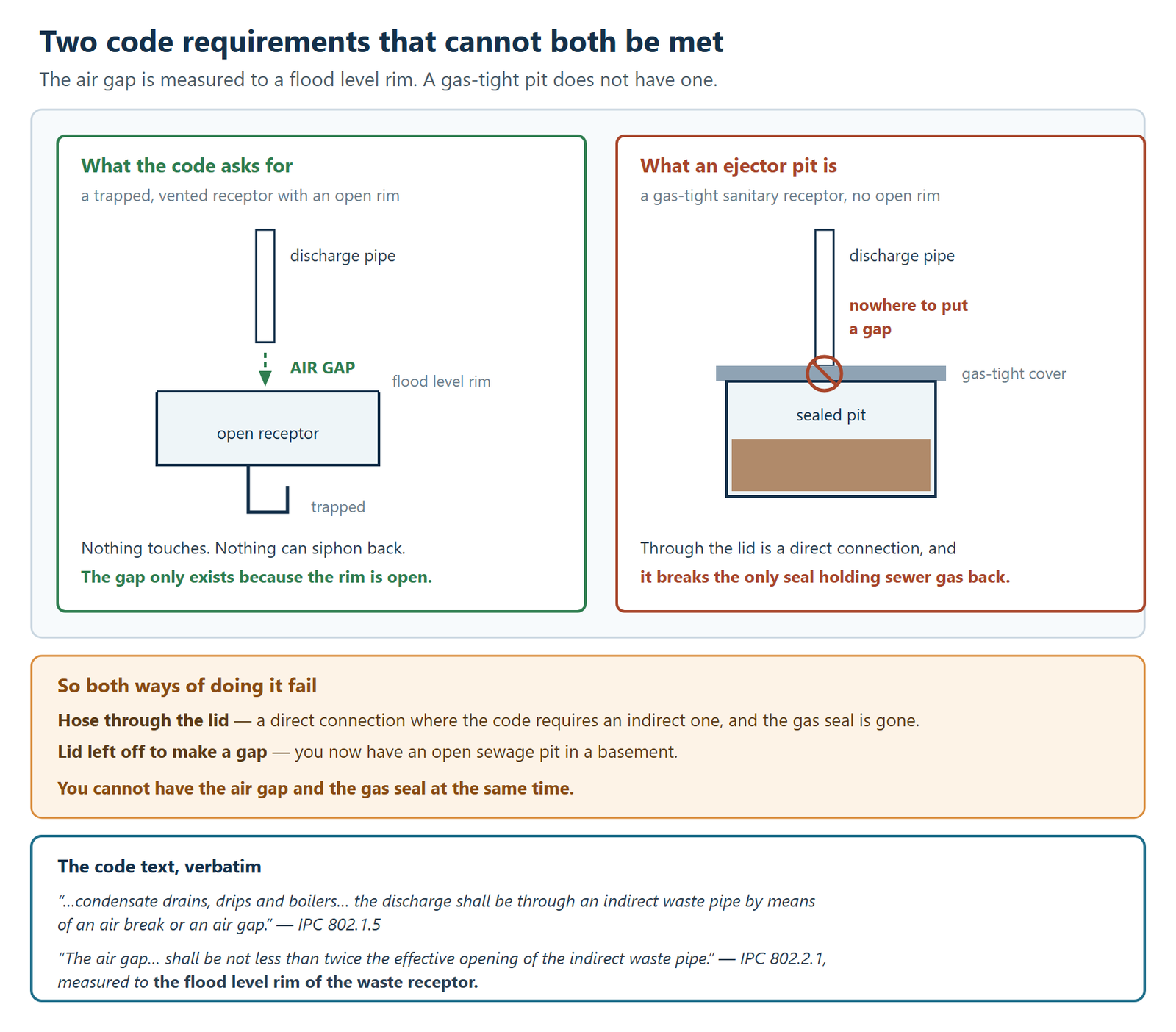
No — and the reason is cleaner than the usual “check your local code” answer. The plumbing code requires a dehumidifier’s discharge to reach the drainage system indirectly, through an air gap measured to the receptor’s flood level rim. A sewage ejector pit is gas-tight. It has no flood level rim.
You cannot have the air gap and the gas seal at the same time. That is the whole answer.
The two requirements, side by side
The code treats a dehumidifier’s output as clear-water waste, and it is specific about how that reaches the drains. From the IPC:
“Where devices and equipment such as process tanks, filters, condensate drains, drips and boilers discharge nonpotable water to the building drainage system, the discharge shall be through an indirect waste pipe by means of an air break or an air gap.”
Indirect. Never plumbed straight in. And the gap has a defined size:
“The air gap between the indirect waste pipe and the flood level rim of the waste receptor shall be not less than twice the effective opening of the indirect waste pipe.”
Read the measurement carefully — it is taken to the flood level rim. That phrase assumes a receptor with an open top: a floor drain, a standpipe, a sink. Something with a rim that water would spill over if it filled.
Now think about what an ejector pit is. Its defining feature is a gas-tight cover. There is no open surface. There is no rim.
So both ways of doing it fail
Run the hose through the lid. You have made a direct connection from equipment the code says must be indirect — and you have opened the seal that is the only thing between your basement and sewer gas.
Leave the lid off to create a gap. You now have an open sewage pit in a basement.
There is no third option, because the requirement and the hardware are in direct conflict.
A note on how the code is phrased
The IPC does not contain a sentence saying “do not drain a dehumidifier into an ejector pit.” It does not need one.
It specifies what a receptor has to be — “trapped and vented”, with a flood level rim to measure a gap against — and a gas-tight sanitary pit cannot be that. The prohibition is structural rather than explicit, which is why you will not find it by searching for it.
That distinction matters if you are talking to an inspector. The argument is not “the code bans this.” It is “this cannot meet 802.”
Why the sump-pit answer does not transfer
This is where the confusion comes from, and it is understandable.
A sump pit and an ejector pit look identical from across a basement — a hole in the floor with a pump in it. People read that condensate can go to a sump, and reasonably assume the same applies here.
They are not the same thing. A sump pit collects groundwater. An ejector pit is a sanitary receptor below sewer level, holding sewage, sealed and vented as part of the drainage system. It has its own vent, sized and required by code, which is a different thing again from the trapped-and-vented receptor the clear-water rule is talking about.
Whether a sump is an acceptable receptor for condensate varies by jurisdiction and is a separate question. It is simply not the question you are asking when the pit in your basement is a sewage pit.
The second reason, which has nothing to do with code
Even if it were permitted, it would be a poor idea.
Clean water put into a sewage pit gets pumped as sewage. Every gallon a dehumidifier produces in a damp basement becomes run time on a machine built to move waste, on a float with a fixed on and off point.
Those are pump starts the pit did not need, and starts are what wear a pump out. If you are already looking at replacing one, adding a continuous clear-water feed to it is working against the thing you just paid for.
And more liquid moving through the pit is not neutral. What stands in a pit and for how long is what drives the smell, and the pit was never designed to handle a second, continuous inflow.
What a compliant arrangement looks like
Not instructions — just what to look for, so you can tell whether what you have is right and ask a plumber the correct question.
The code names what the receptor must be: trapped and vented, with a flood level rim, and the discharge stopping short above it by at least twice the pipe’s opening.
In a basement that normally means a trapped floor drain, a laundry standpipe, or a utility sink — with the discharge ending above the rim rather than inside the pipe.
The air gap is the whole point. It is not a detail of neatness; it is what guarantees that nothing in the drain can ever be drawn back up into the equipment.
When this needs a pro
Any new drain connection. It is drainage work and it is inspected.
Anything involving the pit lid. The cover is a gas seal, and a grommet somebody cut and did not reseal is a common finding.
A basement damp enough to need continuous dehumidification. That is worth understanding on its own, because a dehumidifier is managing a symptom.
What you can do yourself: look at where your dehumidifier discharges now. If the hose disappears into the pit lid, or the lid is sitting loose because a hose is running under it, you have found something worth fixing — and it takes ten seconds to check.
FAQ
Can I drain a dehumidifier into a sewage ejector pit?
No. The code requires clear-water waste to discharge indirectly, through an air gap measured to the receptor’s flood level rim, and a gas-tight ejector pit has no rim. Running the hose through the lid creates a direct connection and breaks the gas seal.
Is it different for a sump pit?
Yes, and that is where the confusion starts. A sump pit collects groundwater; an ejector pit is a sealed sanitary receptor below sewer level. Whether condensate may go to a sump depends on the jurisdiction, but it is a different question with a different answer.
What does the code say about condensate drains?
IPC 802.1.5 groups condensate drains with process tanks, filters, drips and boilers, and requires their discharge to reach the drainage system through an indirect waste pipe by means of an air break or an air gap.
How big does the air gap have to be?
Not less than twice the effective opening of the indirect waste pipe, measured between the pipe and the flood level rim of the receptor.
Where should a dehumidifier drain instead?
Into a receptor that is trapped and vented with an open rim — typically a floor drain, a laundry standpipe or a utility sink — with the discharge ending above the rim rather than inside the pipe. Fitting that is a plumber’s job.
What happens if a dehumidifier already drains into my ejector pit?
Two things worth knowing. The gas seal is likely compromised where the hose passes through, and the pump is running extra cycles on clean water. Neither is an emergency, but both are worth correcting when someone is next working on the system.