On this page
Last Updated on October 3, 2026 by Muhammad Toqeer
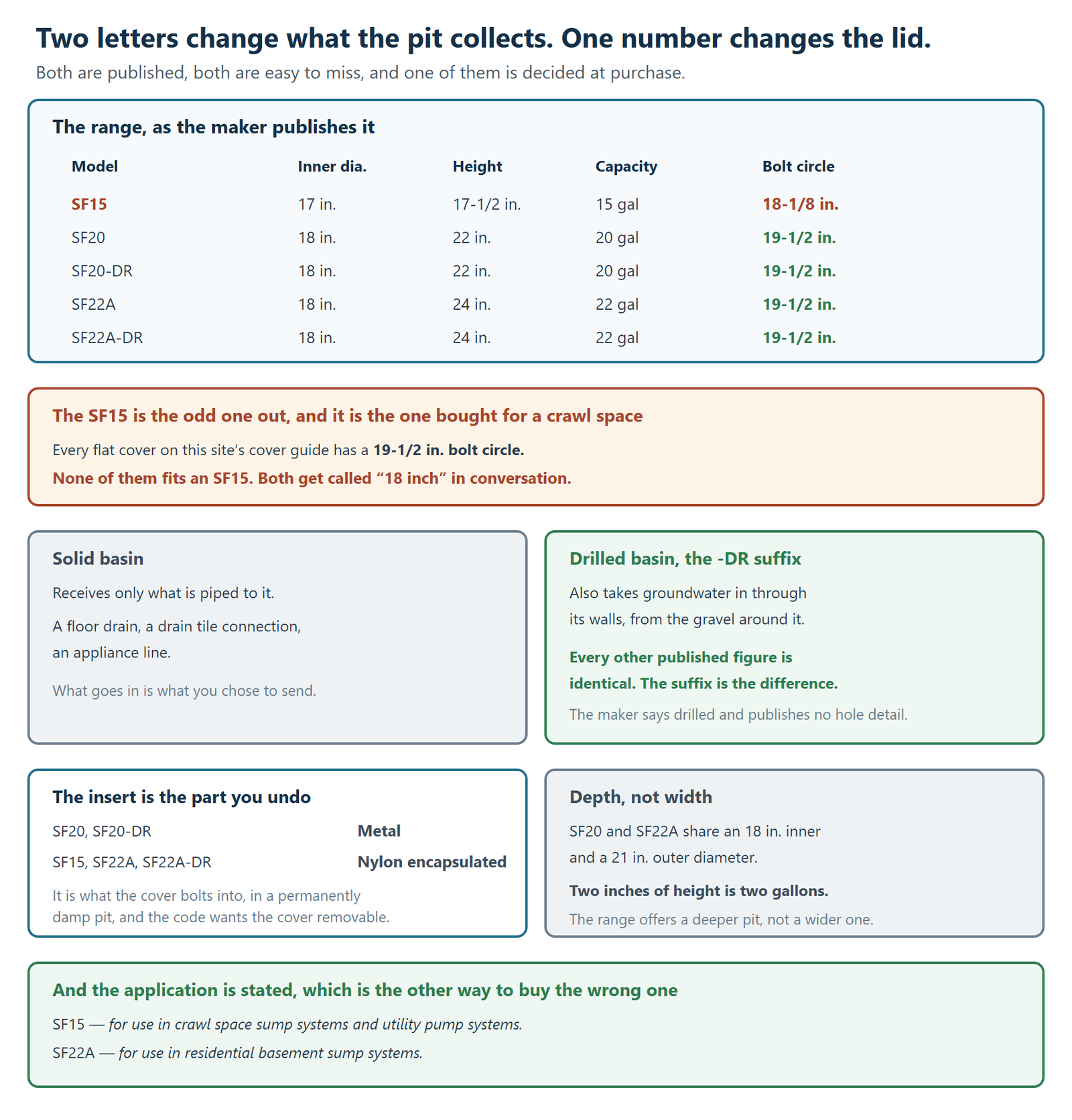
Check the suffix before anything else. A -DR on the model number means drilled, and a drilled basin takes groundwater in through its walls from the gravel around it. A solid basin receives only what is piped to it.
Every other published figure on those two models is identical — same diameter, same height, same capacity, same material, same weight. The two letters are the entire difference, and they decide what your pump spends its life pumping.
Then check the bolt circle, because it is not constant across the range. Four of the five basins here publish 19-1/2 inches. The SF15 publishes 18-1/8. Every flat cover in this site’s cover guide has a 19-1/2 inch bolt circle — so none of them fits an SF15, and both get called “an eighteen-inch pit” in conversation.
The range, as the manufacturer publishes it
| Model | Inner dia. | Outer dia. | Height | Capacity | Bolt circle | Insert |
|---|---|---|---|---|---|---|
| SF15 | 17 in. | 19 in. | 17-1/2 in. | 15 gal | 18-1/8 in. | Nylon encapsulated |
| SF20 | 18 in. | 21 in. | 22 in. | 20 gal | 19-1/2 in. | Metal |
| SF20-DR | 18 in. | 21 in. | 22 in. | 20 gal | 19-1/2 in. | Metal |
| SF22A | 18 in. | 21 in. | 24 in. | 22 gal | 19-1/2 in. | Nylon encapsulated |
| SF22A-DR | 18 in. | 21 in. | 24 in. | 22 gal | 19-1/2 in. | Nylon encapsulated |
All five are current catalogue items on the manufacturer’s own site, checked 3 October 2026. This guide is single-brand, because Jackel’s were the only basin pages readable at manufacturer level this session — a limitation of the research rather than a verdict on anyone else.
Drilled or solid, and why it is the first decision
The product titles say it outright:
“DRILLED STRUCTURAL FOAM SUMP BASIN | 18″ ID x 22″ H | MODEL: SF20-DR”
A drilled basin is part of the drainage system. Water in the gravel around it finds its way in through the walls, which is what you want when the job is lowering the water table under a slab.
A solid basin is a receiver. It takes a floor drain, a drain tile connection, an appliance line — whatever you deliberately plumb into it — and nothing else.
Get this backwards in either direction and the pump pays for it. A solid basin where groundwater needed collecting leaves the water outside. A drilled basin where it was not needed invites water that was never going to arrive otherwise.
One-minute check: is there a drain tile loop around the footing, and does it terminate at the pit? If the system is already piped, a solid basin is usually the right receiver. If the pit is the collection point itself, it needs to be drilled.
And it changes what “running with no rain” means. A pump cycling on a dry week has a short list of causes, and a drilled basin in a high water table is on it — not as a fault, but as the thing the basin was bought to do.
Scope note: the manufacturer says drilled and publishes no hole count, size or pattern. Nothing here invents one.
The bolt circle decides your lid, and the SF15 is the trap
Four of these five publish a 19-1/2 inch bolt circle. The SF15 publishes 18-1/8.
That is not a rounding difference. The flat covers documented on this site all use 19-1/2, and the residential code requires a gas-tight, removable cover on any installed sump pump — so a basin you cannot buy a listed cover for is a compliance problem as well as an inconvenience.
The SF15 is also the one most likely to be bought by accident, because it is the smallest, the lightest at 8 lbs, and the obvious choice for a crawl space.
And the maker tells you its job:
SF15 — “For use in crawl space sump systems and utility pump systems.”
SF22A — “For use in residential basement sump systems.”
One-minute check before ordering a cover: find the basin’s model number, then order the cover against that model rather than against a measurement.
The five worth knowing
SF22A — the deepest in the family
Jackel SF22A — 18 in. inner, 21 in. outer, 24 in. high, 22 US gallons, 19-1/2 in. bolt circle, 14 lbs. HDPE structural foam, nylon encapsulated insert. “For use in residential basement sump systems.”
Who it is for: the default basement basin, and the one to pick when you want the deepest drawdown this family offers.
The honest drawback: 24 inches of depth is 24 inches of excavation. On a retrofit into an existing slab that is the whole job, and the extra two gallons over an SF20 is the smallest part of what you are buying.
SF22A-DR — the same basin, drilled
Jackel SF22A-DR — identical on every published figure: 18 in. inner, 21 in. outer, 24 in. high, 22 gallons, 19-1/2 in. bolt circle, 14 lbs, nylon encapsulated insert. “For use in residential basement sump systems.”
Who it is for: a basement where the pit is the collection point and groundwater needs to get in through the walls.
The honest drawback: it cannot be undone. A drilled basin set in concrete is a drilled basin for the life of the house, and you are committing to collecting whatever the surrounding ground delivers.
SF20 — two inches shallower, and a metal insert
Jackel SF20 — 18 in. inner, 21 in. outer, 22 in. high, 20 US gallons, 19-1/2 in. bolt circle, 11 lbs. HDPE structural foam, metal insert.
Who it is for: the same basement job where two inches of depth are not available, or where 11 lbs rather than 14 matters for handling.
The honest drawback: the insert is published as metal rather than nylon encapsulated, and it is the threaded fitting your cover bolts into in a permanently wet pit. The manufacturer does not say why the two differ and this page will not guess — but it is the part you will be undoing for every pump service.
SF20-DR — the drilled twin
Jackel SF20-DR — “DRILLED STRUCTURAL FOAM SUMP BASIN | 18″ ID x 22″ H.” Every published figure matches the SF20: 20 gallons, 22 in. high, 19-1/2 in. bolt circle, 11 lbs, metal insert.
Who it is for: the collection-point job in a shallower installation.
The honest drawback: same irreversibility as the SF22A-DR, plus the metal insert.
SF15 — the crawl space basin, and the one to check twice
Jackel SF15 — 17 in. inner, 19 in. outer, 17-1/2 in. high, 15 US gallons, 8 lbs, HDPE structural foam, nylon encapsulated insert — and a 18-1/8 in. bolt circle. “For use in crawl space sump systems and utility pump systems.”
Who it is for: exactly what it says — a crawl space, or a pit serving a utility pump rather than a permanent basement sump.
The honest drawback, and it is the reason this model leads the warnings on this page: its bolt circle does not match the covers. It is also not specified for residential basement sump systems, so using it as a stand-in basement pit puts you outside the maker’s stated application and outside the cover range in one move.
Depth, not width — and why that matters
The SF20 and SF22A share an 18 inch inner diameter and a 21 inch outer. The published difference is two inches of height, two gallons, and three pounds.
So this family offers you a deeper pit, not a wider one.
That matters because of what this site has already worked out. Widening a pit buys the same reduction in pump starts as deepening it, without extending how long the pump runs dry at the end of a cycle — and the catalogue does not offer width in this range.
Pro note: if starts per hour is your problem, the basin range is not where the fix is. The switch differential is the simpler lever, and tether length is the setting that controls it.
And on diameter generally: that same guide publishes a 14 inch minimum basin diameter for a tethered float on sump duty. Every basin here clears it — 17 and 18 inch inner diameters — which is worth knowing if you were worried a smaller pit would save work.
How to choose, in order
First, is the pit a collector or a receiver? Drilled if groundwater has to get in through the walls. Solid if everything arrives by pipe.
Second, how deep can you actually go? On a retrofit this is set by the slab and the excavation, not by preference.
Third, write down the bolt circle and order the cover against the basin model, not against a tape measure.
Fourth, check the stated application — crawl space and utility pump systems are a different listing from residential basement sump systems.
And last, the insert material, which is the part you will be unbolting every time the pump comes out.
When this needs a pro
Setting a basin into an existing slab. It is concrete cutting, excavation and backfill, and the pit has to end up level and supported.
Anything involving drain tile. Connecting a basin into a footing drain is drainage design, and getting it wrong moves water somewhere worse.
Deciding drilled or solid on a house you do not know yet. If you cannot tell whether there is a drain tile loop, that is a question for someone who can look.
And any pit that is not a manufactured basin at all — a site-formed concrete hole has no model number, no bolt circle and no listed cover, which is a measuring and fabrication problem rather than a shopping one.
What you can do yourself: find the model number moulded into the rim or side of your existing basin, measure the inside diameter, and look for whether anything enters through the walls below the floor. Three things, one tape measure — and they settle both the basin and the cover.
FAQ
What does -DR mean on a sump basin?
Drilled. The product title says so outright, and it means the basin takes groundwater in through its walls from the surrounding gravel rather than only receiving what is piped to it. Every other published figure — diameter, height, capacity, material, weight — is identical to the undrilled model.
What size sump basin do I need?
The family here offers depth rather than width: an 18 inch inner diameter across the basement models, with 22 inch and 24 inch heights giving 20 and 22 gallons. If your problem is the pump starting too often, the basin range is not where the fix is — the switch differential is a simpler lever.
Will any lid fit my sump basin?
No, and the figure to check is the bolt circle rather than the diameter. Four of the five basins here publish 19-1/2 inches and one publishes 18-1/8, so a cover that fits most of the range will not fit the smallest basin even though both are described as roughly eighteen inches.
Can I use a crawl space basin in a basement?
The manufacturer specifies the smallest model for crawl space sump systems and utility pump systems, and the larger ones for residential basement sump systems. Beyond the stated application, its bolt circle does not match the covers — so it is outside the listing and outside the cover range at the same time.
What is the insert on a sump basin?
The threaded fitting the cover bolts into. It is published per model — metal on two of these basins and nylon encapsulated on the other three — and it lives in a permanently damp pit. Since the code requires the cover to stay removable, it is the part you will undo at every pump service.
Does a deeper sump basin mean fewer pump starts?
It gives more drawdown between the on and off levels, which does reduce starts — but widening achieves the same thing without extending how long the pump runs at the end of each cycle, and this range does not offer extra width. The tether length on the float switch is usually the more practical adjustment.


