On this page
Last Updated on October 2, 2026 by Muhammad Toqeer
The manufacturer’s first instruction is to change the plumbing, not the pump. For a pump that cannot keep up, Liberty’s own troubleshooting table says: “Route discharge piping to a lower level. If not possible, a larger pump may be required.”
Reroute first. Replace second. Every page on this subject has that order backwards.
And three of the five published causes are the discharge line. Only one is the pump.
The five causes, and where each one lives
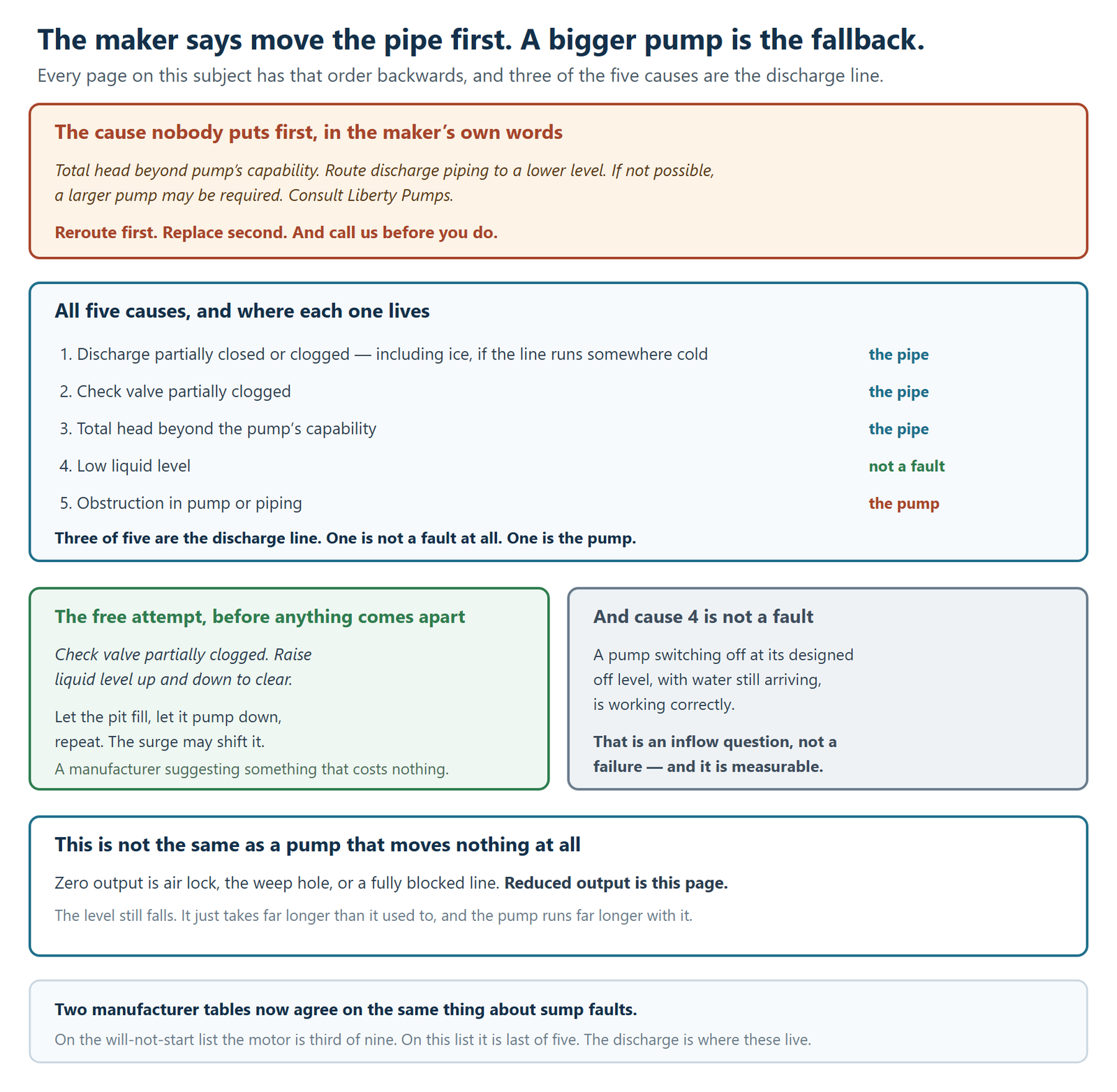
Liberty publishes this list under “Pump does not deliver proper capacity”:
| # | Cause | Where it lives |
|---|---|---|
| 1 | Discharge partially closed or clogged | The pipe |
| 2 | Check valve partially clogged | The pipe |
| 3 | Total head beyond the pump’s capability | The pipe |
| 4 | Low liquid level | Not a fault |
| 5 | Obstruction in pump or piping | The pump |
Three of five are the discharge. One is not a fault at all. One is the pump, and it is last.
That is the same shape as the will-not-start list, where the motor sits third of nine. Two manufacturer tables, the same conclusion: sump faults live in the pipe.
Start with the free one
“Check valve partially clogged. Raise liquid level up and down to clear; remove check valve to remove obstruction.”
Let the pit fill. Let the pump run it down. Repeat.
The surge may shift whatever is sitting in the valve, and the manufacturer suggests trying that before anything is dismantled. It costs nothing and takes ten minutes.
If it works, you have found your cause. If it does not, the valve comes out — which is a plumbing job on the line that protects your basement.
Then check the discharge, including the cold part of it
“Discharge partially closed or clogged. Check the discharge line for foreign material, including ice if the discharge line passes through or into cold areas.”
Note that the manufacturer names ice in a general capacity fault, not only in a winter one.
A partly frozen line behaves exactly like a partly blocked one — the pump still moves water, just less of it — and a discharge to daylight freezes at two specific places rather than along the buried run.
One-minute test: follow the line outside and feel it. And look at where it ends — a discharge terminating in a drift, a flowerbed that has risen, or six inches of leaves is partly closed whether or not anything froze.
Then the one everybody skips: is the pipe the problem?
This is the cause with the manufacturer’s most surprising remedy.
“Total head beyond pump’s capability. Route discharge piping to a lower level. If not possible, a larger pump may be required. Consult Liberty Pumps.”
Total head is what the pump is actually lifting against, and it is set by the plumbing rather than by the pit. Raise the point where the discharge terminates, add elbows, add length, and you have added head without touching the pump.
So a pump that used to cope and now does not may be fine, with a discharge route that changed — an extension added to get the water further from the house, a line rerouted around an obstruction, a riser taken higher over a joist.
This site’s sizing article explains why flow has to be read at the lift you actually have — and the corollary is that reducing the lift is a real alternative to buying more pump.
Which is exactly what the manufacturer says to try first.
And cause four is not a fault at all
“Low liquid level. Check liquid level.”
A pump that switches off at its designed off level while water is still arriving is working correctly.
During a genuine storm, a pump that “never catches up” may simply be meeting an inflow it was never sized for — which is a measurement rather than a failure, and the fill test gives you the number in one minute with the pump switched off.
That is a sizing question, and it has a different answer from all of the above.
What this is not
It is not a pump that moves nothing. Zero output is air lock, the weep hole, or a fully blocked line, and that is a different page with different causes.
The distinction is whether the level falls at all. On this page it does — slowly, and the pump runs far longer doing it.
When this needs a pro
Removing or replacing the check valve, which means cutting into the line with water standing in it.
Rerouting the discharge, which is the manufacturer’s own first remedy and is still plumbing.
Anything inside the pump. Liberty’s fifth cause is an obstruction, and past removing it the instruction is to consult the manufacturer.
A pit you cannot see into properly, since the cover should be gas-tight and fastened down.
What you can do yourself: cycle the pit up and down a few times, walk the discharge line to its end, and look at whether anything about the route has changed. Three things, no tools — and they clear the three causes that are most likely.
And if it really is the pump, compare replacements on flow at your actual lift — which is the same number the third cause is about.
FAQ
Why is my sump pump running but the water level barely drops?
Three of the five published causes are the discharge line: a partly blocked pipe, a partly clogged check valve, or total head beyond the pump’s capability. Only one cause is the pump itself, and the manufacturer lists it last.
Should I buy a bigger sump pump if it cannot keep up?
Not first. Liberty’s own remedy for total head beyond the pump’s capability is to route the discharge piping to a lower level, and a larger pump only if that is not possible — with a recommendation to consult them before doing it.
How do I clear a partly clogged check valve?
The manufacturer suggests raising the liquid level up and down to clear it — let the pit fill, let the pump run it down, and repeat. If the surge does not shift the obstruction, the valve has to come out, which is a plumbing job.
Can ice cause a sump pump to lose capacity rather than stop completely?
Yes, and the manufacturer names it in the general capacity fault rather than only in a winter one. A partly frozen line behaves like a partly blocked one: the pump still moves water, just less of it.
My sump pump never catches up during heavy rain — is it broken?
Possibly not. “Low liquid level” is on the manufacturer’s own cause list, and a pump switching off at its designed off level while water keeps arriving is behaving correctly. That is an inflow measurement rather than a fault.
Is this the same as a sump pump that runs and moves no water at all?
No. Zero output points at air lock, the weep hole or a fully blocked line. This page is about reduced output, where the level still falls but takes much longer and the pump runs much longer with it.


