On this page
Last Updated on October 1, 2026 by Muhammad Toqeer
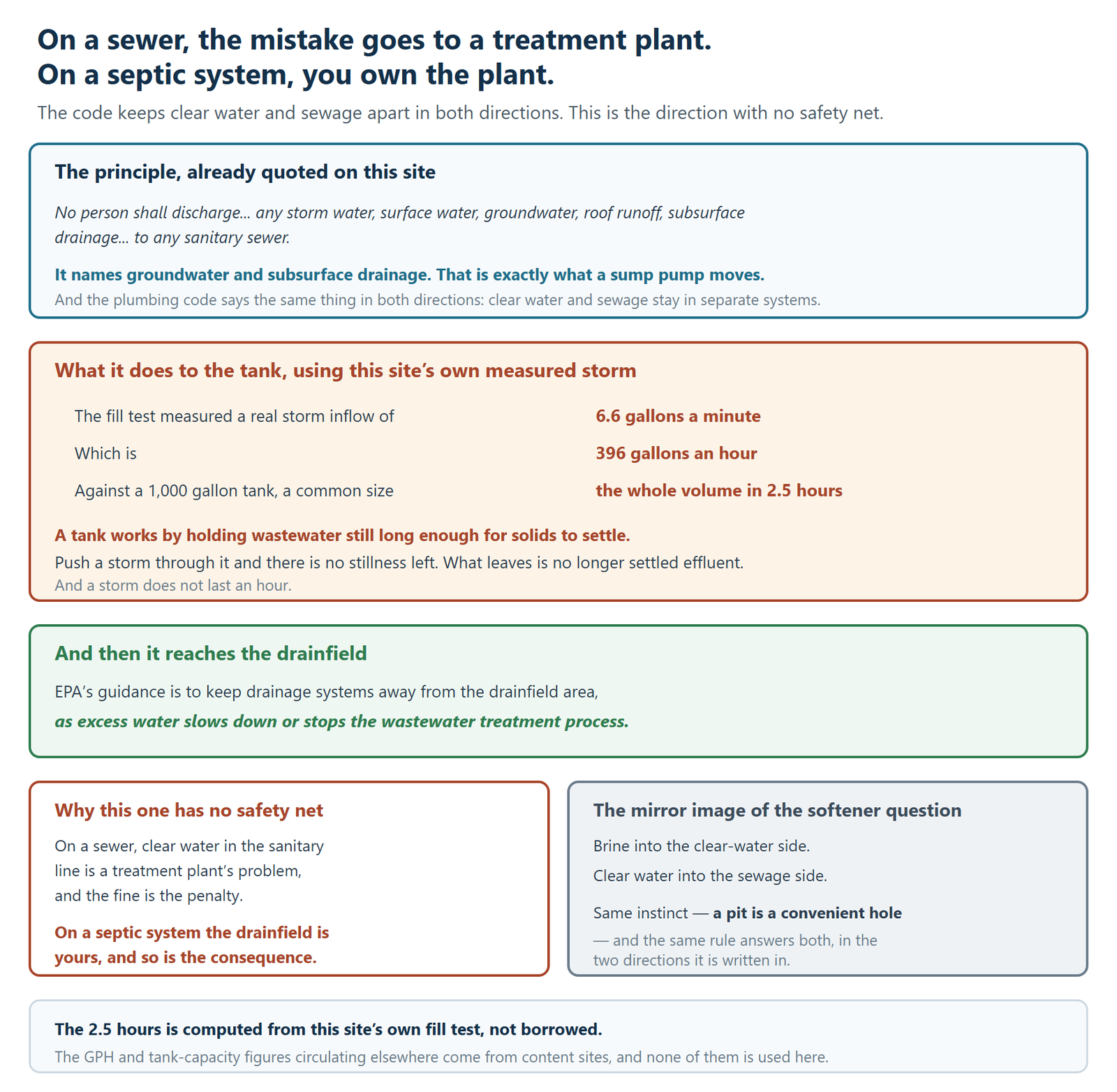
No, and the reason is not the rule — it is that you own the consequences. Routing a sump discharge into a sanitary sewer is prohibited and the penalty is a fine. Routing it into a septic system puts a storm through a tank sized to hold about a day of household wastewater, and the drainfield downstream is yours.
At the storm inflow this site actually measured — 6.6 gallons a minute, or 396 an hour — a 1,000-gallon tank sees its entire volume in about two and a half hours.
And a storm does not last an hour.
The principle, which this site already quotes
The ordinance language on this site’s sump pillar is widely adopted and names the water precisely:
“No person shall discharge or cause to be discharged any storm water, surface water, groundwater, roof runoff, subsurface drainage, uncontaminated cooling water or unpolluted industrial process waters to any sanitary sewer.”
Groundwater. Subsurface drainage. That is what a sump pump moves and nothing else.
And the plumbing code states the separation in both directions:
“Sumps and ejectors handling sub-soil drainage and footing drains shall not receive any sewage, and sumps and ejectors handling sewage shall not receive subsoil drainage and footing drains.”
Clear water and sewage stay in separate systems. A septic tank is simply the sanitary side of a house that has no sewer to connect to.
The principle is identical. What changes is who absorbs the error.
What a storm does to a septic tank
A septic tank is not a container. It is a settling vessel. It works by holding wastewater still long enough for solids to sink and scum to rise, so that what leaves is relatively clear effluent fit to soak away.
Everything about that depends on the water standing still.
This site measured a real storm inflow during a fill test: 6.6 gallons a minute, which is 396 gallons an hour.
Against a 1,000-gallon tank — a common residential size — that is the entire nominal volume in about two and a half hours.
So the arithmetic is not marginal. A tank sized to hold roughly a day of household wastewater is being asked to pass a day’s worth every couple of hours, for as long as it rains.
Retention time collapses, and solids that should have settled leave with the effluent.
And then it reaches the drainfield
This is the part that is yours.
EPA’s own guidance on maintaining a drainfield is to keep drainage systems away from the drainfield area, “as excess water slows down or stops the wastewater treatment process.”
Two things arrive there that should not. The water itself, in volumes the field was never sized for. And the solids that no longer had time to settle, which is how a drainfield’s soil stops accepting water.
On a sewer, clear water in the sanitary line is a treatment plant’s problem and a municipal fine is the penalty. Unpleasant, but it is a bill.
On a septic system, the plant is in your garden.
It is the same question as the softener, in the other direction
Worth seeing them together, because the instinct behind both is identical.
A water softener draining into the sump pit puts brine into the clear-water side. A sump draining into the septic system puts clear water into the sewage side.
Both come from the same reasonable-looking thought: there is a pipe right there, and water needs to go somewhere.
And both are answered by the same rule, which is written in both directions precisely because people arrive at it from both ends.
Where it should go instead
Outside, to a storm sewer, or to a dry well — the same three destinations the sump pillar names, and which the sanitary prohibition exists to protect.
Two cautions this site has already established, and both apply with more force on a rural property with a septic system:
If there is a private well, the discharge has a separation distance to respect, and a dry well is a subsurface pit with a much longer one.
And the discharge still has to clear the house. Water released beside the foundation soaks back to the drain tile and returns to the pit, so a short run is not a solution anywhere.
If the pit water genuinely needs pumping somewhere a gravity run cannot reach, that is a different machine and a different question — the pumps built for on-site wastewater have their own category and their own specifications, and a sump pump is not one of them.
When this needs a pro
Any change to a septic system, which is a permitted alteration in most jurisdictions and inspected in many.
Disconnecting an existing sump-to-septic connection, because what it is connected to and how matters, and because the drainfield may already have taken damage that needs assessing rather than guessing at.
The local rules, which vary and which your county health department will tell you for free. Several states prohibit this outright.
Anything involving the drainfield itself. It is the half of a septic system you cannot simply swap out, and it is not a DIY component.
What you can do yourself: follow your sump discharge pipe and find out where it actually terminates. One walk — and on an older rural property that is a question worth settling, because this connection was not always unusual.
FAQ
Can a sump pump drain into a septic system?
It should not, and many jurisdictions prohibit it. A septic tank works by holding wastewater still long enough for solids to settle, and a storm’s worth of groundwater passing through removes exactly that. Several states ban the connection outright.
Why is sump water bad for a septic tank?
Not because it is dirty — it is groundwater. The problem is volume. At a measured storm inflow of 396 gallons an hour, a 1,000-gallon tank sees its whole nominal volume in about two and a half hours, so solids that should settle leave with the effluent instead.
What happens to a drainfield if a sump pump discharges into it?
It receives water in volumes it was never sized for, plus solids that no longer had time to settle. EPA’s guidance on drainfields is to keep drainage away from them because excess water slows or stops the treatment process.
Is it worse than draining a sump into the sanitary sewer?
Both are prohibited, but the consequences differ. On a sewer the water goes to a treatment plant and the penalty is a municipal one. On a septic system the drainfield is on your property and the damage is yours to repair.
Where should a sump pump discharge on a property with a septic system?
Outside, to a storm sewer, or to a dry well — away from both the septic components and, if there is one, the well. A dry well in particular carries its own separation distances on a property with a private well.
My house already has the sump connected to the septic — what now?
Find out where it goes and ask your county health department what applies locally. Disconnecting it is a change to a septic system, which is permitted work in most places, and the drainfield may need assessing rather than assuming.


