On this page
Last Updated on September 29, 2026 by Muhammad Toqeer
Two numbers size this, and neither is horsepower. They are your motor’s locked rotor amps and its voltage, both published by the company that made the motor. A Franklin 1 hp submersible runs on 8.2 amps and its locked rotor figure is 48.7 — nearly six times as much, for the instant it starts.
Every generator chart online indexes on horsepower. Horsepower is the one thing that does not decide the answer.
What the motor maker actually publishes
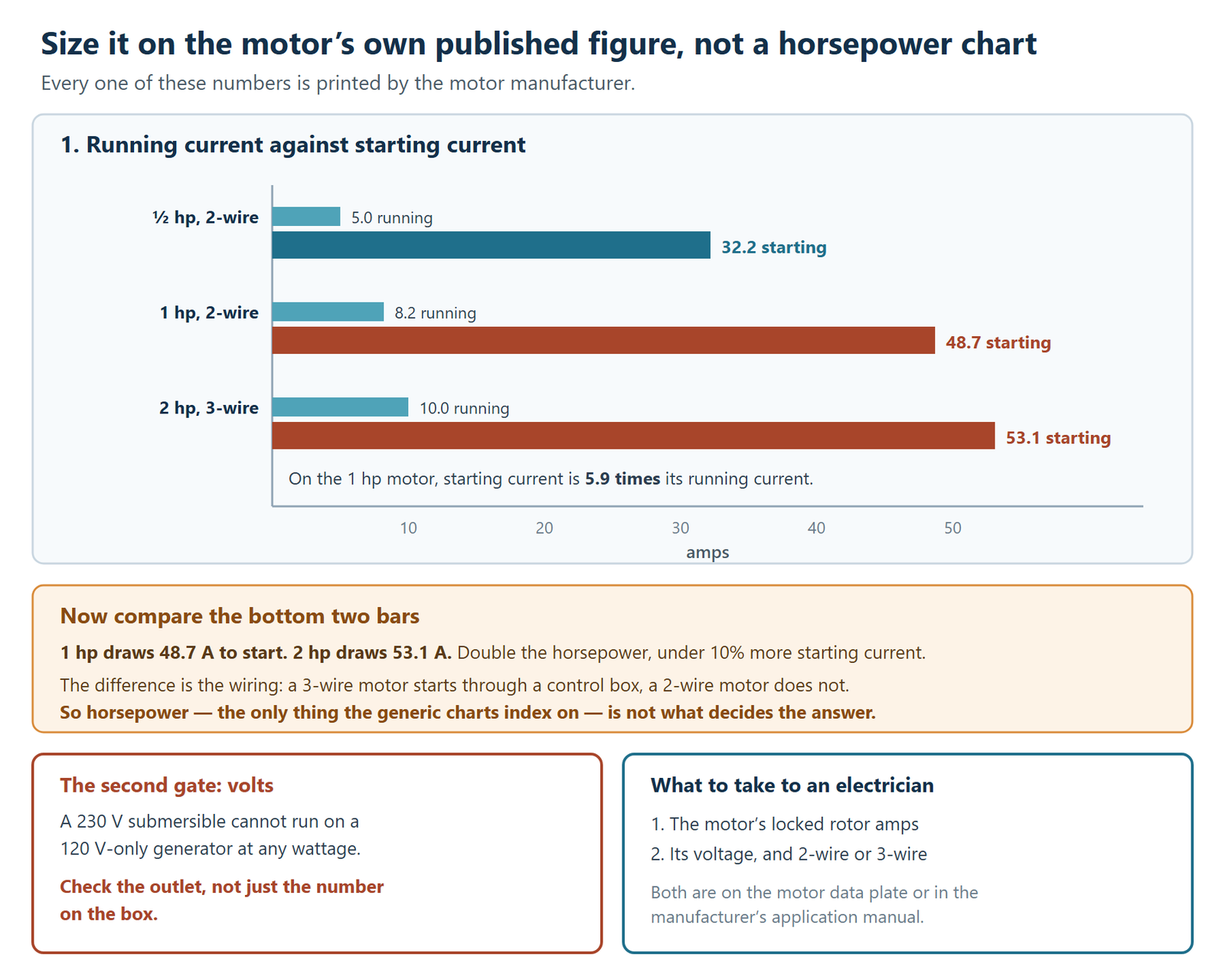
Franklin Electric publishes this for every motor it builds. Three of its 4-inch stainless submersibles:
| Motor | Full load amps | Max amps | Locked rotor amps |
|---|---|---|---|
| ½ hp, 230 V, 2-wire | 5.0 | 6.0 | 32.2 |
| 1 hp, 230 V, 2-wire | 8.2 | 10.4 | 48.7 |
| 2 hp, 230 V, 3-wire | 10.0 | 13.2 | 53.1 |
Locked rotor amps is what the motor demands at the instant of starting, before the rotor is turning. It is brief, and it is the peak the generator has to survive without its voltage collapsing or its breaker opening.
On the 1 hp motor that is 48.7 amps against 8.2 running — 5.9 times.
Now look at the bottom two rows again
The 1 hp 2-wire motor starts on 48.7 amps. The 2 hp 3-wire motor starts on 53.1.
Double the horsepower. Under ten per cent more starting current.
The difference is not the size of the motor, it is how it is wired. A 3-wire motor starts through a control box containing a start capacitor and a relay; a 2-wire motor has its starting components inside the motor and behaves differently. That control box is the same component that decides what a clicking pump is telling you.
So a horsepower chart cannot see the thing that matters. Two motors a full horsepower apart can ask nearly the same question of a generator, and two motors of the same horsepower can ask very different ones.
What the generic charts say, and why to treat them as a floor
The published guidance runs roughly:
- ½ hp — 700 to 900 running watts, 4,000 W generator minimum
- 1 hp — 1,000 to 1,500 running watts, 6,500 W
- 1½ hp — 8,500 W
Use them as a starting point and nothing more. Not one of them cites a motor’s published locked rotor amps, and not one distinguishes 2-wire from 3-wire. They are averages across a category that contains real differences.
The number to hand an electrician is the one off your own motor.
The second gate, which has nothing to do with wattage
A 230 V submersible cannot run from a 120 V-only generator at any wattage at all.
Plenty of portable generators are 120 V only. Plenty more offer 240 V through a single outlet with a much lower rating than the headline figure on the box. A 5,000 W generator that is 120 V only is the wrong tool, and no amount of surplus watts changes that.
Check the outlet and its rating, not the number on the carton.
Where to find your two numbers
The motor data plate, if the pump is out of the well or you have the paperwork from when it went in.
The manufacturer’s application manual. Franklin publishes full electrical data for its motor range, and most makers do the same.
The control box, if you have one. Its presence tells you the motor is 3-wire, which is itself half the answer.
If none of those is available, knowing how the pump was sized in the first place usually leads back to the paperwork that has the motor details on it.
Soft starters
A soft starter limits the current a motor draws as it comes up to speed, which lets a smaller generator do the job.
They exist, they work, and the figure to ask a supplier for is the reduced starting current — not a percentage from a marketing page. If your motor’s locked rotor figure is the thing putting you into a much larger generator, this is the conversation worth having before buying one.
When this needs a pro — and one thing that is genuinely dangerous
Connecting a generator to a well pump circuit is transfer-switch work. The pump is hard-wired on a dedicated 240 V circuit; there is no plug to move.
Do not backfeed the house through an outlet. Running a generator into a socket to energise the panel sends power back up the utility’s service drop, where it can kill a lineman working to restore your supply. It is the single most dangerous thing people do with a generator, and it is what a transfer switch exists to prevent.
Sizing for the pump plus anything else — a furnace, a fridge, a freezer — is a load calculation rather than an addition sum, because only one motor should be starting at a time.
And if the power has already come back and the pump has not, that is a different problem with its own sequence — start there before assuming the outage damaged anything.
What you can do yourself: find the motor’s locked rotor amps and its voltage, note whether there is a control box, and take those three things to an electrician. That is the whole specification, and it turns a guess into a quote.
If you are replacing the pump anyway, published electrical data differs between models, and choosing with the generator in mind is easier than working around it afterwards.
FAQ
What size generator do I need to run a well pump?
Size it on the motor’s published locked rotor amps and its voltage, not on horsepower. A Franklin 1 hp 230 V 2-wire submersible has a locked rotor figure of 48.7 amps against 8.2 running, and that surge is what the generator has to survive.
How many amps does a well pump draw on startup?
Far more than it runs on. Franklin publishes 32.2 locked rotor amps for a ½ hp 2-wire motor, 48.7 for a 1 hp, and 53.1 for a 2 hp 3-wire — roughly six times the running current on the 1 hp.
Will a 5,000 watt generator run a well pump?
It depends on the motor and the outlet. A 5,000 W generator that only produces 120 V will not run a 230 V submersible at all, and a 1 hp motor’s starting surge may exceed what a 5,000 W unit can hold. Check your motor’s locked rotor amps first.
Does a 2-wire or 3-wire pump make a difference to generator size?
Yes, and more than horsepower does. A 1 hp 2-wire motor starts on 48.7 amps while a 2 hp 3-wire motor starts on 53.1, because a 3-wire motor starts through a control box and a 2-wire motor does not.
Can I plug my well pump into a generator?
No. A submersible is hard-wired to a dedicated 240 V circuit, so connecting a generator means a transfer switch installed by an electrician. Backfeeding the house through an outlet can kill utility workers and must never be done.
Will a soft starter let me use a smaller generator?
Often, yes. A soft starter limits the current drawn as the motor comes up to speed. Ask a supplier for the reduced starting current figure for your specific motor rather than relying on a general percentage.


