On this page
Last Updated on September 29, 2026 by Muhammad Toqeer
You need two numbers: how many psi short you are, and how many gallons a minute the house draws at once. For an ordinary home the answers land near 18 psi of boost and 13 gpm — and the second number explains why almost every domestic booster on the market is rated 13 to 14 gpm.
Both numbers come from a gauge reading and a published code table. Neither requires a professional to work out.
The reading is at the bottom. The problem is at the top.
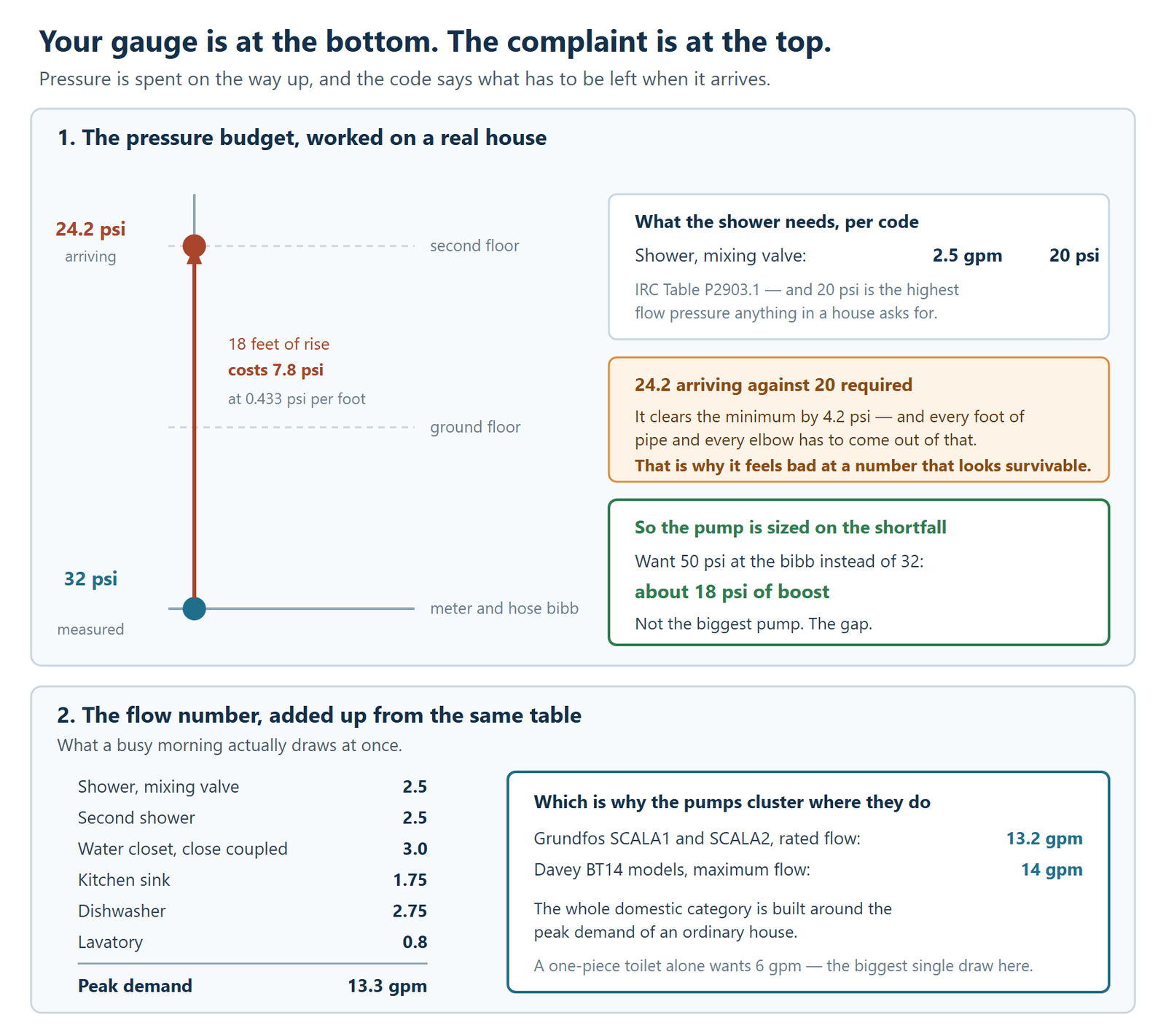
You measure at a hose bib because that is where the thread is. That is also the lowest point in the system, and the shower that prompted all this is usually the highest.
Water costs 0.433 psi for every foot it climbs. Nothing to do with the pump or the pipe — it is the weight of the column.
So an 18-foot climb to a second-floor shower takes 7.8 psi off whatever the gauge showed, before a single elbow gets involved.
Worked, on a real set of numbers
- Measured at the hose bib: 32 psi
- Second-floor shower, 18 feet up: −7.8 psi
- Arriving: 24.2 psi
Now compare that against what the shower actually requires. The residential code publishes it — 2.5 gpm at 20 psi for a shower with a mixing valve.
24.2 against 20 required. It passes, by 4.2 psi — and every foot of pipe, every elbow and every partly open valve between the meter and the head has to come out of that 4.2.
That is why a house can feel dreadful at a gauge reading that looks survivable. The margin is gone by the time the water arrives.
What the code says each fixture needs
This table is the part nobody quotes, and it makes the whole calculation possible. From IRC Table P2903.1, which the code introduces plainly: “The water service and water distribution systems shall be designed and sized for peak demand using values shown in Table P2903.1.”
| Fixture | Flow rate | Flow pressure |
|---|---|---|
| Bathtub, balanced-pressure or thermostatic valve | 4 gpm | 20 psi |
| Shower, mixing valve | 2.5 gpm | 20 psi |
| Water closet, tank, one-piece | 6 gpm | 20 psi |
| Water closet, tank, close coupled | 3 gpm | 20 psi |
| Sillcock or hose bibb | 5 gpm | 8 psi |
| Laundry tray | 4 gpm | 8 psi |
| Dishwasher | 2.75 gpm | 8 psi |
| Sink | 1.75 gpm | 8 psi |
| Lavatory | 0.8 gpm | 8 psi |
Two things worth noticing.
The highest flow pressure anything asks for is 20 psi. Not 40, not 60. If 20 psi is genuinely arriving at the fixture, the fixture will work. Comfort is a different standard from function, which is why most people aim well above the minimum — but it reframes what “low pressure” means.
And a one-piece toilet wants 6 gpm — more than a bathtub, double a close-coupled one, and the largest single draw in an ordinary house. If your pressure dies when someone flushes upstairs, that line in the table is the explanation.
The flow number
Add up what plausibly runs at the same time on a bad morning:
| Running at once | gpm |
|---|---|
| Shower, mixing valve | 2.5 |
| Second shower | 2.5 |
| Water closet, close coupled | 3.0 |
| Kitchen sink | 1.75 |
| Dishwasher | 2.75 |
| Lavatory | 0.8 |
| Peak demand | 13.3 gpm |
Now look at what the pumps are rated at. The Grundfos SCALA1 and SCALA2 are both rated 13.2 gpm. Davey’s BT14 models are 14 gpm.
The category is built around this number. Once you have seen the arithmetic, the product range stops looking arbitrary — and the differences between models become easy to read.
So: do you need one?
Yes, if your static reading is genuinely low and stays low, and the shortfall between what you measure and what you want is more than a few psi.
No, if a healthy static reading collapses the moment a tap opens. That is a restriction and a pump will not widen it — the pillar covers that test in full, and it is the single most common reason a booster pump disappoints the person who fitted it.
No, if you are on a well. Low pressure on a well is a different diagnosis entirely, with a pump, a tank and a switch already in the system.
The size, in one line
Boost needed = the pressure you want, minus the static pressure you measured.
Wanting 50 psi at the hose bib from a measured 32 gives you 18 psi. That is a modest pump. Buying 45 psi of boost because it was on the shelf pushes the house toward the 80 psi static limit the code imposes, and buys nothing you asked for.
What this calculation deliberately leaves out
Friction loss through the house piping. It is real, and on a long run of old half-inch pipe it can be the whole problem. It depends on pipe size, material, length and how many fittings are in the way, and there is no honest way to give you a number for it from here.
Treat it as the margin you are trying to restore rather than a figure to add. If your arithmetic says you should be fine and the shower says otherwise, friction is the missing term — and at that point the pipe is worth looking at before the pump is.
When this needs a pro
Any house where the calculation comes out marginal. A 4 psi margin on paper is not a design; it is a coin toss.
Anything with filtration, softening or irrigation. Each takes pressure that has to be added to the gap, and the manufacturer’s figure for that equipment is the place to start.
The installation itself, which is a connection to the public supply and is permit work in most places.
What you can do yourself: take the static reading, measure the height from the meter to the highest fixture, and add up the flow from the table above. Those three numbers are the whole specification, and handing them to whoever quotes the job saves an hour of guessing on both sides.
FAQ
How do I know if I need a booster pump?
Measure static pressure at a hose bib. If it is low and stays low when a tap opens, a booster is the right tool. If it is healthy at rest and collapses under flow, the problem is a restriction and a pump will not fix it.
How many psi should a booster pump add?
The difference between what you measure and what you want, which for most homes is 15 to 25 psi. The code requires a pressure-reducing valve above 80 psi static in the building, so more boost is not automatically better.
What GPM booster pump do I need for a house?
Add the flow rates of the fixtures that realistically run at once. For a typical family home with two bathrooms that comes to roughly 13 gpm, which is why so many domestic booster pumps are rated 13.2 to 14 gpm.
Does a second floor need more water pressure?
It needs the same pressure at the fixture, but it starts further behind. Water loses 0.433 psi for every foot it rises, so a shower 18 feet above the meter sees about 7.8 psi less than a gauge at ground level shows.
What is the minimum water pressure for a shower?
The residential code lists a shower with a mixing valve at 2.5 gpm and 20 psi flow pressure at the fixture, and 20 psi is the highest flow pressure any fixture in the table requires.
Why does my water pressure drop when someone flushes the toilet?
Look at the fixture’s flow rate rather than its size. A one-piece tank toilet is listed at 6 gpm, more than a bathtub and double a close-coupled toilet, so it takes a large bite out of the supply while it refills.