On this page
Last Updated on September 29, 2026 by Muhammad Toqeer
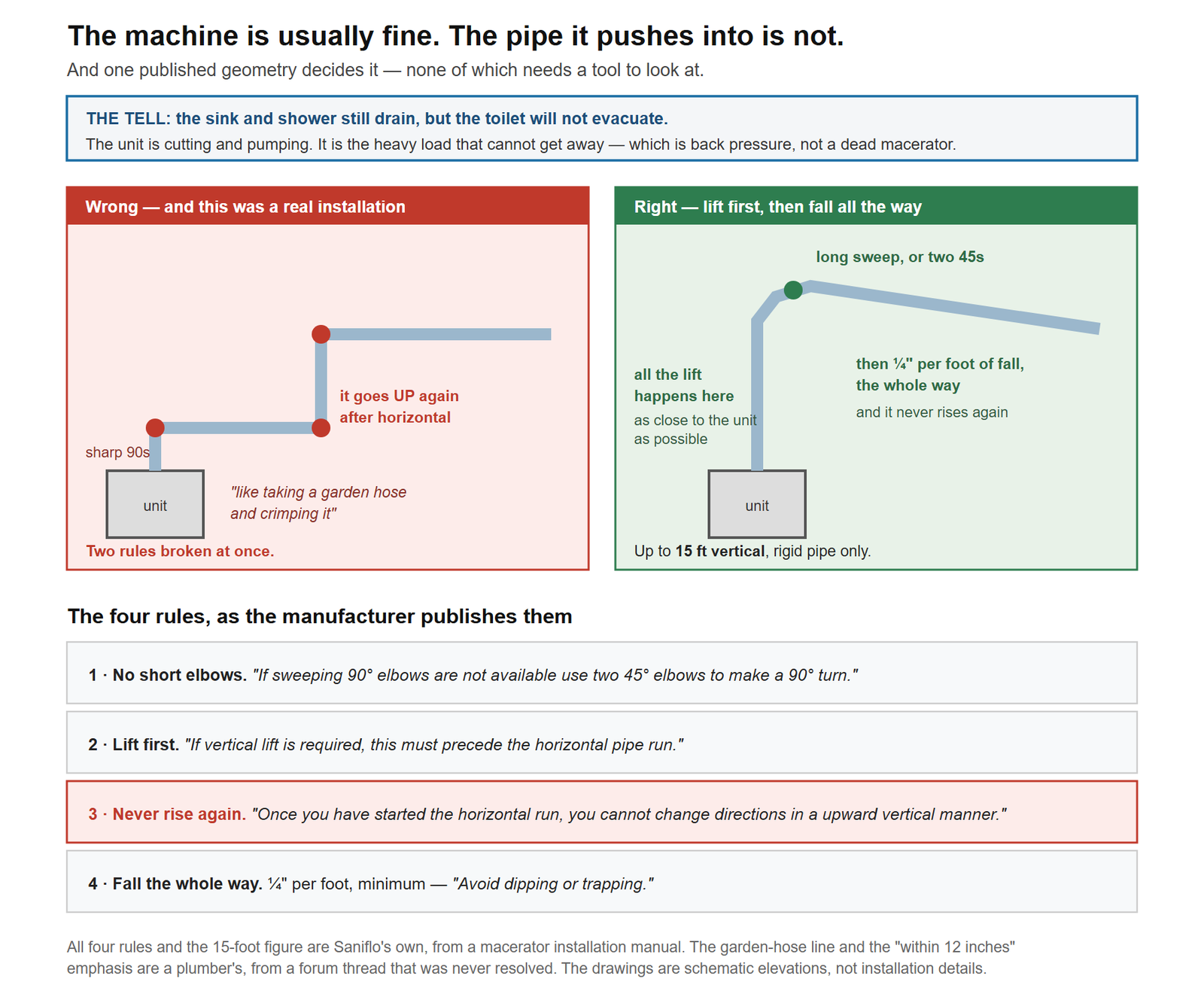
Does anything else still drain? If the sink and the shower go away normally and only the toilet will not clear, the macerator is cutting and pumping. It is the heavy load that cannot get out — and that points at the pipe rather than the machine.
Every guide on this sends you to the unit. The discharge geometry is published, specific, and almost never checked.
The tell is the asymmetry
A macerator cuts what it is given and pumps the result up into a small-diameter pipe. Grey water from a sink or shower will get through a run that solids cannot.
So the pattern matters:
- Nothing drains at all → the unit, or its power. Different problem.
- Sink and shower fine, toilet will not clear, pump running on and on → the unit is working. It cannot push the heavy load through the pipe it has been given.
That second pattern is the one this page is about, and it has a specific cause set.
The four rules, and you can check them by looking
None of these needs a tool. They are what the manufacturer publishes, and a discharge run that breaks them will fight the pump for the life of the installation.
1. No short elbows
“Where possible long sweeping bends should be used. Do not use short elbows. If sweeping 90° elbows are not available use two 45° elbows to make a 90° turn.”
Two 45s make the same turn with a fraction of the resistance. A sharp 90 in a small-bore discharge is a genuine restriction, not a detail.
2. All the lift happens first
“If vertical lift is required, this must precede the horizontal pipe run.”
And it should start as near the unit as possible — the manual says the vertical “should commence as near as possible to the discharge elbow.”
3. Once it goes horizontal, it never rises again
“Once you have started the horizontal run, you cannot change directions in a upward vertical manner.”
This is the one that catches people, usually when a run has to get over a joist or round an obstruction. The pump has already spent its lift; asking for more halfway along is asking for something the machine does not have.
4. Fall the whole way
A quarter of an inch per foot, minimum, for the entire horizontal run. The manual is specific about why: “Avoid dipping or trapping, which may cause the build up of residual solids and subsequent blockage.”
A sag in a horizontal run collects what passes through it, and then collects more.
And there is a ceiling on the whole thing. The manual gives the unit as pumping “up to 15 feet vertically, with a 1/4″ per foot gravity fall (minimum) constantly throughout the horizontal run” — so the lift and the fall are one specification, not two. A run that is close to 15 feet of lift has no margin left for a badly turned elbow.
Also worth a look: the pipe should be rigid — “copper, PVC or CPVC (Do not use flexible pipes)” — supported at least every three feet, and it must never discharge “directly into an open drain, fixture, manhole or rainwater drainpipe.” The manual calls that last one illegal and a health hazard.
What a failing installation actually looked like
A homeowner on Terry Love’s forum had exactly the asymmetric symptom on a unit installed months earlier:
“the toilet will not fully evacuate. The pump will seem to run almost constantly when using the toilet, and not pump out the #2 waste.”
The shower and sink were fine.
A plumber looked at the photographs and found two of the four rules broken:
“You have two MAJOR issues with the discharge line. first you put 90 elbow in your turns…your suppose to use two 45’s or long sweeps, second your not suppose to go vertical again after you go into a horizontal.”
And the description of what that does:
“each of those 90’s especially the one within 12 inches of the discharge elbow is like taking a garden hose and crimping it, you have created tremendous back pressure, it can’t fully evacuate.”
The emphasis on the elbow closest to the unit is that plumber’s, though it sits comfortably alongside the manufacturer’s instruction to get the lift started as near the discharge elbow as possible.
That thread was never resolved — the owner did not reply after the diagnosis. The reasoning is sound and the outcome is unknown.
A quicker thing to rule out first
The first reply in that thread was “maybe your vent is plugged or partially”, and it is worth a thought before anything else because it costs nothing.
A macerator’s discharge still has to breathe. If venting is restricted, the unit is pushing against a partial vacuum as well as everything else.
It is not a homeowner fix, but it is worth mentioning to whoever comes out, particularly if the problem appeared without anything being changed.
Can the unit itself be repaired?
Worth knowing before you pay for a diagnosis, because the answer is unusually clear-cut.
The manufacturer marks internal service “qualified personnel only”, and within that section tells even those technicians not to dismantle the motor — it is clipped together, the clips break, and it is filled with dielectric oil.
And this line settles the economics:
“the distributor purposely does not keep seals, bearings…”
Those parts are deliberately not stocked. A macerator is not a rebuildable machine in the way a pit pump sometimes is — which is a genuine difference from the grinder in a sewage pit, where the cutter and motor are serviced as a unit by a contractor.
When this needs a pro
Any repiping. Recognising that your discharge breaks the rules is a homeowner job. Correcting it is not — it is small-bore sanitary pipework carrying macerated sewage, and getting the fall wrong creates the next blockage.
Anything inside the unit, which the manufacturer restricts to qualified personnel outright.
The vent, which is part of the house’s drainage venting.
And a unit that runs constantly even with a correct discharge — the same “it runs and does not clear” shape shows up on pit pumps too, and the diagnosis is worth understanding before you replace anything.
What you can do yourself: note which fixtures still drain, follow the discharge pipe with your eyes from the unit to where it joins the waste, and count the sharp elbows and any point where it rises after running flat. That is the whole diagnosis, and it takes two minutes.
And if the job turns out to be a pit pump rather than a macerator, the flow figures worth comparing are the ones measured at the lift you actually have, not the headline number on the box.
FAQ
Why won’t my macerating toilet flush properly?
Check whether the sink and shower still drain. If they do, the unit is cutting and pumping and the problem is back pressure in the discharge pipe — most often sharp elbows, or a run that rises again after going horizontal.
Can a macerator pump run but not clear the toilet?
Yes, and it is the classic signature of a restricted discharge. Grey water gets through a run that macerated solids cannot, so the light fixtures keep working while the toilet does not.
Are 90 degree elbows allowed on a Saniflo discharge?
The manufacturer says to use long sweeping bends and not short elbows, and where a sweep is not available to use two 45 degree elbows to make the turn instead.
Can the discharge pipe go up after it has run horizontally?
No. The manual is explicit: once the horizontal run has started, it cannot change direction upward again. All the vertical lift has to happen first, as close to the unit as possible.
How much fall does the horizontal run need?
A quarter of an inch per foot, minimum, for its whole length, with no dips. A sag collects residual solids and turns into a blockage.
Is a macerator worth repairing?
Rarely in the way a pit pump is. The maker restricts internal work to qualified personnel and states that its distributor deliberately does not stock seals and bearings, which tells you how the manufacturer expects failures to be handled.