On this page
Last Updated on September 29, 2026 by Muhammad Toqeer
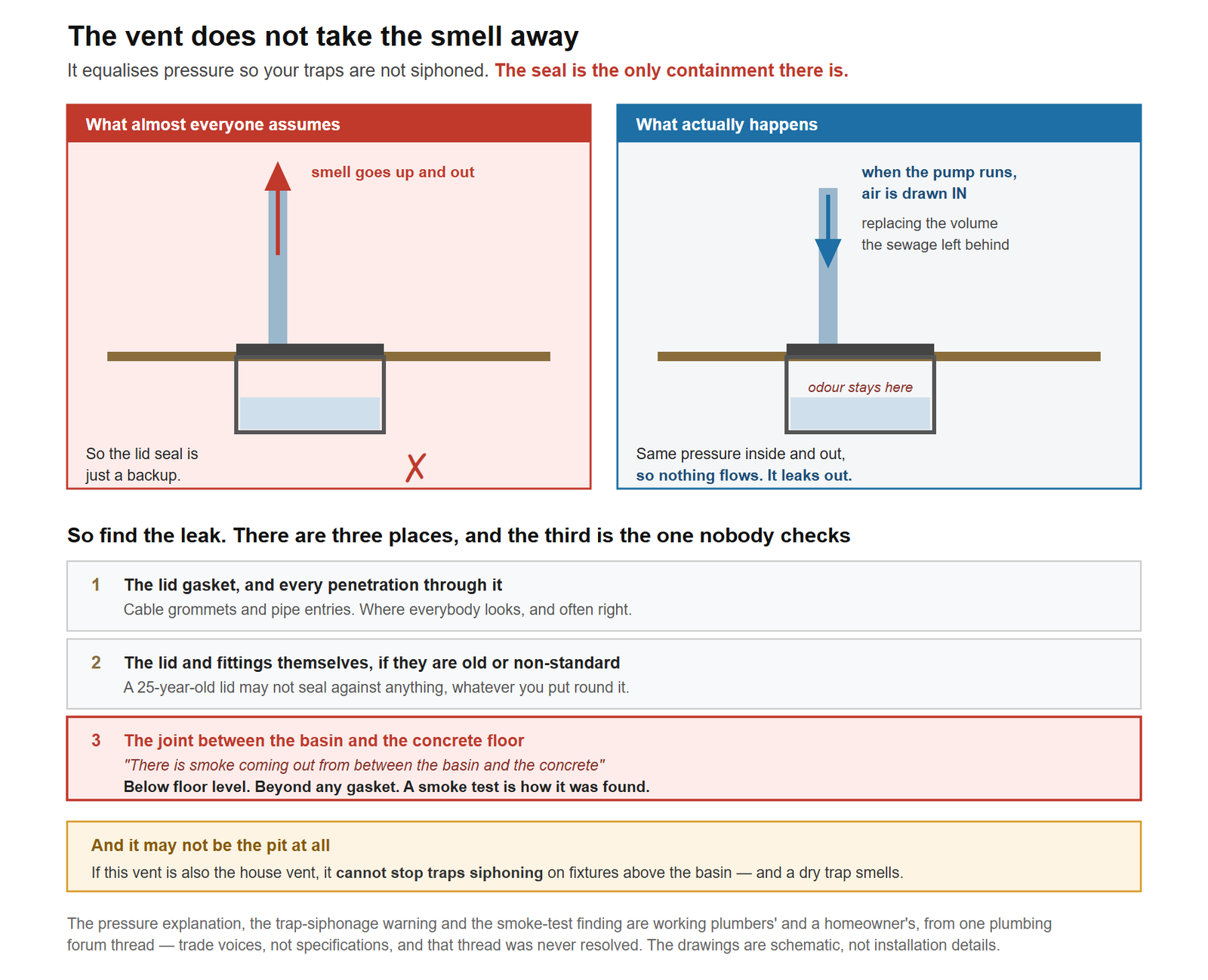
The vent is not taking the smell out of your pit, and it never was. Almost everyone assumes odour rises up the vent and leaves the building, which makes the lid seal feel like a backup.
It is not a backup. It is the only containment there is — and when you go looking for the leak, it is worth knowing that it is frequently not the lid at all.
Why the vent will not fix this
A master plumber on Terry Love’s forum explains it in two sentences, and the reasoning is simple enough to check against your own house:
“Your house and the outside atmosphere are probably at the same pressure so the odor is just going to stay in the pit and leak out. When the pump runs it is sucking air IN from the vent.”
Two things follow from that.
Nothing is pulling the odour up the pipe. A vent is not a flue and there is no fan on it. Air moves when there is a pressure difference, and between a basement and the garden there usually is not one.
And during a cycle the vent runs backwards. When the pump pushes sewage out of the basin, that volume has to be replaced by something, and the something is air coming down the vent.
The vent is there so your traps are not siphoned, which matters enormously — just not for the reason people think. It is not an extractor. If you can smell the pit, the seal has failed somewhere, and no amount of vent work will change that.
So find the leak — and there are three places
1. The lid gasket, and every penetration through it
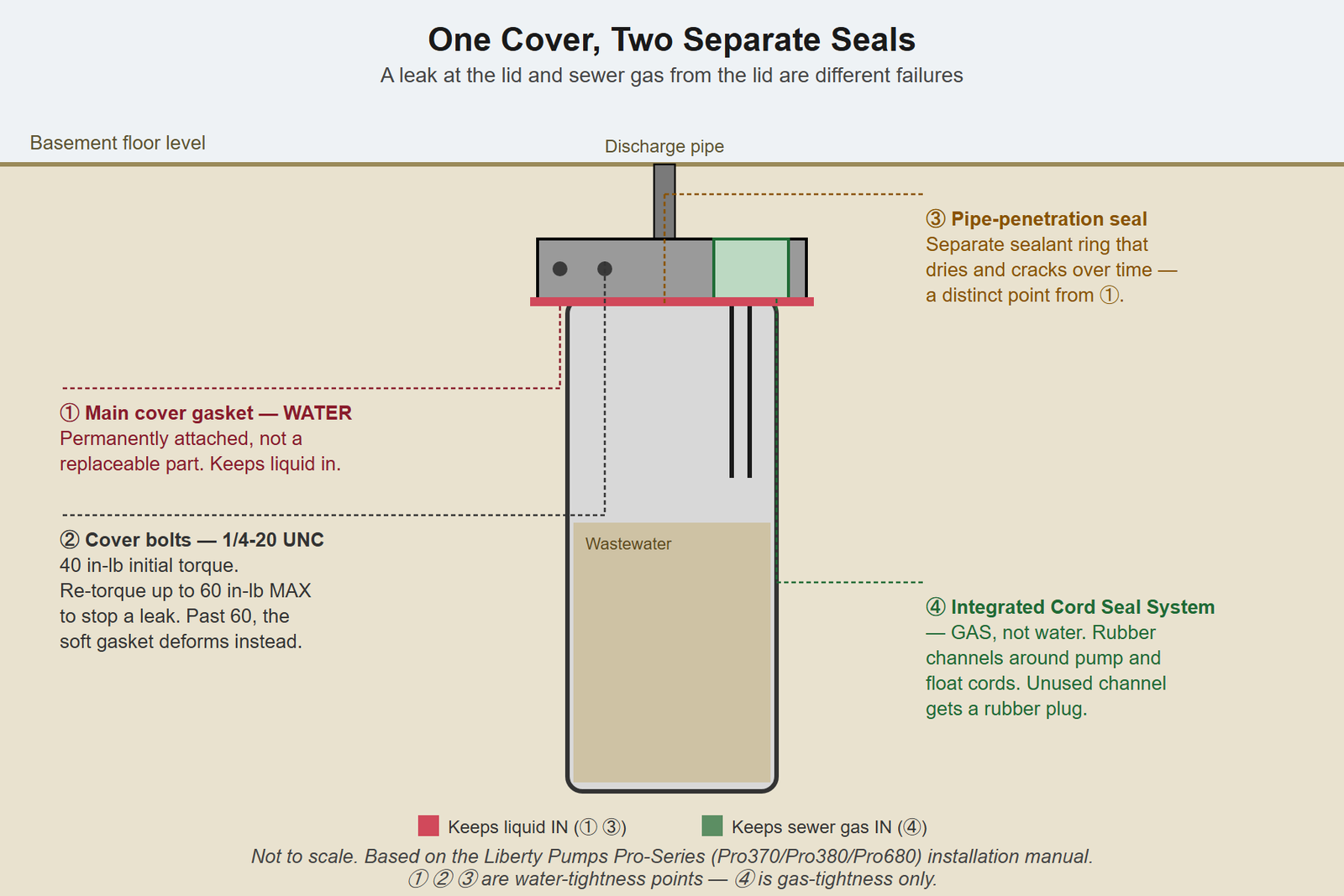
Where everybody looks, and often correctly. The penetrations are the usual culprits rather than the gasket itself — the cable entry for the pump, the alarm float’s cord if there is one, the discharge and the vent where they pass through.
A cable grommet that somebody cut out and never resealed is the classic.
2. The lid and the fittings themselves
If the lid is old, warped or not the one that came with the basin, there may be nothing for a seal to seal against. A plumber on the same thread, looking at a 25-year-old non-standard lid, put it plainly:
“Given the condition of he lid and fittings, the basin could be leaking also.”
Which is the thought that leads to the third place.
3. The joint between the basin and the floor
This is the one nobody checks, and in the case that prompted this article it was the answer. The homeowner ran a smoke test and found:
“There is smoke coming out from between the basin and the concrete – perhaps there is a crack just below the surface.”
Below floor level. Beyond any gasket, any sealant round the lid, any amount of tightening bolts. If the basin has cracked or the pour around it has separated, gas comes up through the slab joint and the lid is innocent.
And it is worth knowing that a crack works both ways — the same crack that lets smell out lets groundwater in, and that shows up as a pump that runs far too often. If you have both symptoms, you almost certainly have one cause.
The test that actually finds it
A smoke test is what located the leak in that case, and it is the only method on this page that does not rely on guessing.
It is how the trade finds odour leaks generally: smoke is introduced into the drainage system and you watch for where it emerges. It is not a DIY job on a sewage system — it needs the right equipment and someone who knows what they are looking at — but it is the thing to ask for by name rather than paying for a sequence of guesses.
What you can do before that call: go round the lid with your nose while the pump is idle, check every penetration, look for daylight or gaps at the slab joint, and note whether the smell is worst at floor level.
When the smell is not the pit at all
Worth ruling out, because it costs nothing.
If the ejector’s vent is also doing duty as the vent for the rest of the house, it cannot do both jobs. The same plumber:
“If this is the ONLY vent for the entire house, you have a much worse problem, because that vent CANNOT prevent trap siphonage on any sink that is higher than the basin.”
A siphoned trap is a dry trap, and a dry trap is an open pipe to the sewer. The smell then comes from a basin or a floor drain, not from the pit, and sealing the pit will achieve nothing.
The cheap check: pour a jug of water down every floor drain and every seldom-used fixture in the basement. If the smell goes, it was a trap.
(In the case above the owner reported no siphonage even though every fixture sat above the basin — so the warning is real but it was not their fault. Worth ruling out rather than assuming.)
What the pattern tells you
That case had two details worth borrowing, because they are diagnostic rather than decorative.
It was worse in cold weather. A house shut up for winter exchanges less air, so the same leak becomes far more noticeable.
And it was worst when waste had stood overnight and the pump ran in the morning. Standing sewage generates more gas, and the cycle then stirs it. If your smell has a timetable, note it — it tells whoever comes out when to be there.
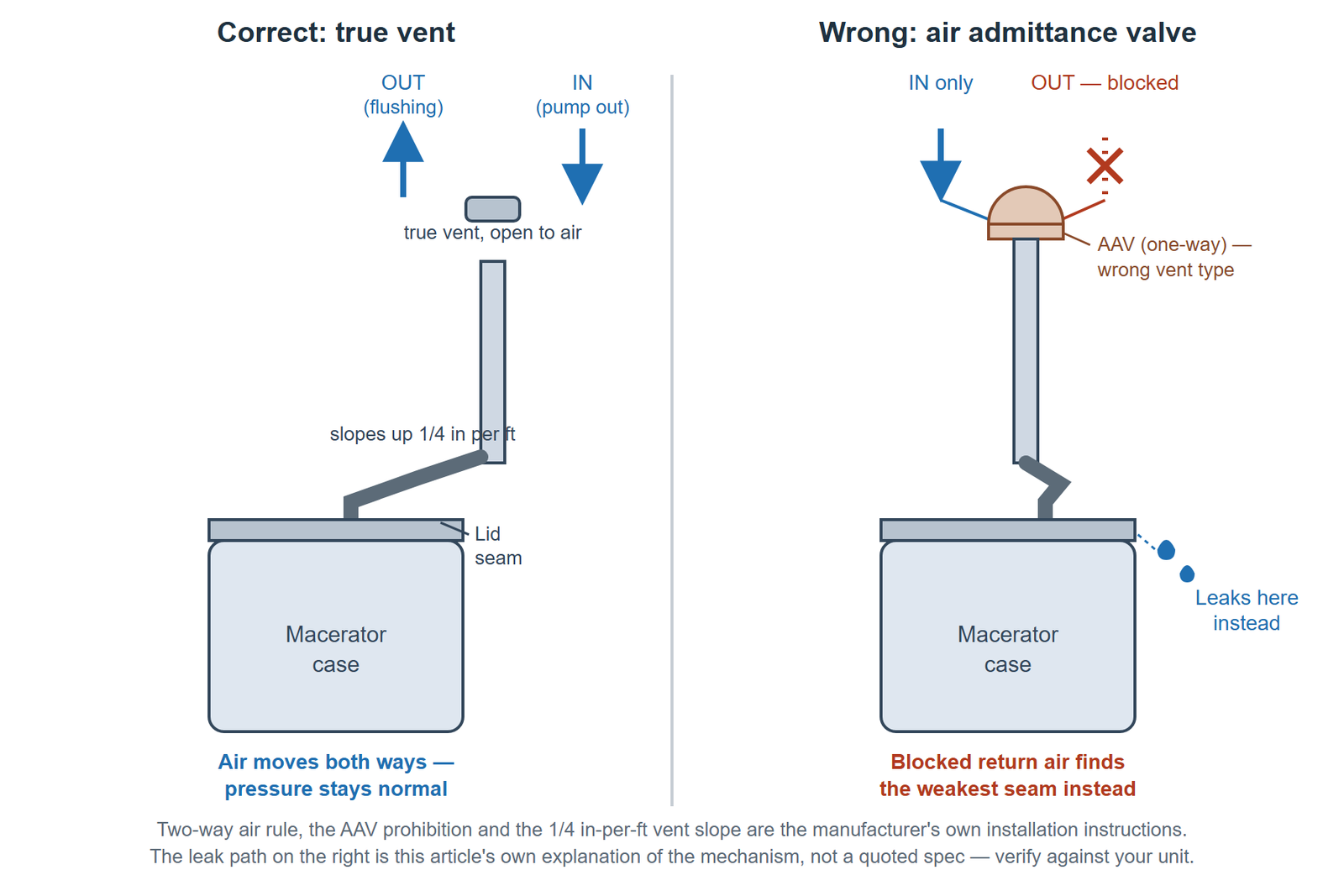
One more thing to check while you are looking up: the vent pipe should be pitched so that condensation and rainwater inside it drain back down into the basin rather than pooling. A vent holding water is not doing its job.
When this needs a pro
Smoke testing. The right way to find this, and not a homeowner procedure on a sewage system.
Anything involving opening the pit. The cover is a gas seal, and what is behind it is the thing you are already smelling.
A cracked basin, or a failed joint at the slab. That is a repair or a replacement and it is quoted, not improvised.
Any vent work. It is part of the house’s drainage venting and it is code-governed.
And if the pit is also not emptying properly, standing waste makes everything worse — start with whether the pump is running at all.
And if a replacement is on the cards, the depth at which a pump switches on runs from nine inches to sixteen across common models — which sets how much waste stands in the pit between runs.
FAQ
Why does my sewage ejector pit smell?
Because the seal has failed somewhere. The vent does not carry odour away — there is no pressure difference to move it, and during a pump cycle air is drawn into the pit rather than out. If you can smell it, gas is escaping.
Should the vent stop the smell?
No, and expecting it to sends people down the wrong path. The vent equalises pressure so traps elsewhere are not siphoned. Containment is the lid and the basin, not the vent.
Where do ejector pits usually leak?
Start with the lid gasket and every penetration through it — pump cable, alarm cord, discharge and vent. Then the lid and fittings themselves if they are old. Then the joint between the basin and the concrete, which is below floor level and is the one people miss.
Can a sewer smell in the basement come from something other than the pit?
Yes. A dry trap on a floor drain or an unused fixture is an open pipe to the sewer. Pour water down every drain in the basement before you spend anything on the pit.
Why is the smell worse in winter?
A house shut up for cold weather exchanges less air with outside, so an existing leak becomes much more noticeable. The leak has not changed; your ventilation has.
Is smoke testing something I can do myself?
Not on a sewage system. It needs the right equipment and someone who can read the result, but it is worth asking for by name — it finds the leak instead of guessing at it.