On this page
Last Updated on September 27, 2026 by Muhammad Toqeer
Your tank’s drawdown in gallons must be at least your pump’s flow in GPM. That single rule decides the purchase, and it is not a rule of thumb — it falls out of the motor manufacturer’s own minimum run time.
Size on bathrooms instead and you can easily buy a tank that wears the pump out. The 20-gallon tank widely recommended as “standard for a 2–3 bathroom house” fails the rule for any pump above 6.2 GPM.
Drawdown, not gallons
A “44-gallon” tank does not hold 44 gallons of usable water. Most of it is the air charge that pushes the water back out. The number that matters is drawdown — what you actually get between the pump shutting off and starting again.
Across every tank checked for this guide, from two brands in two different materials, drawdown lands at about 31% of the nominal rating. So a rough conversion in either direction: multiply your required drawdown by about 3.2 to get the tank size on the box.
The rule, and where it actually comes from
Plenty of pages tell you to aim for a one-minute pump run. Almost none say whose rule it is. It is Franklin Electric’s, in the manual for the motors themselves:
“Motors should run a minimum of one minute to dissipate heat build up from starting current.”
Run time per cycle is just drawdown ÷ pump flow. Set that to one minute and the requirement reduces to something you can check on a spec sheet in five seconds:
Drawdown (gallons) ≥ pump flow (GPM).
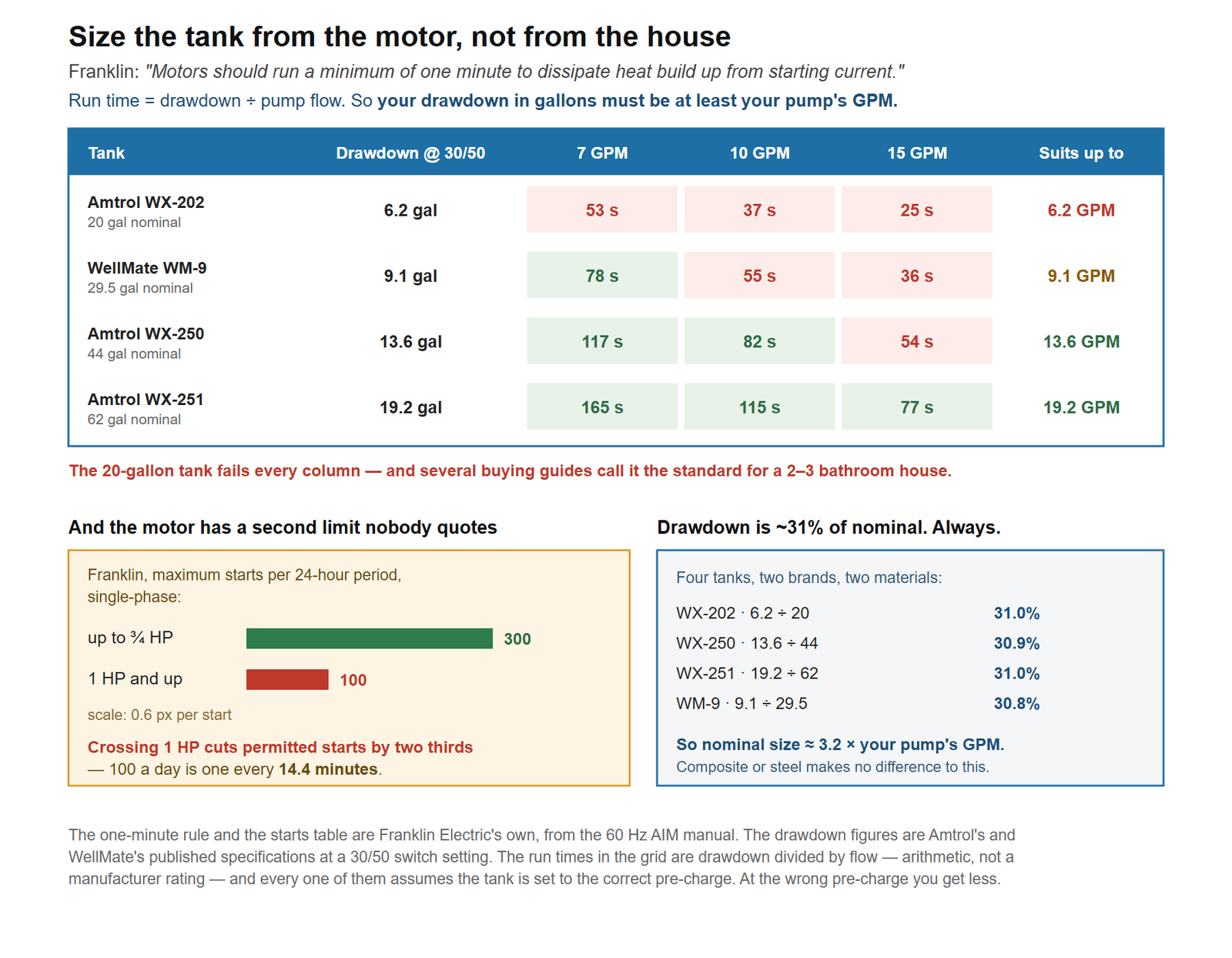
Look at the top row. The Amtrol WX-202 is a well-made tank and it is frequently named as the default for an average house. Its published drawdown at 30/50 is 6.2 gallons. On a 10 GPM pump that is a 37-second run — well under Franklin’s minimum, every single cycle, for the life of the system.
That is not a manufacturing fault. It is the wrong tank for that pump.
The second limit, which nobody quotes
Franklin also publishes a hard ceiling on how often a motor may start at all. From the same manual’s Table 3, for single-phase motors:
| Motor rating | Maximum starts per 24 hours |
|---|---|
| Up to ¾ HP | 300 |
| 1 HP and up | 100 |
Crossing one horsepower cuts your permitted starts by two thirds. At 100 starts a day you are allowed one every 14.4 minutes, averaged across the whole day.
Which limit binds in practice? Usually the run time, not the start count. A WX-250 gives 13.6 gallons per cycle, so 100 starts covers 1,360 gallons a day — comfortably above the EPA’s figure that “the average American family uses more than 300 gallons of water per day at home.”
So use the run-time rule to choose the tank, and treat the starts table as the reason not to go smaller. And if your pump is already cycling far more often than this, the tank is not the first thing to check — that is a fault, not a sizing problem.
The five, side by side
Drawdown figures are the manufacturers’ own, at a 30/50 switch setting. Change your switch and these change too — the same WX-250 gives 13.6 gallons at 30/50, 11.8 at 40/60 and 10.4 at 50/70.
| Tank | Nominal | Drawdown @ 30/50 | Max pressure | Body | Warranty |
|---|---|---|---|---|---|
| Amtrol WX-202 | 20 gal | 6.2 gal | 150 psi | Steel | 7 yr |
| WellMate WM-9 | 29.5 gal | 9.1 gal | 125 psi | Composite | 5 yr |
| Water Worker HT-32B | 32 gal | not published | 100 psi | Steel | 5 yr |
| Amtrol WX-250 | 44 gal | 13.6 gal | 150 psi | Steel | 7 yr |
| Amtrol WX-251 | 62 gal | 19.2 gal | 150 psi | Steel | 7 yr |
The picks
Amtrol WX-250 — 44 gallons, the default for most houses
Who it is for: the common case — a 10 GPM pump on a 30/50 switch.
13.6 gallons of drawdown gives an 82-second run at 10 GPM, comfortably clear of the one-minute floor with room for the pre-charge to drift a little before it becomes a problem. Amtrol’s build is the reference in this category: “Deep Drawn Steel and Multi-Dome Construction”, a “Heavy Duty Butyl diaphragm”, a 150 psi maximum working pressure, an antimicrobial liner, and an industry-leading 7-year limited warranty.
The honest drawback: at 15 GPM it drops to 54 seconds and fails the rule. It is the right tank for a 10 GPM pump, not a universal answer.
Amtrol WX-251 — 62 gallons, for higher flow or a quiet life
Who it is for: pumps at 15 GPM and above, or anyone who would rather over-size than re-do it.
19.2 gallons of drawdown passes every column in the grid. Same construction, same 150 psi, same 7-year warranty.
The honest drawback: it is physically large, and on a modest pump the extra capacity buys longer runs you did not need. Over-sizing a tank is harmless to the pump; it is your floor space that pays.
WellMate WM-9 — 29.5 gallons, and it cannot rust
Who it is for: corrosive or coastal water, damp pits, anywhere a steel tank’s outside is the thing that fails first.
A shell of “continuous fiberglass strands sealed with high-grade epoxy resin”, 16″ × 44″, 27 lb — light enough for one person — with 9.1 gallons of drawdown, 125 psi maximum, and a 5-year limited warranty with a one-year replacement labor allowance.
Two honest drawbacks. It clears the one-minute rule only up to 9.1 GPM. And WellMate’s material describes the composite as giving “greater drawdown than comparably sized steel tanks” — on the published figures it does not. Its drawdown is 30.8% of nominal against Amtrol’s 31.0%. Buy it for the corrosion resistance, which is real; not for extra water, which is not visible in the numbers.
Amtrol WX-202 — 20 gallons, and only for small systems
Who it is for: a genuinely low-flow system — a jet pump at 6 GPM or less, a cabin, a single-bathroom house.
Same Amtrol build quality, same 150 psi, same 7-year warranty.
The honest drawback, and it is the reason this guide exists: 6.2 gallons of drawdown. It is widely recommended as the standard tank for a 2–3 bathroom house, and for any pump above 6.2 GPM that recommendation puts the motor below its own manufacturer’s minimum run time on every cycle.
Water Worker HT-32B — 32 gallons, the value option
Who it is for: a straightforward replacement where the 100 psi ceiling is not a constraint.
Factory pre-charged to 38 psi — which is the standard shipping figure, and still needs setting to match your switch — with a heavy diaphragm and locking ring, a polypropylene liner, NSF Standard 61 listing, made in the USA, and a 5-year limited warranty.
The honest drawback: its 100 psi maximum working pressure is a third lower than Amtrol’s 150, and no drawdown figure was found at the manufacturer. Retail pages quote one; this guide will not reproduce a specification it could not verify at source. If you buy it, ask the seller for the drawdown at your switch setting before you commit.
Steel or composite?
Not a performance question — the drawdown ratios are effectively identical.
Steel gives you higher pressure ratings (150 psi against 125) and, at Amtrol, a longer warranty. Composite cannot corrode, does not dent, and weighs a fraction as much.
Buy composite when the environment is the enemy: coastal air, a damp pit, water that eats steel. Buy steel otherwise, and for high-pressure systems where 125 psi is too close to the ceiling.
One thing that makes every number above wrong
Every drawdown figure on this page assumes the tank is at the correct pre-charge — and tanks ship at a generic factory setting rather than yours.
Set it wrong and you do not get the drawdown you paid for. Set it far enough wrong and the tank behaves like a much smaller one, which puts you back under the one-minute rule with a brand-new tank in the basement.
The rule and the test both live here: what the pre-charge should be and how to check it. Do it before you decide the tank was a bad buy.
And size the tank and the pump together, not in sequence — your pump’s flow is the input to everything above, and your switch setting moves both the drawdown and the head the pump works against.
FAQ
What size pressure tank do I need for my well?
Match drawdown to your pump’s flow: a 10 GPM pump needs at least 10 gallons of drawdown, which is roughly a 44-gallon nominal tank. Drawdown runs about 31% of the nominal rating, so nominal size is roughly 3.2 times your pump’s GPM.
How much water does a 44-gallon pressure tank actually hold?
About 13.6 gallons of usable water at a 30/50 switch setting, on Amtrol’s published figure for the WX-250. The rest is the air charge. At 40/60 the same tank gives 11.8 gallons.
Why does my pressure tank size depend on the pump?
Because the tank sets how long the pump runs each time it starts. Franklin requires a minimum one-minute run to dissipate heat from starting current, and run time is drawdown divided by flow — so a bigger pump needs a bigger tank to stay above that floor.
Is a bigger pressure tank always better?
For the pump, essentially yes — longer runs and fewer starts. There is no performance penalty, only size, weight and cost. What a bigger tank will not do is raise your water pressure; that is the pressure switch’s job.
Does a pressure tank increase water pressure?
No. It stores water at whatever pressure your switch is set to. A larger tank means the pump runs less often, not that the water comes out harder.
How many times per day should a well pump start?
Franklin caps single-phase motors at 300 starts per 24 hours up to ¾ HP, and 100 from 1 HP upward — one every 14.4 minutes at that limit. Fewer is better; the tank is what buys you fewer.


