On this page
Last Updated on September 14, 2026 by Muhammad Toqeer
Most mini-splits do not need one. The indoor head hangs seven to eight feet up a wall and the installer bores the wall penetration at a deliberate downward angle so the condensate simply falls out of the building. A pump is for the cases where there is nothing downhill to fall to — an interior wall, or a head below every available drain.
Search this and you get a shop. Almost every result is a retailer or a manufacturer selling you a pump, and none of them starts by asking whether you need one.
Three things to check before you buy anything
All three are instructions from the manufacturer’s own install manual, and any one of them can be the real reason a head is dripping.
The drain can probably come out the other side. “The indoor unit has 2 drain connections on left and right sides. Either one can be utilized. One side will have a hose connected, while the other is plugged.” If the hose is plumbed toward the wrong end of the room, that is a swap, not a purchase.
No traps. The manual is emphatic: “DO NOT create a water trap (siphon)”, and “Make sure there are no kinks, dents or siphons in the drain hose, to ensure proper drainage.” This is the one that catches people. A contractor on GreenBuildingAdvisor described a run with “decent pitch all the way and 12 feet vertical drop” where a single trap still “will cause water to drip out the front of the head unit”. All the fall in the world does not help if the line holds water somewhere in the middle.
Do not drown the end of the hose. “DO NOT put the end of the drain hose in water or in a container that will collect water.”
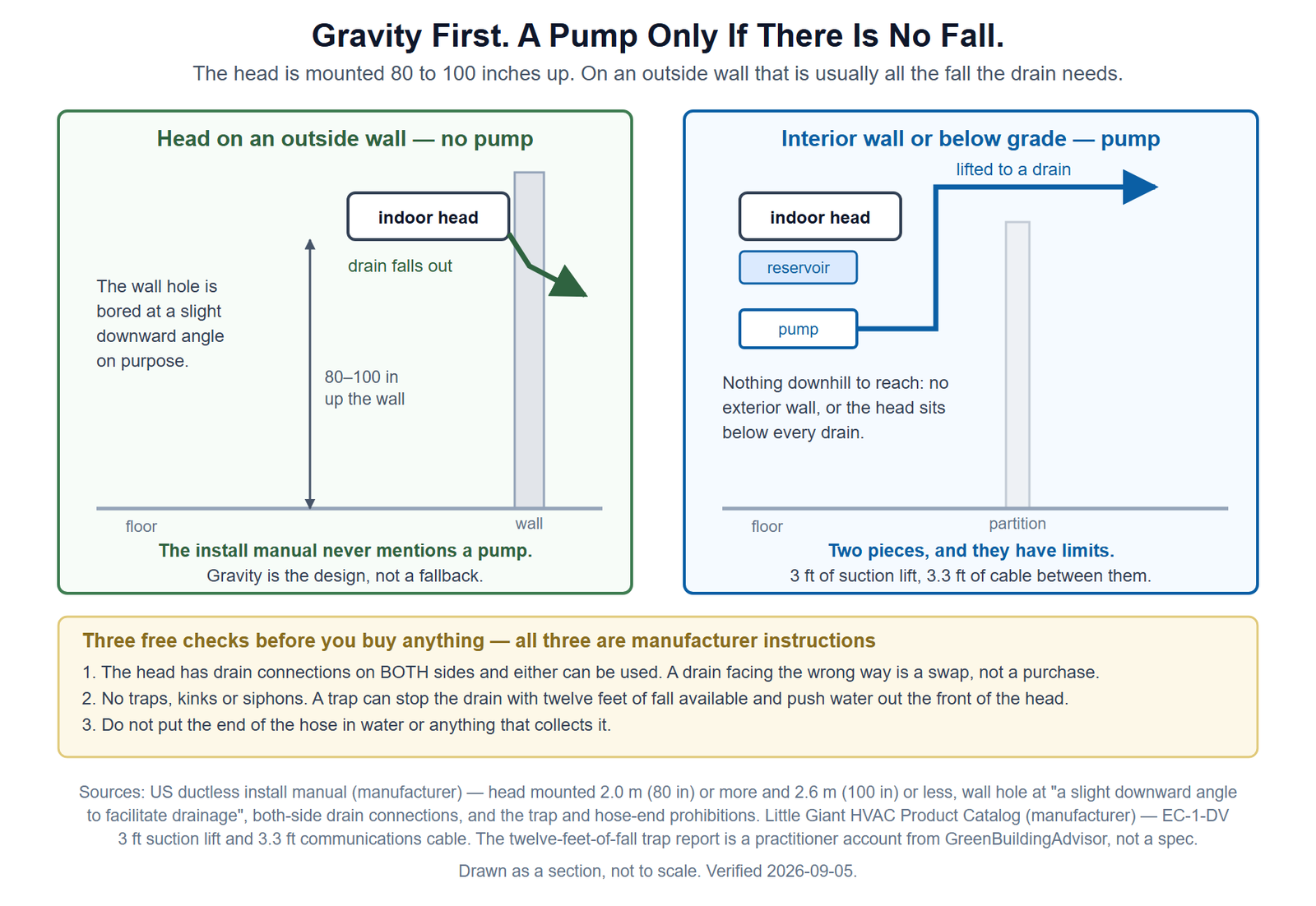
Practitioners put the slope figure at “a continuous downward slope of at least 1%”. No manufacturer document read for this article states a number — only that “slight downward angle” — so treat 1% as a working target rather than a published requirement.
When you genuinely need one
Three situations, and they are narrower than the search results suggest.
- An interior wall. There is no exterior wall to bore through and no route that stays downhill.
- Below grade. A head in a basement sitting lower than any drain in reach.
- A long horizontal run that loses its fall. Crossing a dropped ceiling or a closet, where holding a continuous downward pitch over the distance stops being realistic.
The trade view on everything else is worth hearing, because it is the opposite of what the SERP sells. One responder: “The best way would be to have it drain through gravity and skip the condensate pump, one less thing to fail.” Another, more bluntly: “try to avoid condensate pumps at all costs, more moving parts, some are noisy, more drain lines, more fuss, usually by the time you know the pump has failed its time to bring out the shop vac.”
That is not an argument against pumps. It is an argument for using one only where the geometry leaves no choice.
Your head may already lift — by about twenty inches
Some indoor units have a condensate lift built in, and it is easy to mistake that for “it has a pump”. Mitsubishi’s MLZ one-way ceiling cassette publishes a built-in lift of 19-11/16 inches on the MLZ-KP09NA.
Inches, not feet. Enough to clear a joist bay or get over a lip on the way to a drain, and nowhere near enough to move water out of a basement. Check your indoor unit’s spec sheet before assuming either way.
What a mini-split pump actually is
Here is the part the product listings skip. A mini-split pump is not a smaller tank pump. It is the opposite trade, and the numbers make that obvious.
| EC-1-DV (mini-split) | VCMA-20 (tank pump) | |
|---|---|---|
| Flow at 1 ft | 2.5 GPH | 80 GPH |
| Flow at 20 ft | 1.2 GPH | 0 — its shut-off |
| Shut-off head | 33 ft | 20 ft |
| Noise | 21 dB(A) | not published |
| Power | 18 W, 0.18 A | 93 W, 1.5 A |
| Discharge | 1/4″ I.D. | 3/8″ O.D. barbed |
| Supply | 110–240 V, 50/60 Hz | 115 V |
Thirty-two times less flow, and it out-lifts every tank pump in the range. That is what you are buying: a device that moves almost nothing, very high, almost silently, on a fifth of the power. The 21 dB(A) figure is the whole reason the category exists — this thing lives in a bedroom, three feet from a wall-mounted head, where a tank pump’s cycling would be intolerable.
Why 2.5 gallons an hour is plenty
The low flow reads like a weakness against a tank pump’s eighty. It is not, and the arithmetic settles it.
The EC-1-DV is rated for ductless heads “up to 34,000 Btu” — call it 2.8 tons. Published condensate rates run about 0.1 to 0.3 gallons per ton-hour depending on humidity, so that head produces somewhere near 0.3 to 0.85 gallons an hour. Even at twenty feet of lift, where the pump is down to 1.2 GPH, it is still ahead of the load at its worst.
If you want the general version of this — why the lift figure on any condensate pump box is the number that misleads — that is which condensate pump do I need.
Where the two pieces have to fit
A mini-split pump comes in two parts: a reservoir that sits inside or behind the head, and a pump-controller mounted away from it, usually in the line-set cover. Two published limits decide whether that works in your room.
- Suction lift: 3 feet. The reservoir cannot sit more than three feet below the pump.
- Communications cable: 3.3 feet between the two pieces.
The reservoir also “must be positioned flat and horizontal”, while the pump itself can go in any orientation. Measure the run from where the reservoir has to live to where you can actually hide the pump before ordering anything.
One genuine advantage worth knowing: the reservoir uses Hall effect level sensors rather than a mechanical float. There is no float arm to gum up — which, on a tank pump, is the single most common thing that goes wrong. A stuck float is not a failure mode this design has.
Wire the shutdown
The EC-1-DV carries a normally-closed relay rated 8 A resistive at 250 V. Its job is to cut the indoor unit if the water rises past where it should.
Connect it. A mini-split pump is often mounted above finished space, behind a wall or inside a line-set cover, where nothing about a failure is visible until a ceiling stains. The relay is what turns a pump failure into “the head stopped cooling” instead. What actually happens when nobody wires it is covered in what happens if a condensate pump fails.
One seasonal note that surprises people: on a heat pump, the indoor drain only matters in cooling. In heating the indoor coil is the condenser and makes no condensate — the outdoor unit is the one shedding water. A responder put it plainly: “In heating mode the outdoors are condensing.. the indoor drains can freeze all they want—they are not used.”
Which pump to buy
Once you have the specification, the mini-split buying guide compares five current models — and the spec that separates them is not maximum head, because four of the five publish exactly the same 33 feet.
When this needs a pro
Choosing between gravity and a pump is a judgement about your room, and you can make it with a tape measure. The parts that are not DIY:
Boring a new drain path through an exterior wall means going near a live line set. Getting that wrong is a refrigerant repair, not a plumbing one.
Wiring the shutdown relay puts you in the indoor unit’s control wiring. On a mini-split that is manufacturer-specific and unforgiving, and a relay wired wrong looks like protection while doing nothing.
And if the head is dripping out the front, get the drain looked at before anyone sells you a pump. That symptom is a blockage or a trap far more often than it is a missing pump, and a pump fitted to a still-trapped line does not fix it. The rest of the silo starts from the condensate pumps guide.
FAQ
Do mini-splits need a condensate pump?
Usually not. The indoor head is mounted 80 to 100 inches up the wall and the wall penetration is bored at a downward angle so condensate drains by gravity. The manufacturer’s install manual does not mention a pump at all. You need one when there is no downhill route — an interior wall, a below-grade head, or a long run that cannot hold its fall.
Why is my mini-split dripping water from the front?
Most often a trap, kink or sag in the drain hose rather than a lack of pump. The manual specifically prohibits creating a siphon, and one contractor reported water coming out of the front of a head that had twelve feet of vertical drop available — the trap was the problem, not the fall.
How much water does a mini-split condensate pump need to move?
Very little. A 34,000 BTU head is about 2.8 tons, and published rates put that at roughly 0.3 to 0.85 gallons an hour. A mini-split pump rated 2.5 GPH at one foot of lift is comfortably ahead of that even at twenty feet, where it still moves 1.2 GPH.
Can I use a regular condensate pump on a mini-split?
Physically often yes, sensibly usually no. A tank pump is bulkier, moves far more water than a single head produces, and has no published noise figure — mini-split pumps are specified at 21 dB(A) because they sit in living space. The tank pump also needs somewhere to sit, which is exactly what a wall-mounted head does not offer.
How high can a mini-split condensate pump lift water?
Higher than a tank pump. The EC-1-DV shuts off at 33 feet against a common tank pump’s 20, and still moves 1.2 gallons an hour at 20 feet. As with any pump, the shut-off figure is where flow reaches zero, not a working height.


