On this page
Last Updated on September 14, 2026 by Muhammad Toqeer
Stop comparing these pumps on gallons per hour and maximum lift. Every pump sold for a furnace moves more than twenty times the water a house produces, and the lift number on the box is the height at which flow stops, not a place to work. Once you have measured your rise, six other specs decide it — and one of them has quietly changed which pump you should buy.
The pump everyone recommends is no longer made
The Little Giant VCMX-20 is the default answer across most of the internet for this job. It is also absent from Little Giant’s current product line.
Their condensate listing today runs VCMA-15, VCMA-20, VCMA-20-PRO, the VCL high-capacity series, the VCCA low-profile pair, the HT-VCL high-temperature pumps, a neutralizing model and the mini-split range. No VCMX.
Its replacement is the VCMA-20-PRO, and the published curve is identical: 84 GPH at one foot, 60 at ten, 42 at fifteen, 10 at twenty, shut-off at 21 feet. So the advice was sound and the product name went stale. If you have been sent to buy a VCMX, buy the PRO instead — that is genuinely the same pump’s performance in a current box.
This site had the same error. Which condensate pump do I need recommended the VCMX for fifteen feet of lift; it has been corrected to the PRO.
The six things that actually differ
Flow and lift are settled the moment you have a measurement. What is left is this.
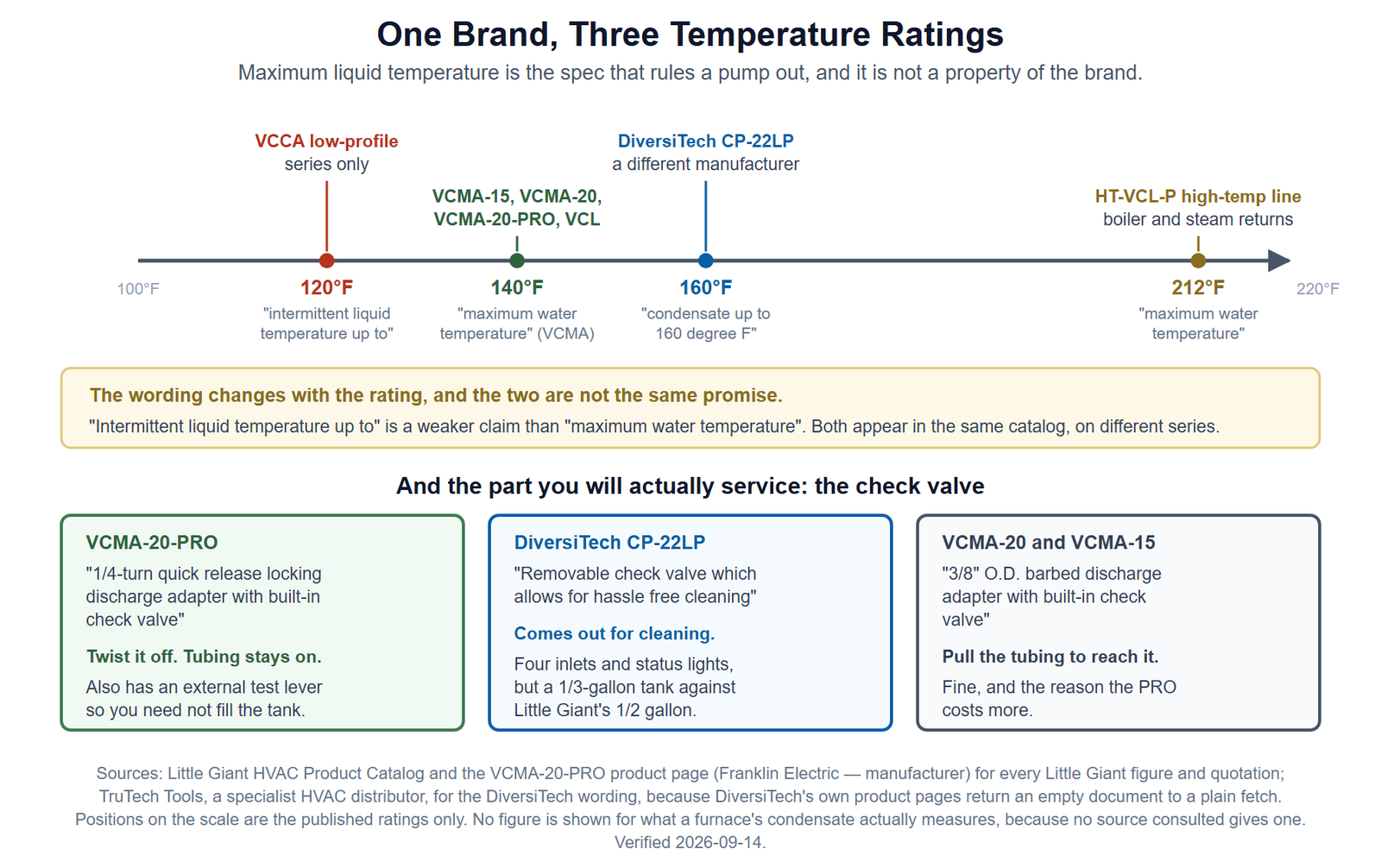
1. Maximum liquid temperature, which is not a property of the brand. Within Little Giant alone it runs 120 °F on the low-profile VCCA line, 140 °F on the VCMA and VCL series, and 212 °F only on the high-temperature HT-VCL pumps. The catalog even changes its phrasing between series — “intermittent liquid temperature up to” on some, “maximum water temperature” on others. Those are not the same promise, and no retail listing reproduces either.
2. Whether you can reach the check valve. It is the part that gums up and the part you will service. The PRO uses a “1/4-turn quick release locking discharge adapter with built-in check valve” — it twists off with the tubing still attached. DiversiTech advertises a “removable check valve which allows for hassle free cleaning.” The plain VCMA-20’s check valve lives inside a barbed adapter, so reaching it means pulling tubing off a barb. Nothing wrong with that; it is just a job rather than a twist. This is what a pump that runs but moves no water usually needs.
3. Whether the safety switch is in the box. This is a suffix, not an option. UL has no switch. ULS has the high-water switch that shuts your equipment down before the tank overflows. They are different item numbers at different prices, and the cheaper one is the one without the part that stops water on the floor. Buy the ULS.
4. Tank volume, because it sets how often the pump runs. Little Giant’s VCMA tanks hold half a gallon. The DiversiTech CP-22LP holds a third. Hartell’s KT-15 holds three quarts. Same condensate, different number of starts per day — and starts are what wear a small pump out.
5. Plenum listing. If the pump goes inside an air handler or a ceiling return, it needs to be built of plastics tested to UL Standard 2043. Standard pumps are not, and the ones that are say so explicitly.
6. Warranty. Two years on the Little Giant PRO. One year on the Hartell KT-15. On a part that costs less than a service call, that difference is more about what the manufacturer expects than about what you will claim.
The shortlist
Six pumps, all confirmed as current product lines. Specifications are the manufacturers’ own.
Little Giant VCMA-20ULS-PRO — the one to buy if you buy one
Item 554630. 1/30 hp, 115 V, 1.5 A. 84 / 75 / 60 / 42 / 10 GPH at 1 / 5 / 10 / 15 / 20 feet, shut-off 21 feet. Maximum liquid temperature 140 °F. Three 1-1/8″ inlets, two capped. Safety switch included.
It wins on the two things that matter after sizing: it holds 42 GPH at fifteen feet where the plain VCMA-20 has stopped being quoted, and its discharge adapter is the quarter-turn type, so servicing the check valve does not involve wrestling tubing off a barb. It also has an external test lever, which means you can run it without filling the tank. Little Giant calls it the slimmest footprint they make.
The honest drawback: it costs more than the plain VCMA-20, and for a rise under ten feet you are paying for headroom you will never reach.
Little Giant VCMA-20ULS — the sensible default
Item 554425. 1/30 hp, 115 V. 80 / 70 / 48 / 0 GPH at 1 / 5 / 10 / 20 feet, shut-off 20 feet / 8.7 PSI. Maximum water temperature 140 °F. Half-gallon tank, three inlets, safety switch included.
This is the pump under half the furnaces in the country and there is nothing wrong with it. At ten feet it still moves 48 gallons an hour, roughly fifty times what a 100,000 BTU furnace produces.
The honest drawback: the catalog stops quoting a figure between ten and twenty feet, which tells you where its useful range ends. If your rise is twelve feet or more, this is not the pump — and its check valve needs the tubing off.
Little Giant VCMA-15ULS — only for short rises
Item 554405. 1/50 hp, 115 V, 1.0 A, 60 W. 65 / 50 / 25 / 0 GPH at 1 / 5 / 10 / 20 feet, shut-off 15 feet / 6.5 PSI. Same half-gallon tank, same three inlets, same 140 °F.
If the pump sits beside the furnace and the line climbs five or six feet to a nearby drain, this is enough pump and it draws a third less power than the 20.
The honest drawback: a 15-foot shut-off means it is realistically a sub-ten-foot pump, and there is no margin if the discharge line ever gets rerouted higher. Most people should spend the small difference on the 20.
DiversiTech CP-22LP — the one for tight spaces and warmer condensate
22 feet of lift, 4-3/8 inches tall, third-gallon reservoir. Rated for “condensate up to 160 degree F” — above every standard Little Giant HVAC pump. Removable check valve, four inlet holes, built-in overflow switch with SPDT isolated contacts and two terminals for equipment shutdown. Red, yellow and green status lights for alarm, running and power. Rubber feet and an elastomeric motor mount for vibration.
The height is the real argument. If the pump has to slide under a cabinet or into a cramped return, four and three-eighths inches solves a problem no amount of lift rating will.
The honest drawback: the third-gallon tank is a third smaller than Little Giant’s, so it cycles more often for the same condensate.
Little Giant VCCA-20-P — only if it goes in a plenum
The low-profile plenum model, “constructed with plastics that have been tested by Underwriter’s Laboratories to UL Standard 2043.” The VCCA series exists because its “low tank height allows these condensate pumps to be used where other condensate pumps will not fit.”
If the pump is going inside an air handler or above a ceiling that serves as a return, this listing is not a nice-to-have.
The honest drawback: the VCCA line is the 120 °F one. You are buying a fire-test listing and giving up twenty degrees of temperature headroom to get it — and if the pump is not going in a plenum, you are paying for a certification that does nothing for you.
Hartell KT-15X-1ULT — the simple one
15 feet of lift, three-quart reservoir, 3/8″ ID barbed outlet, 115 V, 3,000 rpm motor with a stainless steel shaft, full-flow check valve, six-foot cord. Sold with the safety switch and 20 feet of tubing. Described by the manufacturer as suitable for gas condensing furnace applications.
The honest drawback: two of them. Its warranty is one year against Little Giant’s two, and I could not find a published maximum liquid temperature for it in any source — which on the spec that rules pumps out is a gap worth knowing about before you buy.
Side by side
| Pump | Shut-off | GPH at 10 ft | Max liquid temp | Tank | Check valve | Switch |
|---|---|---|---|---|---|---|
| VCMA-20ULS-PRO | 21 ft | 60 | 140 °F | 1/2 gal | 1/4-turn release | Included (ULS) |
| VCMA-20ULS | 20 ft | 48 | 140 °F | 1/2 gal | In barbed adapter | Included (ULS) |
| VCMA-15ULS | 15 ft | 25 | 140 °F | 1/2 gal | In barbed adapter | Included (ULS) |
| DiversiTech CP-22LP | 22 ft | not published* | 160 °F | 1/3 gal | Removable | Built in |
| VCCA-20-P | 20 ft | — | 120 °F | low profile | In adapter | Varies by item |
| Hartell KT-15X | 15 ft | not published* | not published | 3 qt | Full-flow, included | Included on ULT |
\ Figures circulate for both, but neither appears in a manufacturer document I could reach, so they are left blank rather than repeated. Little Giant’s own note on its tables is worth carrying: “GPH is through check valve.”*
Little Giant vs DiversiTech vs Hartell
Worth folding in here rather than arguing separately, because the brands differ in a way the model tables hide.
Little Giant is the depth option. The range is genuinely segmented — lift, tank height, temperature, plenum listing and neutralizing are all separate product lines, which is why the temperature ladder above has three Little Giant rungs on it. That segmentation is the reason to buy from them and also the reason to read the series name rather than the brand: a VCCA and an HT-VCL share a badge and ninety degrees of difference.
DiversiTech competes on the installation rather than the curve. The CP-22LP’s arguments are all physical — the height, four inlets instead of three, status lights you can read from across a basement, isolated switch contacts for a building automation system, and a check valve designed to come out. It is a contractor’s pump.
Hartell is the plain one, and that is a legitimate thing to want. Three quarts, a full-flow check valve, a motor with a stainless shaft, done. The trade-off is documentation: one year of warranty and no published temperature figure I could find, against a competitor that publishes a number for every series.
For what it is worth, the reason the temperature spec keeps coming up is that it is the only one on this page that can make a pump wrong rather than merely undersized. Everything else is a matter of degree. For the background on why, the condensate pumps guide covers what these pumps are actually doing.
Three shortcuts
Rise under ten feet, ordinary furnace: VCMA-20ULS. Do not overthink it.
Rise of twelve feet or more: VCMA-20ULS-PRO. It is the only one on this list still quoting a real number at fifteen feet.
No room: CP-22LP if the problem is height, VCCA-20-P if the problem is that it has to live inside the air handler.
And whatever you buy, buy the version with the S. A pump without a safety switch saves a few dollars and removes the only thing that stops a blocked discharge becoming a ceiling repair. If the float in your current one is the problem rather than the pump, that is a float you can often free rather than a purchase.
When this needs a pro
Wiring the safety switch is the part people skip. The switch has to interrupt the equipment’s control circuit to do anything at all — Little Giant ships theirs with “dual function NO and NC operation (set to NO from factory for equipment shutdown connection)”, and getting that wrong means a switch that clicks and changes nothing. If you are not confident which terminals on the furnace board take it, that is a service call rather than a guess.
Two other lines worth respecting. Anything going into a plenum or a return-air ceiling needs the UL 2043 listing and, usually, an inspection. And if your equipment is a steam or hydronic boiler rather than a furnace or air handler, none of the pumps above is the right product — that is the high-temperature line, and the gap between 140 °F and 212 °F is the whole reason it exists.
FAQ
What is the best condensate pump for a furnace?
For most installations, the Little Giant VCMA-20ULS — a 20-foot shut-off, 48 GPH at ten feet, 140 °F rating and the safety switch included. If your discharge line climbs twelve feet or more, the VCMA-20ULS-PRO is the better choice because it still delivers 42 GPH at fifteen feet where the standard model’s published figures stop.
Is the Little Giant VCMX-20 still available?
No. It has been replaced by the VCMA-20-PRO Series, which publishes an identical performance curve — 84 GPH at one foot and a 21-foot shut-off. Many guides and retail listings still recommend the VCMX, so check the model number before ordering.
What does the S in VCMA-20ULS mean?
It is the high-water safety switch. A UL model has no switch; a ULS model has a float-activated switch that shuts the HVAC equipment down when the tank fills, before the water reaches the floor. It is a different item number rather than an accessory, and it is worth the difference.
How hot can condensate be for a standard pump?
It depends on the series, not the brand. Little Giant’s VCMA pumps are rated to 140 °F and its low-profile VCCA line to 120 °F, while the DiversiTech CP-22LP is rated to 160 °F. Only the high-temperature HT-VCL line handles 212 °F, which is what a steam or hydronic return needs.
Do I need a bigger pump for a bigger furnace?
Almost certainly not. A 100,000 BTU condensing furnace produces roughly a gallon of condensate an hour, and the smallest pump here moves 25 gallons an hour at ten feet of lift. Capacity is not the constraint in a house — the height the water has to climb is.


