On this page
Last Updated on October 25, 2026 by Muhammad Toqeer
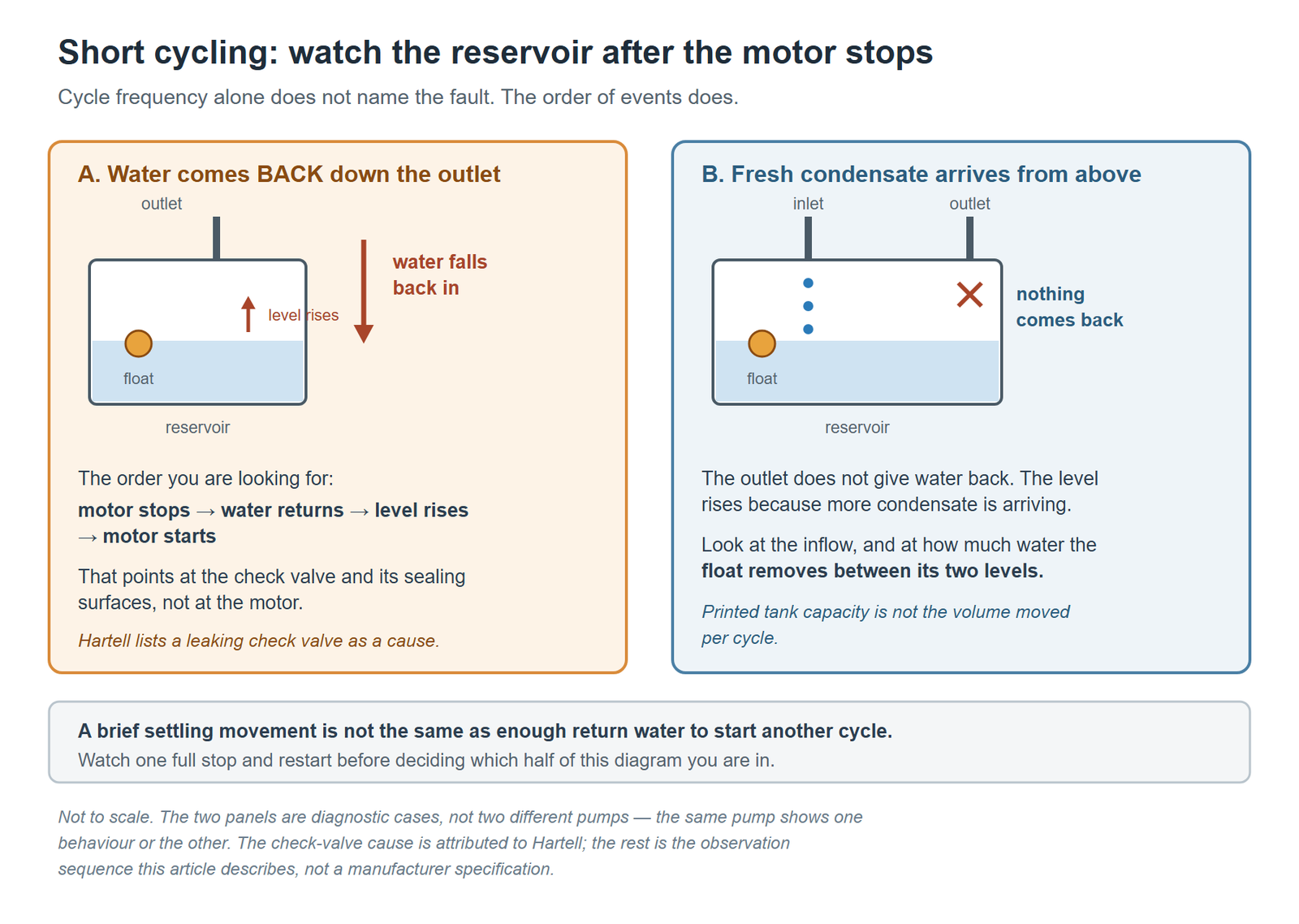
A condensate pump that starts again almost immediately may be pumping the same water repeatedly. Watch what happens just after it stops: if water returns through the discharge and the reservoir rises, investigate the check valve. If fresh condensate enters from above, investigate inflow and usable tank volume instead. Cycle frequency alone does not identify the fault.
Is the motor cycling, or is the air conditioner cycling?
They are different observations. The pump may start and stop normally while an overflow safety interrupts the air conditioner. Conversely, the pump may restart repeatedly while cooling continues.
One-minute check: from a dry position, observe which device stops. Note the pump’s sound, reservoir level and visible discharge. Do not open a cover or touch the pump while it is energized. If water is approaching overflow, stop the connected equipment and isolate the pump before inspection.
Does water return when the pump stops?
Watch the outlet tube and water level immediately after a completed cycle. A brief settling movement is not the same as enough return water to trigger another cycle.
One-minute check: where the level and tubing are safely visible, record a short video of one stop and restart. The useful evidence is the order: motor stops, water returns, level rises, motor starts. [Hartell identifies a leaking check valve as a cause of this repeat cycle][1].
If that sequence occurs, ask for inspection of the check valve and its sealing surfaces. Cleaning may be sufficient if the service procedure permits it. A worn or damaged valve needs the correct replacement.
Do not add another generic valve farther up the tubing as the first experiment. Extra components change the water path and may leave returning water below the new valve. Correct the specified outlet assembly and route instead.
Why can the replacement valve still be wrong?
Because matching the tube size does not necessarily match the pump connection or internal valve design.
As one example, the current Little Giant VCMA-20ULS family parts listing separates check-valve compatibility at production date codes 25J and 25K.[2] Identify the installed pump and date code before ordering, rather than assuming every replacement sold under the family name fits.
One-minute check: photograph the nameplate and any accessible date code with power isolated. Compare them with the manufacturer’s current parts table. Do not disassemble a fitting merely to obtain a photograph if the discharge can drain back unexpectedly.
The right repair record includes the pump identification, the valve ordered and whether the same return-flow symptom remained afterward.
What if the reservoir refills from the inlet instead?
Then the pump may be responding to real incoming water. Several connected appliances, a changed operating pattern or reduced working space in a dirty reservoir can make starts more frequent.
One-minute check: note which inlet receives water. Do not plug, pinch or disconnect an appliance drain to perform the observation. Compare the pattern with normal operation and report any new continuous inflow.
The printed tank capacity is not the amount removed between each start and stop. The float’s two switching levels determine the working volume. The reservoir can also retain water by design, so trying to make every cycle empty it completely can create a new control problem.
For an illustrative calculation, a pump receiving one cup while removing only one cup per cycle will cycle more often than one removing two cups per cycle at the same inflow. Those are hypothetical volumes, not specifications for your pump. The point is to inspect the actual operating range rather than infer it from the tank’s outside dimensions.
Can dirt or poor positioning change the cycle?
Yes. Debris in the float’s travel path can interfere with switching, and an unsuitable mounting position can change how the mechanism sits.
One-minute check: after safe isolation, use only the routine access described in the manual to inspect for interference. Confirm the pump sits securely and level. Do not bend a float arm to produce a longer run.
Clean and reassemble according to the installed model’s instructions, then perform its controlled operation test with all covers back in place. Observe several cycles. One successful start does not establish that a recurring obstruction is gone.
If the discharge route has recently changed, review condensate drain slope and permitted discharge routing. A pressure discharge and a gravity inlet are different parts of the system.
When should the pump be replaced?
Replace it when the control or pumping assembly is confirmed defective and cannot be serviced, or when verified inflow exceeds the appropriate operating capacity. Repeated cycling alone is insufficient: a replacement connected to the same returning water can repeat the problem immediately.
Where the control or pumping assembly is confirmed defective, compare AC condensate pumps by operating flow and overflow protection together.
When this needs a pro
Get service for inaccessible discharge piping, a hardwired unit, repeated electrical trips or a shutdown circuit that does not protect the connected equipment. Give the technician the stop-and-restart video and the pump identification. They show whether the next test should start at the valve, the inflow or the control.
[1]: https://www.hartell.com/en-us/news/residential-ac-unit-condensate-pump-troubleshooting/ [2]: https://www.littlegiant.com/products/condensate-removal-pumps/condensate-pumps/vcma–vcmx-series/vcma-20/