On this page
Last Updated on November 1, 2026 by Muhammad Toqeer
Choose an AC condensate pump by the water it can move through your actual drain route, the space available below the coil drain and the overflow protection your installation needs. A tank pump beside a central air handler and a remote mini-split pump solve different layout problems. Maximum lift alone does not choose between them.
The five candidates below are compared from manufacturer documentation, not hands-on testing. The recommendations are conditional on fit and verified operating capacity.
Which symptom brought you here?
Most people reach this page mid-problem, with the air conditioning off. Find your row — it will tell you whether a new pump is actually the answer.
| What happened | What it usually means | Is a new pump the fix? |
|---|---|---|
| The air conditioning shut itself off | The safety switch opened on a full tank | Not yet. The switch did its job — find out why it filled |
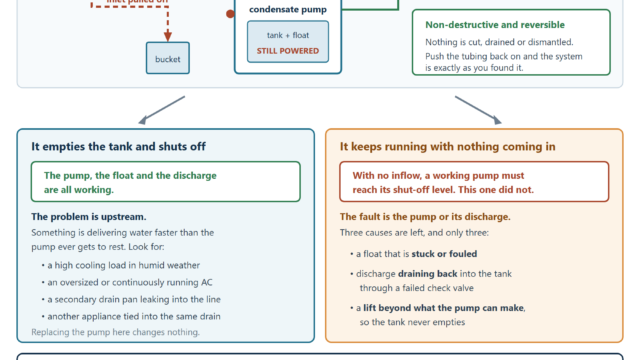
| It buzzes but moves nothing | Power is reaching the motor and it cannot turn | Often not. Three routes to rule out first |
| It starts and stops every few seconds | Water returning down the outlet, or a float set too tight | Find out which one — only one needs a pump |
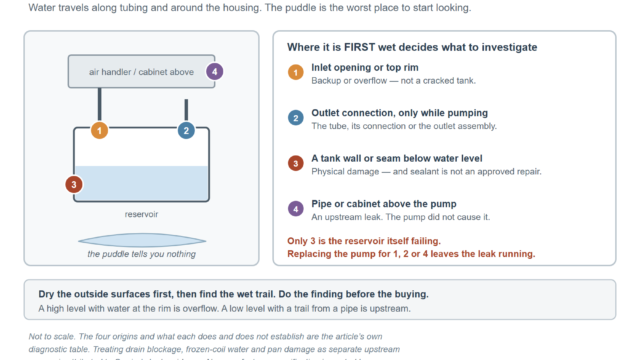
| Water under the tank | Usually a fitting or the lid, not the tank itself | Often not. Find the first wet spot |
| The drain line keeps blocking | Biofilm in the line, downstream of the pump | No. Clear the line |
| It cannot lift to the drain | Your vertical lift exceeds the pump’s rating | Yes. That is exactly what the table below is for |
Only one of those six rows is solved by buying. This page will still be here when you have ruled the others out.
Which condensate pump fits your installation?
| Product | Best-matched situation | Verified performance or fit detail | Honest limitation |
|---|---|---|---|
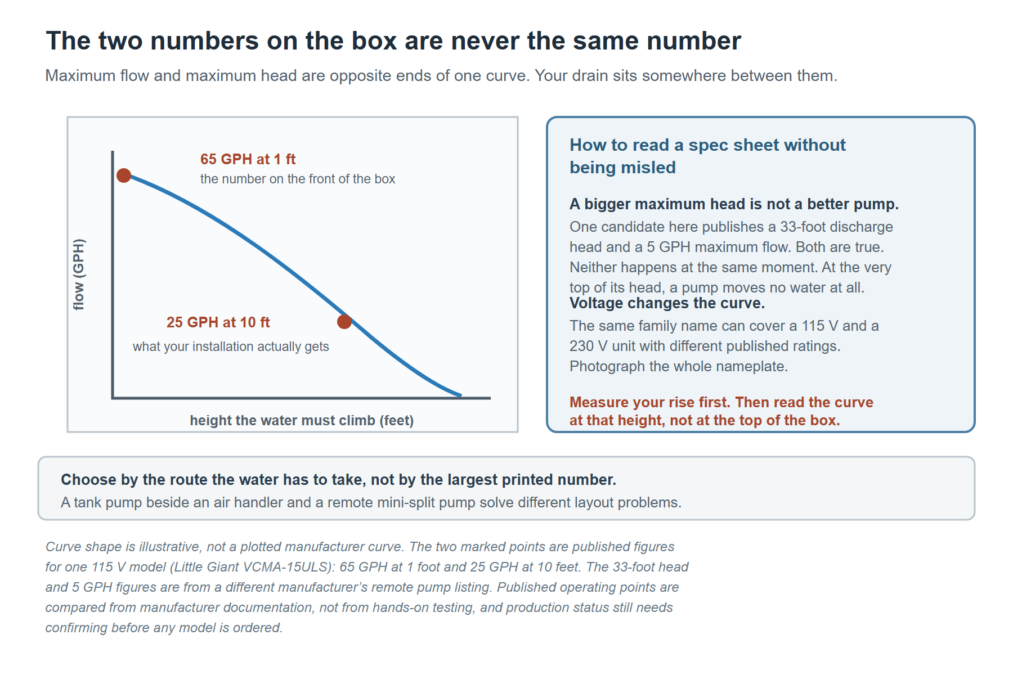
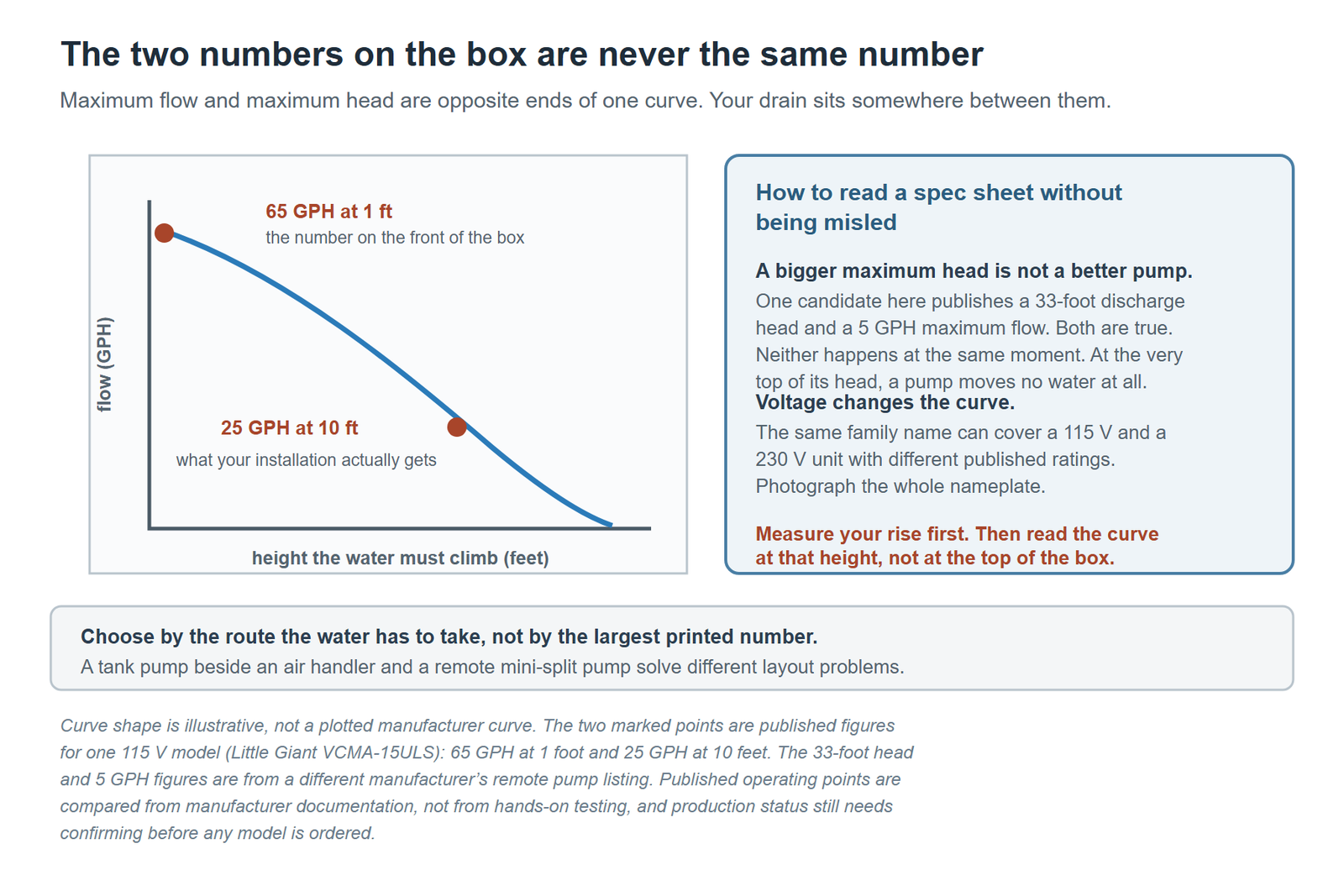
| Little Giant VCMA-15ULS | Accessible tank-pump installation with modest head | 65 GPH at 1 foot; 25 GPH at 10 feet; 115 V | Output falls substantially with height |
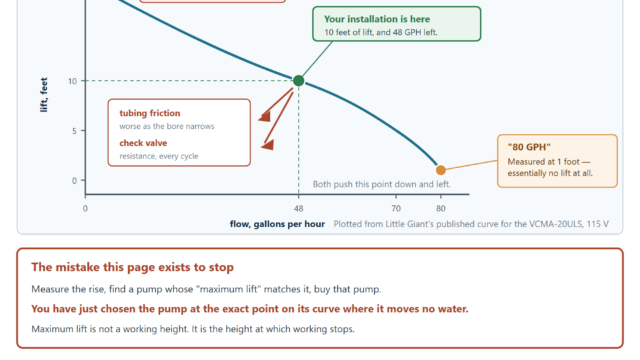
| Little Giant VCMA-20ULS | Tank installation requiring more output at head | 115 V model: 48 GPH at 10 feet | Do not copy its curve to the 230 V variant |
| DiversiTech CP-22 | Tank installation needing its control/status features | 120 V version: 1.6 GPM at zero head; 22-foot maximum head | Zero-head flow is not flow at 22 feet |
| Beckett BK171UL | Service-accessible tank installation | 112 GPH at 1 foot; 17-foot maximum lift; safety switch | Standard model is not plenum-rated |
| Sauermann Si-30 | Remote pump arrangement for an AC unit | US page: 5 GPH maximum flow; 33-foot discharge head | Remote detector, suction arrangement and duty limits need careful matching |
Sources: [VCMA-15][1], [VCMA-20][2], [CP-22 installation data][3], [BK171UL manufacturer listing][4] and [Si-30 US information][5]. Maximum flow and maximum head are different operating conditions. The table deliberately labels them rather than implying they happen together.
Little Giant VCMA-15ULS: start with the curve
This is a candidate when the existing drainage layout can be served comfortably by its published output. Its selected model includes a safety switch; the manufacturer’s order table distinguishes it from variants without that feature.[1]
The drawback is limited output as head increases. A pump being physically small enough to sit under the inlet is only the first check. Compare the required flow at head before accepting it as a like-for-like replacement.
Little Giant VCMA-20ULS: more output is useful only where needed
At a documented operating point, this selected 115-volt unit provides more flow than the smaller candidate. That can matter when the drain climbs or the connected equipment produces more condensate.
Its limitation is model confusion: the family includes different voltage variants with different shutoff ratings.[2] Photograph the complete nameplate before comparing. A similarly named unit from another electrical market is not a substitute specification.
DiversiTech CP-22: compare the inlet height too
Its reservoir, indicators and overflow circuit make it a candidate for an accessible installation where service checks are straightforward. The manual distinguishes standard and low-profile inlet heights.[3]
The important drawback is that maximum lift does not establish useful capacity at your destination. Request the appropriate curve if a published operating point is not enough to establish the duty. Do not select it solely because one maximum is higher than a competitor’s.
Beckett BK171UL: check the replacement identity
Beckett names this as the replacement for its discontinued CB151UL. The listing describes a lift-to-test tab, serviceable check valve and included safety switch.[4]
That replacement identity is more useful than a reseller calling an old model “popular.” The limitation is application-specific: the standard listed model is not plenum-rated. A unit suitable beside a furnace is not automatically suitable inside an air-handling plenum.
Sauermann Si-30: a different layout, not a bigger tank pump
This is the remote-pump candidate in the comparison. It uses a separate detection arrangement and the US documentation states separate discharge-head and suction-head limits, as well as operating duty conditions.[5]
Its drawback is installation sensitivity. A ceiling route, detector position and suction lift cannot be reduced to a single “maximum lift” number. Have an HVAC installer match the complete arrangement; do not assume the highest headline head means it is the best general replacement.
What measurements do you need before ordering?
Record the equipment being drained, the inlet height, available service clearance, exact electrical supply and route to an approved discharge destination. Include tubing size and restrictive fittings. Confirm the expected peak condensate load from the equipment documentation or an appropriate professional assessment.
A pump that physically fits can still be wrong if its inlet sits too high to receive gravity drainage. A pump that moves water during a short test can still be wrong if it lacks adequate output for the installed route.
Does an included safety switch protect the house automatically?
No. It must be connected and tested in the intended control or alarm circuit. A supplied pair of unused wires cannot stop the equipment from adding water to an overflowing reservoir.
Have the installer demonstrate normal starting and stopping, then verify the manufacturer’s overflow-response procedure without creating an uncontrolled spill. Keep those results with the installation record.
Should you repair the current pump first?
Yes, when the fault is a serviceable obstruction or connection problem. A replacement can inherit the same pinched discharge or unsuitable route.
Before buying, distinguish returning discharge, a pump that makes noise without moving water, and a motor that keeps running as its reservoir empties. Those observations lead to different repairs.
If the pump restarts almost at once, confirm whether water is returning down the outlet before replacing anything. If it buzzes without moving water, work through the three routes that produce that one sound. And if there is water on the floor, find the first wet spot before assuming the reservoir has failed.
The buying decision should follow the diagnosis: replacing a healthy pump does not correct a defective route.
What was checked, and what still needs confirmation?
Manufacturer product information and manuals were checked on October 25, 2026. These are documented candidates, not verified inventory reservations. Before ordering, confirm that the exact variant remains supplied, obtain the latest manual and resolve any missing duty-point information.
No prices, sales ranks or star ratings are used. Where the documentation gives a maximum rather than an operating point, this comparison keeps that distinction visible.
When this needs a pro
Use an HVAC professional for hardwired pumps, overflow-control wiring, concealed routes, plenum installations or any installation whose available drainage capacity is uncertain. Water near electrical equipment and repeated overflow are reasons to stop the connected equipment and arrange service.
[1]: https://www.littlegiant.com/products/condensate-removal-pumps/condensate-pumps/vcma-series/vcma-15/ [2]: https://www.littlegiant.com/products/condensate-removal-pumps/condensate-pumps/vcma–vcmx-series/vcma-20/ [3]: https://cdn.bakerdist.com/diversitech_cp-22_article_1375441859437_en_ii.pdf [4]: https://beckettus.com/product/bk171ul-medium-condensate-removal-pump/ [5]: https://sauermanngroup.com/en-US/condensate-pumps/mini-condensate-removal-pumps/si-30-mini-condensate-removal-pump