On this page
Last Updated on September 14, 2026 by Muhammad Toqeer
Measure one thing: the vertical distance from the pump outlet up to the highest point the discharge line reaches. Then buy a 115V automatic pump whose published flow at that height is still comfortably above zero. Tank size, brand and gallons per hour barely matter in a house. Lift does — and the lift figure printed on the box is the one that misleads.
Nearly every guide answers this question by telling you to match the pump’s flow rating to your system. That advice is real, and it comes from commercial work where a rooftop unit genuinely can outrun a pump. Scaled down to a furnace in a basement it is the wrong thing to worry about, and worrying about it is why people end up with a pump that still cannot reach the window.
Measure the rise, not the run
Stand at the pump and look at where its tubing ends up. The number the manufacturer’s rating describes is the height the water has to climb — from the pump outlet to the highest point the line reaches before it starts heading downhill again. A long horizontal crawl across the joists to a laundry sink is not part of that number.
One-minute test: hook a tape on the pump outlet and read the height where the tubing stops going up. That figure, not the length of tubing in the box, is what you match a pump against.
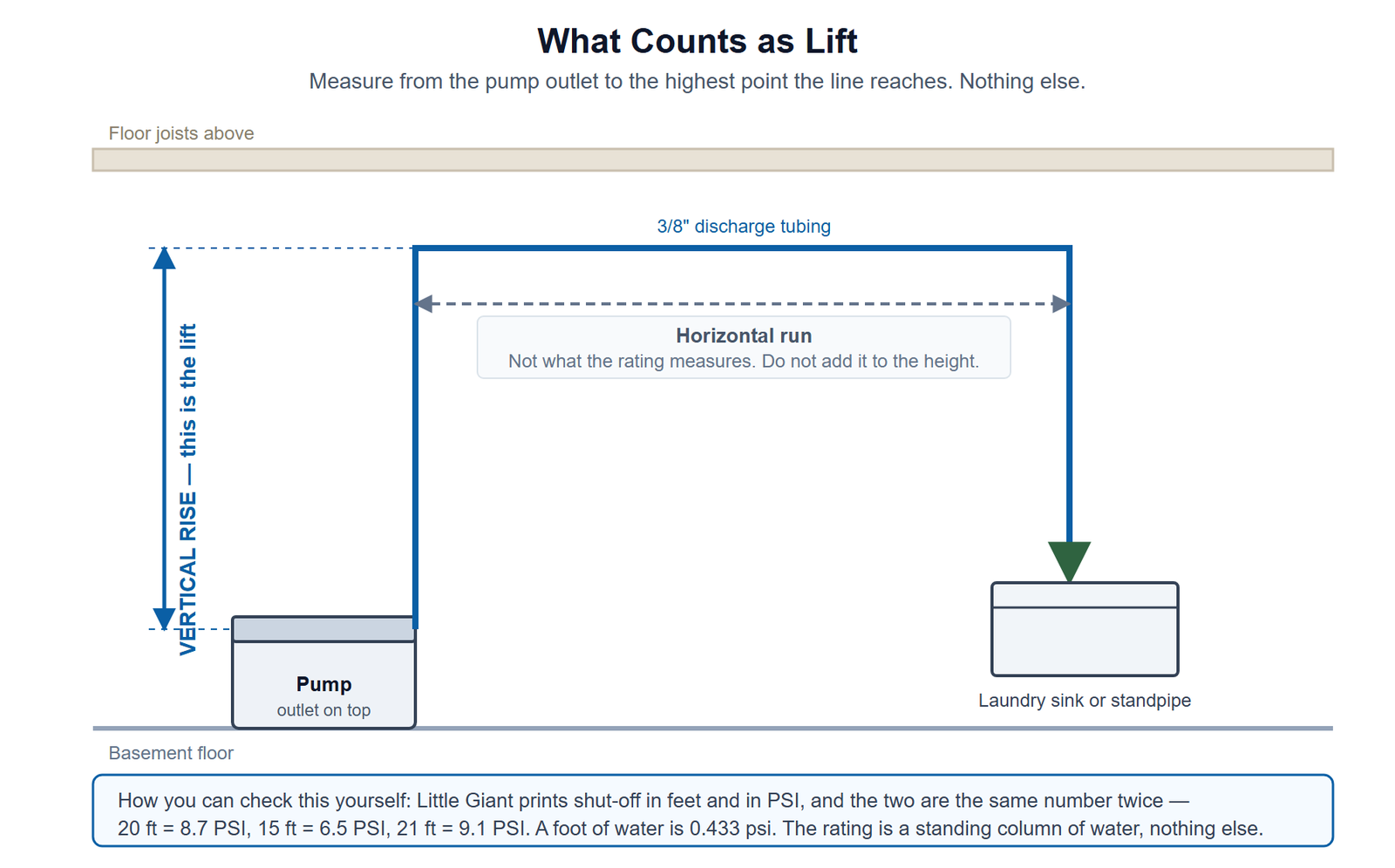
There is a neat way to confirm this for yourself rather than taking it on trust. Little Giant publishes shut-off in two units side by side: 20 feet is listed as 8.7 PSI, 15 feet as 6.5 PSI, 21 feet as 9.1 PSI. A foot of water is 0.433 psi, so each of those pairs is the same quantity written twice. The rating is a standing column of water and nothing else, which is exactly why height is what you measure.
The lift on the box is where the pump stops
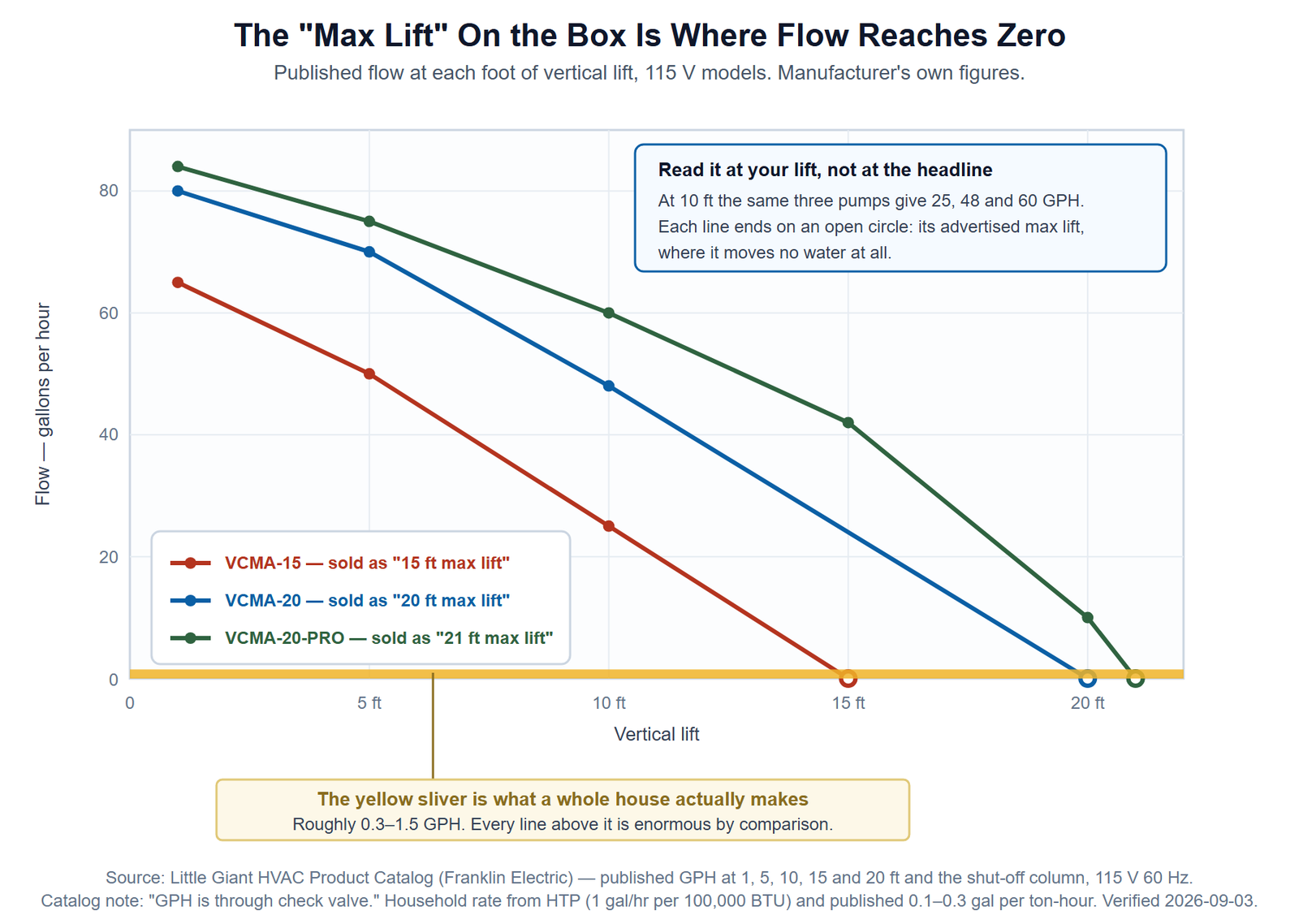
Here is the part that decides most of these purchases wrongly. A pump advertised as “20 ft max lift” does not move water at twenty feet. Twenty feet is its shut-off head — the height at which flow reaches zero.
Little Giant’s own catalog prints it plainly, flow at each foot of lift, 115V models:
| Pump | 1 ft | 5 ft | 10 ft | 15 ft | 20 ft | Shut-off |
|---|---|---|---|---|---|---|
| VCMA-15 | 65 | 50 | 25 | 0 | 0 | 15 ft / 6.5 PSI |
| VCMA-20 | 80 | 70 | 48 | not quoted | 0 | 20 ft / 8.7 PSI |
| VCMA-20-PRO (was VCMX-20) | 84 | 75 | 60 | 42 | 10 | 21 ft / 9.1 PSI |
Figures are gallons per hour, measured through the check valve.
Read across the VCMA-20 row. Eighty gallons an hour at one foot, forty-eight at ten, nothing at twenty. Its retail listing compresses all of that into “20 ft max lift”, which is true in the same way that a car’s top speed is true — it is the edge of the envelope, not a place to operate.
How much margin to leave
Work from the curve rather than a rule someone made up. Pick a pump whose published flow at your measured height is still a real number, not a rounding error — the VCMA-20’s 48 GPH at ten feet is enormously more than any house needs, so ten feet is a comfortable place for it to live. At fifteen feet, that same pump is on the steep part of its curve where the catalog stops quoting figures at all, and the VCMA-20-PRO, which still shows 42 GPH there, is the honest choice for that height. (The VCMX-20 in the table above carried the same curve and was the answer here for years. It has been discontinued — the PRO is its replacement and publishes identical figures. Most guides have not caught up.)
The failure this avoids is not dramatic. A pump asked to work close to its ceiling still empties the tank, just slowly, which means it runs far longer per cycle than it was meant to. If yours already sounds like it is working and the water is barely moving, that symptom has its own diagnosis — see runs but no water leaves — and long, hot cycles are how pumps end up cutting out on their thermal protector.
Flow is the spec you can stop worrying about
Two numbers settle this, and neither appears on any page currently ranking for this question.
A condensing furnace or boiler running flat out produces, in HTP’s words, “one gallon per hour for every 100,000 BTUs of input”. So a 100,000 BTU furnace makes roughly one gallon an hour.
Air conditioning is in the same territory. Published rates run about 0.1 gallons per ton-hour in dry conditions, 0.2 in average ones and 0.3 to 0.4 in humid ones — so a three-ton system lands somewhere near 0.3 to 1.5 gallons an hour depending on where you live and how wet the air is. Sources disagree on exactly where in that range to sit, which is a good reason to treat the range as the answer rather than pick a point in it.
Now set that against the smallest pump in the table. A VCMA-15 at ten feet of lift moves 25 gallons an hour. That is more than twenty times a whole house’s output, from the least capable pump on the shelf, at a height most basements never reach. Every pump sold for this job is enormously oversized on flow, which is why the flow rating cannot be the thing that distinguishes them.
Buying a bigger pump for capacity is solving a problem no house has. Buying one for lift is the entire exercise.
Temperature is what actually rules a pump out
This is the spec that quietly disqualifies pumps, and none of the ranking guides list it.
The rating is not a property of the brand, and that catches people out. Little Giant’s VCMA pumps — the VCMA-15, the VCMA-20 and the VCMA-20-PRO — are rated “maximum water temperature: 140 °F”. Its low-profile VCCA line is the one that carries “intermittent liquid temperature up to 120 °F”. The VCL series is 140 °F again, in that weaker wording. Only the high-temperature line is built for real heat — the HT-VCL-P is rated “maximum water temperature: 212 °F (100 °C)”. Three different figures under one badge, in two different phrasings, and no retail listing reproduces either.
That gap is the line between two completely different products that share a name. Condensate off an air conditioner or a high-efficiency furnace is cool, and a standard 140 °F pump handles it for years. Condensate coming back off a steam or hydronic system is not cool, and the same pump put on that job is outside its rating from the first cycle.
It also explains something odd about searching for this. The most authoritative page you will find titled “How to size a condensate pump” is about steam boiler return receivers — sizing the pump to three times the steaming rate, sizing the receiver to a minute’s worth of condensate. Excellent advice, for a boiler room. If your equipment is a furnace or an air handler, it is not the product you are shopping for. There is more on the distinction in the condensate pumps guide.
A mini-split takes a different pump
A wall-mounted ductless head has no room underneath for a tank-and-float pump, and a living room has no tolerance for the noise of one. These use a separate class of product with a published ceiling on the equipment it can serve.
Little Giant’s EC-1-DV is specified for removing condensate from “wall mount, ductless mini-split air conditioners up to 34,000 Btu”, runs at 21 dB(A), and discharges through 1/4 inch instead of the usual 3/8. It comes in two pieces — a clear reservoir that sits inside or behind the air handler and a pump-controller mounted outside it — and the reservoir “must be positioned flat and horizontal” while the pump itself can go in any orientation within about three feet of it.
Check that BTU figure against the head you are actually fitting it to. It is a limit, not a suggestion, and it is the one number in mini-split pump selection that behaves like a real constraint.
Where it goes can decide it for you
Three placements take the choice out of your hands.
- In a ceiling plenum or under a raised floor. Air-handling spaces need a pump listed to UL 2043, the fire test for heat and visible smoke release. Little Giant’s plenum model exists specifically because “building codes today require a pump that is designed for Plenum Use”. A standard pump with the same performance is not a substitute here.
- Anywhere a leak reaches finished space — an attic, a closet above a ceiling. The residential code provision on condensate disposal asks for one of three things where a clogged drain could damage the structure: a secondary drain pan with its own drain, a secondary drain line to a conspicuous place, or a float switch that shuts the whole system down.
- Anywhere the floor matters. Buy the model with the safety switch. On Little Giant’s range that is the S at the end of the model number, and it is a factory-fitted high water level switch rather than an accessory. Getting it wired is a separate question and a commonly skipped one — why the switch so often fails to stop an overflow covers what goes wrong there.
When this needs a pro
Choosing the pump is not the part that needs a licensed tech. Two things that follow from it are.
The safety switch lands in the same low-voltage control circuit as your thermostat. Wiring it is small work for someone who does it weekly and a bad afternoon for someone who does not, and a switch wired wrong is worse than no switch, because it looks like protection and is not.
The other is the attic and above-ceiling case. If that is where your equipment sits, ask the tech to confirm the install actually meets the secondary-drain requirement instead of only fitting the pump you picked. The right pump in an install that was short of code from the start still floods the same ceiling.
FAQ
What size condensate pump do I need for a furnace?
Almost certainly a standard 115V automatic pump — the capacity question answers itself. A 100,000 BTU condensing furnace produces about a gallon an hour, and the smallest common pump moves 25 gallons an hour at ten feet of lift. Size it on the height it has to push to, not on your furnace’s output.
Does a higher GPH rating mean a better pump?
Not for a house. Flow ratings between residential models differ by tens of gallons an hour against a demand of roughly one, so the difference has nowhere to show up. What the higher-rated pumps generally also have is a better curve at height, and that is the part worth paying for.
My pump says 20 ft max lift. Can I use it for a 20 foot rise?
No. Twenty feet is the shut-off head, where published flow is zero. That same pump is rated 48 gallons an hour at ten feet and the catalog does not quote a figure at fifteen. For a genuine twenty-foot rise, choose a pump that still publishes real flow at twenty feet.
Does the horizontal run count towards the lift?
Not in the way the vertical does. The rating measures a standing column of water — you can see it in the manufacturer’s own table, where shut-off in feet and in PSI convert exactly to each other. Measure the height the water has to climb; a long horizontal stretch adds only a little friction on top of it.
Can I use a regular condensate pump on a steam boiler?
No. Standard HVAC condensate pumps top out at 140 °F — some low-profile models at 120 °F — and a boiler return is far hotter than that. Boiler condensate is a different product line with a different temperature rating, sized a different way.


