On this page
- The two published claims, and what each one rests on
- Which makes the sizing method short
- The hours are a pairing, not a battery property
- Why there is no amp-hour figure for a specific battery on this page
- Wet cell or sealed is a maintenance decision
- It is not a car battery
- A warranty term nobody mentions
- When this needs a pro
- FAQ
Last Updated on October 2, 2026 by Muhammad Toqeer
Find the figure the maker quoted its hours against, and match it. That is the whole method.
Wayne’s 26 hours assumes a 75 amp hour battery. Basement Watchdog’s 48 hours assumes 100. Those numbers are not describing the pumps — they are describing a pump plus a battery that is sold separately and supplied by you afterwards.
So every runtime figure you have read is a claim about a battery you have not bought yet, and fitting a smaller one than the claim assumed means the claim no longer applies.
The two published claims, and what each one rests on
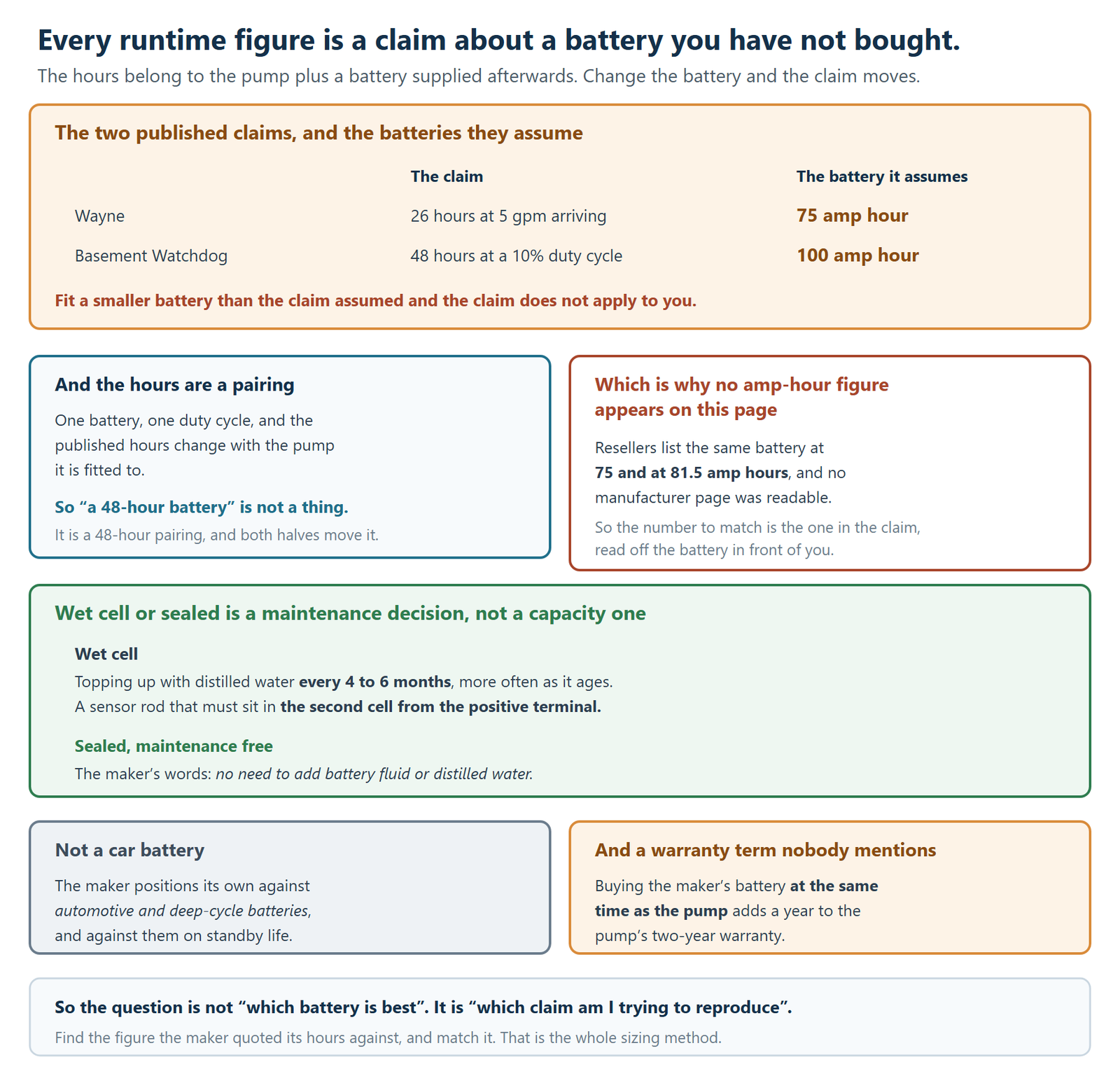
| Maker | The claim | The battery it assumes |
|---|---|---|
| Wayne | 26 continuous hours at 5 gpm arriving | 75 amp hour |
| Basement Watchdog | 48 hours at a 10% duty cycle | 100 amp hour |
Both of those are the manufacturers’ own figures, and this site compared them properly when it compared the pumps — including the point that the two claims are not comparable with each other, because one states an inflow and the other a duty cycle.
What matters here is the right-hand column. It is the part that is not in the box.
Which makes the sizing method short
1. Find the runtime figure your pump’s maker publishes.
2. Find the battery capacity that figure was quoted against. It will be in the same sentence or the same table — Wayne says 75 amp hour in the same breath as 26 hours.
3. Buy that capacity or more.
That is it. There is no separate calculation to do, because the manufacturer has already done one and published the result. Your job is to supply the input it assumed.
And if you buy less, you have not bought a slightly shorter runtime — you have bought an unknown one, because the published figure was the only measured point you had.
The hours are a pairing, not a battery property
Worth understanding before you shop, because it stops you looking for the wrong thing.
The same battery, at the same duty cycle, is quoted at different runtimes on different pumps in its maker’s own range. Forty hours on one, more on another, more again on a third.
So “a 48-hour battery” is not a thing. It is a 48-hour pairing, and changing either half moves the number.
Which is why shopping for hours is the wrong approach and matching the assumed capacity is the right one.
Why there is no amp-hour figure for a specific battery on this page
Because the published ones disagree.
Resellers list the same backup battery at 75 amp hours and at 81.5, and no manufacturer page giving the figure was readable when this was written.
So this page will not tell you a battery’s capacity. It tells you to read it off the battery in front of you and compare it with the number in your pump’s claim — which is the comparison that actually matters.
Wet cell or sealed is a maintenance decision
Not a capacity one. Both types are sold in the capacities these pumps want.
A wet cell needs topping up with distilled water every four to six months, and more often as it ages. It also carries a fluid sensor, and that sensor has to sit in one specific cell — the second from the positive terminal — or it misreads and alarms on its own.
A sealed, maintenance-free battery, in the maker’s own words:
“No need to add battery fluid or distilled water”
And the trade-off is honesty about yourself. A wet cell is a maintenance item in a basement, and the thing it is protecting only matters on the night it runs. If the top-ups will not happen, the sealed one is the correct choice regardless of anything else.
It is not a car battery
The substitution everybody considers, and the manufacturer addresses it directly, positioning its own product against automotive and deep-cycle batteries — specifically on how it behaves in standby.
That is the relevant difference. A backup sump battery spends almost all of its life sitting fully charged doing nothing, and is then asked for everything it has on one night a year. That is a different duty from starting a car every morning.
A warranty term nobody mentions
Buying the maker’s own battery at the same time as the backup pump can add a year to the pump’s warranty — taking a two-year pump warranty to three, in the case this site checked.
That is a purchasing consideration rather than a specification, and it is in the manual rather than on any round-up.
Worth knowing before the two purchases get separated, because the term depends on them being made together.
When this needs a pro
Anything inside a battery. Lead-acid cells produce explosive gas and the electrolyte is acid; the manuals carry their own warnings about both.
Battery siting and ventilation. A lead-acid battery in a basement is a considered decision rather than a shelf.
Anything electrical, including the charger and its circuit.
The pump’s own installation, which sits under a cover that should be gas-tight and fastened down.
What you can do yourself: read your pump’s published runtime claim, read the capacity it assumes, and read what is on the battery you are being offered. Three numbers — and the sizing decision is whether the third matches the second.
And if you have not measured your inflow yet, the fill test takes a minute and it is what makes Wayne’s figure usable at all.
FAQ
What size battery do I need for a backup sump pump?
Match the capacity your pump’s runtime claim assumes. Wayne quotes 26 hours against a 75 amp hour battery; Basement Watchdog quotes 48 hours against 100. Buying less capacity than the claim assumed means the published hours no longer describe your system.
Does a bigger battery give longer runtime?
Broadly yes, but the published hours are a pump-and-battery pairing rather than a battery property. The same battery at the same duty cycle is quoted at different runtimes on different pumps, so matching the assumed capacity is more useful than shopping for hours.
Can I use a car battery for a sump pump backup?
The manufacturer positions its own batteries against automotive and deep-cycle types, specifically on standby performance. A backup battery sits fully charged for months and is then asked for everything at once, which is a different duty from starting a car.
Should I buy a wet cell or a maintenance-free battery?
It is a maintenance decision rather than a capacity one. A wet cell needs distilled water every four to six months and has a fluid sensor that must sit in a specific cell. A sealed battery needs neither. If the top-ups will not happen, buy sealed.
Why do different sources give different amp-hour ratings for the same battery?
They do, and it is a reason to read the figure off the battery itself. The same backup battery is listed at 75 and at 81.5 amp hours by different sellers, which is why this page does not quote a capacity for any specific product.
Does buying the battery with the pump matter?
It can. At least one manufacturer extends the pump’s warranty by a year when its own battery is bought at the same time, which is a term that depends on the two purchases being made together.


