On this page
Last Updated on October 1, 2026 by Muhammad Toqeer
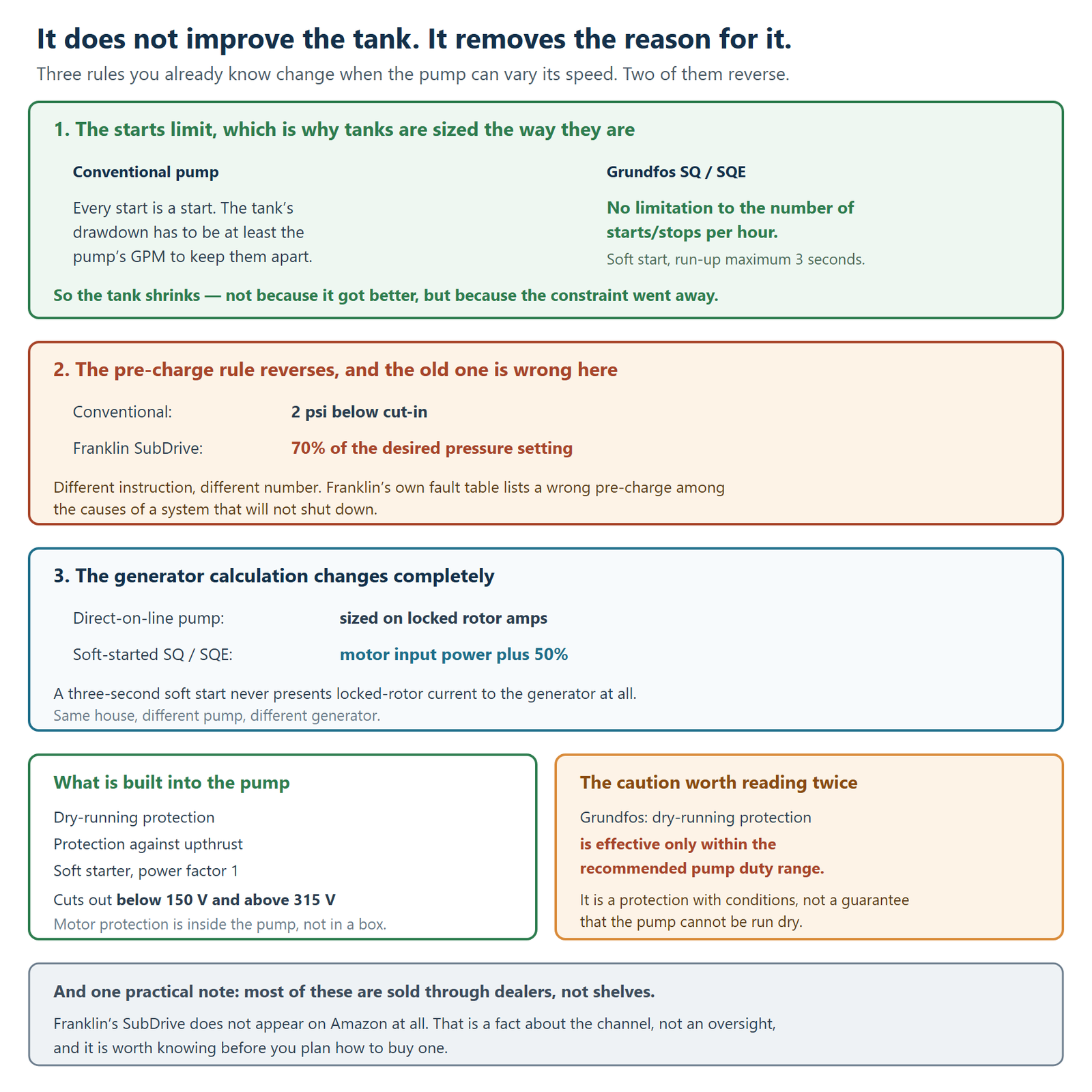
The tank gets smaller because the reason for it goes away. Grundfos publishes, for its SQ and SQE pumps, “No limitation to the number of starts/stops per hour.”
That one sentence undoes the rule a conventional pressure tank is sized by. A tank’s drawdown has to be at least the pump’s GPM precisely so the pump does not start too often. Take away the limit on starts and the tank has nothing left to do at that size.
Two more rules you probably know change as well, and one of them reverses outright.
What actually changes
A conventional well system is a pump with two speeds: off and flat out. It fills a tank, stops, and waits for the tank to empty. Everything about the tank exists to make that cycle slow enough.
A constant-pressure system varies the pump’s speed to match what the taps are taking. It does not fill and wait. It runs at whatever rate holds the pressure steady.
That is the whole mechanism, and three consequences follow.
1. The starts limit disappears, so the tank shrinks
A conventional tank is sized so its drawdown is at least the pump’s GPM, and short cycling is a fault worth an article of its own because starts are what wear a pump out.
Grundfos, for the SQ and SQE, verbatim:
“Run-up time: Maximum 3 seconds. No limitation to the number of starts/stops per hour.”
A soft start over three seconds is not the event a direct-on-line start is. There is no inrush to speak of and no thermal penalty, so the constraint that sized your tank is gone.
Which is why these systems ship with a tank a fraction of the usual size — and why Grundfos lists one configuration as “SQ with Pressure Manager (with/without pressure tank).”
Be precise about what that means, though. Franklin’s SubDrive still requires a tank — “Smaller pressure tank can be used”, not none — and notes that “for pumps rated 2,5 m³/h or more, a slightly larger tank is recommended for optimum pressure regulation.” Smaller is not zero.
2. The pre-charge rule reverses
This is the one that catches people converting an existing system, because the rule they already know produces the wrong number.
Conventional: pre-charge the tank 2 psi below cut-in.
Franklin, for the SubDrive, verbatim:
“Set the pressure tank pre-charge at 70% of the desired water pressure setting.”
Those are different instructions and they do not land in the same place. The conventional rule is anchored to a cut-in point that a constant-pressure system does not have — there is a setpoint instead, and the tank is pre-charged as a proportion of it.
Franklin treats getting this wrong as a real fault, not a nicety: its own troubleshooting table lists “Tank pre-charge pressure” and “Verify precharge at 70%” among the causes of a system that will not shut down.
If you convert, re-set the tank. The old number is not close enough.
3. The generator calculation stops working
This site sized a generator for a well pump on locked rotor amps, because a direct-on-line motor’s starting surge is the thing a generator has to survive. That method is correct for what it describes.
It does not transfer. Grundfos, for the SQ/SQE:
“We recommend that the generator output is equal to the motor input power (P1) plus 50 %, and at least (P1) plus 10 %.”
That is a running-power calculation. A three-second soft start never presents locked-rotor current to the generator at all, so there is no surge to size for.
Same house, same well, different pump — and a different generator. Worth knowing before buying either.
What is built into the pump
On a conventional system, motor protection lives in a control box on the wall. On these it is inside the pump.
Grundfos lists, for the SQ/SQE: dry-running protection, protection against upthrust, a soft starter, high pump and motor efficiency, wear resistance, and overvoltage and undervoltage protection that “cuts out below 150 V and above 315 V.”
Power factor is quoted as PF = 1.
And one caution that deserves reading twice, because it is easy to hear “dry-running protection” as a guarantee:
“The dry-running protection is effective only within the recommended pump duty range, i.e. the bold curves.”
It is a protection with conditions. Run the pump outside its intended duty range and the protection is not promised.
The systems worth knowing
A short list, because the field is small and most of it is sold through dealers rather than off a shelf.
Grundfos CU 301 — the control that makes an SQE constant-pressure
Grundfos CU 301 — control box for SQE pumps, 1/3 to 1.5 hp, 115/230 V, single phase (part 96436754). Maximum 200 m between the CU 301 and the pump. Back-up fuse maximum 16 A. Complies with the EMC Directive, EN 55014.
Who it is for: anyone who has or is buying an SQE and wants constant pressure. The pump does the varying; this tells it what to hold.
The honest drawback: it is only half the purchase. It needs an SQE pump — it will not convert an ordinary submersible — and it needs the pressure sensor below.
Grundfos pressure transducer — the part people forget
Grundfos pressure transducer — MBS1900 / part 98393361, the sensor the CU 301 reads.
Who it is for: every CU 301 installation, and anyone replacing a failed sensor on an existing one.
The honest drawback: it is a consumable in a system people think of as solid state, and a system that behaves strangely often has a sensor problem rather than a controller problem.
Grundfos SQ with PM 1 or PM 2 Pressure Manager — the simpler route
Grundfos SQ with Pressure Manager — Grundfos lists this configuration as working with or without a pressure tank.
Who it is for: a smaller installation that wants the cycling problem solved without a full constant-pressure controller.
The honest drawback: this is not the same thing as CU 301 constant pressure. A Pressure Manager starts and stops the pump on demand; it does not modulate speed to hold a setpoint. Do not buy it expecting the behaviour described at the top of this page.
Franklin SubDrive — the variable-speed drive for a 2-wire motor
Franklin SubDrive — VFD for 2-wire, single-phase motors. Pressure setting factory preset 3.4 bar, adjustable 1.7 to 5.5 bar. Drive rated IP20, pressure sensor IP24. Requires a small pressure tank and a pressure relief valve near the tank, sized for pump flow at maximum rated system pressure.
Who it is for: converting an existing Franklin-motored well to constant pressure without replacing the pump.
The honest drawback: IP20 on the drive. That is a dry indoor rating, so siting matters — and this is the one in the group that does not appear on Amazon at all, so expect to buy it through a dealer.
Franklin MonoDrive and MonoDriveXT — the 3-wire equivalent
Franklin MonoDrive — the counterpart for 3-wire motors.
Who it is for: the same conversion where the existing motor is 3-wire with a control box.
The honest drawback: which drive you need is decided by the motor already down the well, not by preference — and finding out which you have means knowing the motor, not the pump.
Boshart constant-pressure tank tee kit — the plumbing side
Boshart stainless constant-pressure tank tee / VFD manifold kit — stainless manifold with wall-mount brackets, made for Grundfos CU301, Franklin and Goulds systems.
Who it is for: the installation itself, since a constant-pressure system’s small tank and sensor need mounting somewhere sensible.
The honest drawback: an accessory, not a system — and it assumes decisions already made about which drive you are fitting.
Goulds’ Aquavar also competes here. It is named rather than specified, because nothing about it was verified at source and this page does not publish figures it has not read in the manufacturer’s own document.
Side by side
| Conventional system | Constant pressure | |
|---|---|---|
| Starts per hour | Limited; the tank exists to space them | “No limitation” (Grundfos SQ/SQE) |
| Tank size | Drawdown at least the pump’s GPM | Small — and one Grundfos config runs without one |
| Pre-charge | 2 psi below cut-in | 70% of setpoint (Franklin) |
| Generator sizing | Locked rotor amps | Input power + 50% (Grundfos) |
| Motor protection | Control box on the wall | Built into the pump |
Is it worth it?
Honestly: it depends on which problem you have.
If your complaint is pressure that sags when a second tap opens, this is the product class that fixes it, and nothing you do to a conventional tank will.
If your complaint is short cycling, find out why first. A failed tank pre-charge or a waterlogged tank is a repair, not a reason to replace the system — and a constant-pressure system bought to mask a fault still has the fault underneath it.
If nothing is wrong, the honest answer is that a working conventional system delivers water perfectly well, and this is a comfort upgrade rather than a repair.
When this needs a pro
All of it. This is a well, mains power, and a pressure vessel.
The drive selection especially, because it is determined by the motor already in the well — 2-wire or 3-wire — and getting that wrong means the wrong box.
The pre-charge, if you are converting. The rule changes, and Franklin treats a wrong pre-charge as a cause of a system that will not shut down.
Anything down the well. Pulling a submersible is hundreds of feet of pipe, wire and water, and it is not a first-attempt job.
What you can do yourself: find out whether your motor is 2-wire or 3-wire, and read your current cut-in and cut-out off the gauge. Two facts — and they decide which half of this page applies to you.
FAQ
What is a constant pressure well system?
A pump whose speed varies to match demand, instead of running flat out until a tank fills. It holds a pressure setpoint rather than cycling between cut-in and cut-out, which is why the pressure does not sag when a second tap opens.
Do constant pressure systems still need a pressure tank?
Usually a small one. Franklin’s SubDrive requires a tank and says a smaller one can be used; Grundfos lists one configuration that runs with or without. The tank shrinks because the limit on pump starts goes away, not because tanks stopped being useful.
How do I set the pressure tank pre-charge on a constant pressure system?
Not by the conventional rule. Franklin specifies 70% of the desired pressure setting, where a conventional system is pre-charged 2 psi below cut-in. Applying the old rule is listed in Franklin’s own troubleshooting as a cause of a system that will not shut down.
Will a constant pressure pump fix short cycling?
It removes the cycling, because the pump modulates instead of starting and stopping — Grundfos publishes no limit on starts per hour for its SQ and SQE. But if the cycling is caused by a waterlogged tank or a lost pre-charge, that is a repair, and replacing the whole system leaves that fault in place.
What size generator does a constant pressure well pump need?
Different arithmetic from a conventional pump. Grundfos recommends generator output equal to motor input power plus 50%, and at least plus 10%, because a soft start never presents locked-rotor current. Sizing on locked rotor amps is the method for direct-on-line pumps.
Does a constant pressure pump protect itself against running dry?
It has dry-running protection built in, but Grundfos states plainly that it is effective only within the recommended pump duty range. It is a protection with conditions rather than a guarantee.


