On this page
- Four things alarm, and the pit is not one of them
- 1. Pump: the backup ran, and the alarm latched
- 2. Battery: under half an hour of pumping left
- 3. Power: it can sound with your lights on
- 4. Water: and it means the water inside the battery
- What silencing actually does here
- What to do, in order
- When this needs a pro
- FAQ
Last Updated on September 30, 2026 by Muhammad Toqeer
The pit is dry because the backup pump already emptied it. The alarm did not fail to notice — it stayed on deliberately, to tell you something happened while you were asleep or out.
The manufacturer says so in the manual: the alarm “stays on to alert you to the fact that the standby system was used to empty water from the sump.”
So this is not a false alarm. It is a report that your main pump did not cope, and it is the only one you are going to get.
Four things alarm, and the pit is not one of them
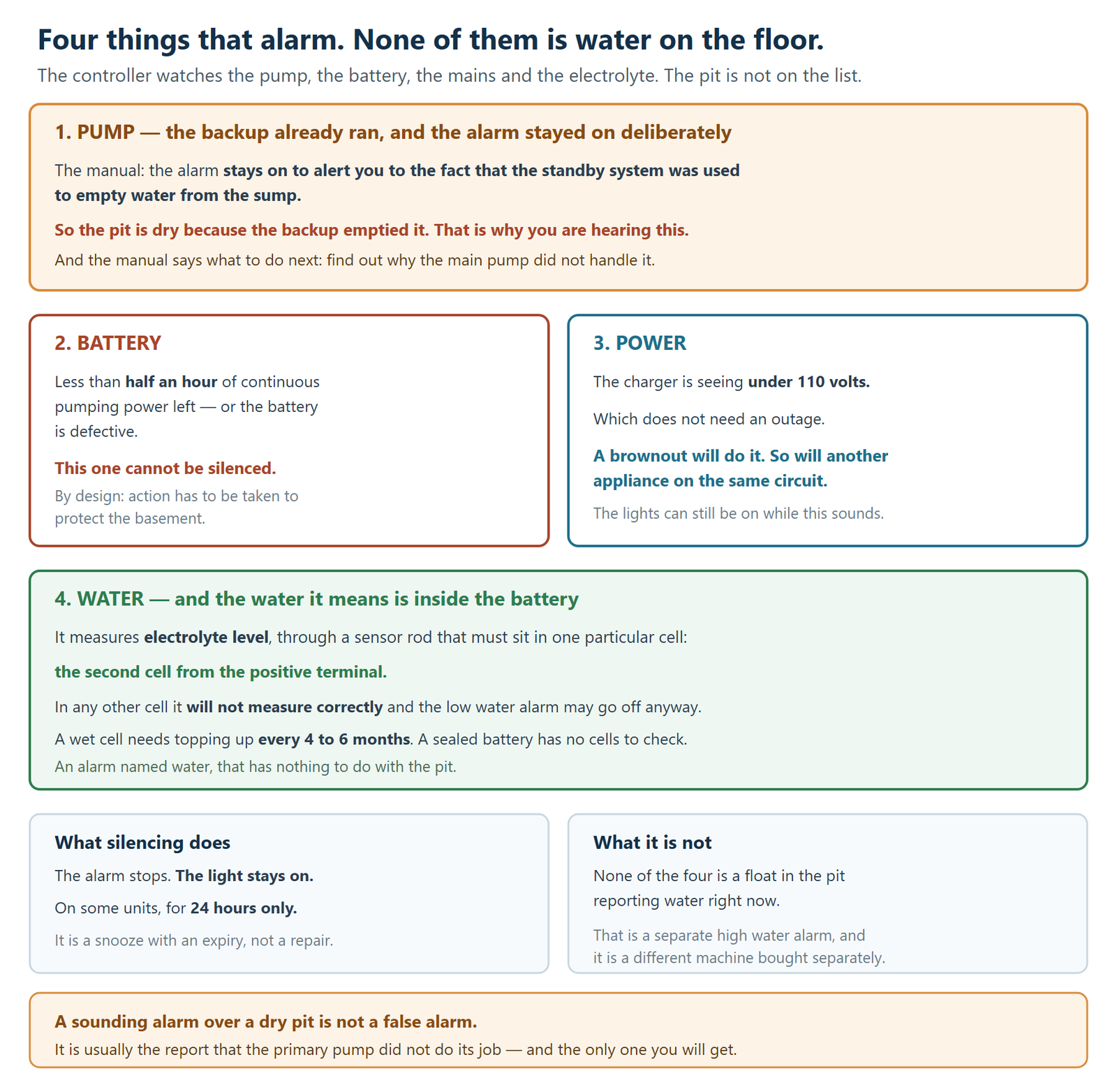
The alarm on a sump installation is almost never a water sensor. It is the controller of a battery backup system, and that controller is watching the pump, the battery, the mains supply and — genuinely — the fluid inside the battery.
A float in the pit shouting about water is a separate device, bought separately, and most houses do not have one.
Which is why the pit being dry tells you nothing about whether the alarm is right.
1. Pump: the backup ran, and the alarm latched
This is the common one, and it is the one that fits a dry pit exactly.
The manual describes the sequence plainly: when water rises and trips the float, the backup pump starts, and the pump light and alarm come on. Then it says the alarm stays on afterwards, on purpose, so that the event cannot pass unnoticed.
The backup emptied the pit. The alarm is reporting the past.
And the manufacturer is specific about what to do about it, which is the part the search results skip entirely:
“Try to determine what caused the system to activate. Check the main AC pump for failure. It may not be working, the float switch may be stuck, or it may be too small to…”
Read that as what it is: the maker of the backup system telling you the alarm is about your primary pump. Silencing it and walking away throws out the only notice you will receive that the pump protecting your basement did not do the job.
2. Battery: under half an hour of pumping left
This alarm cannot be silenced, and that is deliberate.
The manual: the light and alarm come on when the controller detects less than half an hour of continuous pumping power left in the battery, or that the battery is defective. It then states that the alarm cannot be silenced “as action needs to be taken to protect your basement.”
It also gives a blunt age rule — if the battery is more than five years old, replace it.
Half an hour is the number to sit with. The runtime figures backup systems are sold on assume a healthy battery, and this alarm is the controller telling you that you no longer have one.
3. Power: it can sound with your lights on
The one nobody expects.
The manual: a supply “lower than 110 volts will activate the Power alarm,” and it names the causes — “utility company brownouts or a heavy power draw from other appliances on the same circuit.”
There does not have to be an outage. The charger only has to see under 110 volts.
And the manufacturer’s own fix is a circuit fix: “Reduce the number of appliances on the circuit.”
Which is the same conclusion this site reached from a completely different direction. A sump pump wants a dedicated circuit rather than shared supply — there for reasons of code and voltage drop, here because a freezer starting up on the same circuit can set off the alarm on the thing guarding your basement.
4. Water: and it means the water inside the battery
The alarm is called a water alarm. It has nothing to do with the pit.
It measures electrolyte level in a wet-cell battery, through a sensor rod — and the rod has to sit in one specific cell.
The manufacturer’s FAQ: “place the sensor rod in the correct cell — the second cell from the positive (+) terminal of the battery.”
And what happens otherwise: “If the sensor rod is put into any other cell, it will not measure correctly and the ‘low water’ alarm may go off.”
So the alarm can be reporting nothing but its own sensor being in the wrong hole.
Two more things worth knowing:
- A wet cell needs topping up with distilled water every four to six months, and more often as it ages
- A sealed or maintenance-free battery has no cells to top up at all. For those, the maker’s instruction is to clamp the sensor rod onto the positive terminal, which “permanently disable[s] the ‘water fluid low’ alarm” — because on that battery the alarm is measuring something that does not exist
What silencing actually does here
It stops the noise. It does not clear the light, and on several units it lasts 24 hours before returning — you hold the reset button for about five seconds to get that.
And the manufacturer states that not all alarms can be silenced where immediate attention is required. The battery alarm is one of those.
So silencing is a snooze with an expiry. The same logic applies to ejector pit alarms, where the panel is a separate machine again, though the hardware and the failure modes are different.
What to do, in order
Look at the panel before you touch anything. Which light is on is the entire diagnosis, and the manual for your unit names them.
If it is the pump light: your primary pump is the problem. The backup did its job. Find out why it had to.
If it is the battery light: you have under half an hour of protection, and that is not a thing to postpone to the weekend.
If it is the power light with the lights on: look at what else is on that circuit before assuming the unit is faulty.
If it is the water light: check the battery, not the basement — and check which cell the rod is in.
Only then silence it, and only knowing which of the four you have just agreed to stop being told about.
When this needs a pro
Anything inside the battery. Lead-acid cells produce explosive gas and the electrolyte is acid; the manual carries its own warnings about both. Topping up is a routine job that is still a job with real hazards.
Anything electrical, including the charger, the circuit and the receptacle.
The primary pump, if the pump light has told you it failed. It sits under a lid that should be gas-tight and fastened down, so getting at it is not a casual afternoon.
What you can do yourself: read the panel and note which light is lit, then look in the pit and note whether it is dry. Two observations, and they separate a system that just saved your basement from one that is telling you it cannot.
FAQ
Why is my sump pump alarm going off when there is no water?
Most often because the backup pump already ran and emptied the pit. The manual says the alarm stays on afterwards on purpose, to alert you that the standby system was used — so the dry pit is the result, not a contradiction.
Should I just silence a sump pump alarm?
Not before you have read which light is on. Silencing stops the sound but leaves the light lit, lasts only 24 hours on some units, and on the battery alarm is refused outright because the manufacturer considers the condition urgent.
What does the water light mean on a Basement Watchdog?
It refers to the fluid level inside the battery, not water in the pit. It is measured by a sensor rod that must sit in the second cell from the positive terminal; in any other cell it will not measure correctly and can trigger the alarm on its own.
Why is my sump pump alarm sounding when the power is on?
The power alarm triggers when the charger sees less than 110 volts, which does not require an outage. The manufacturer names utility brownouts and heavy draw from other appliances on the same circuit as causes.
How long do I have when the battery alarm sounds?
The manual puts it at less than half an hour of continuous pumping power remaining — or the battery is defective. It also says to replace any battery more than five years old.
Does a sump pump alarm mean my basement is flooding?
Usually not. The alarm on most sump installations belongs to a battery backup controller watching the pump, battery and power supply. A float that reports rising water in the pit is a separate high-water alarm and a separate purchase.


