On this page
Last Updated on September 30, 2026 by Muhammad Toqeer
A backup pump is limited by its battery, not its impeller. Flow at ten feet varies by about ten per cent across the units here — 1,680 to 1,850 gallons an hour. That is not what you are choosing between.
What you are choosing between is how long it keeps going, and the two manufacturers who publish that figure state it with completely different assumptions.
The specs, and what they actually assume
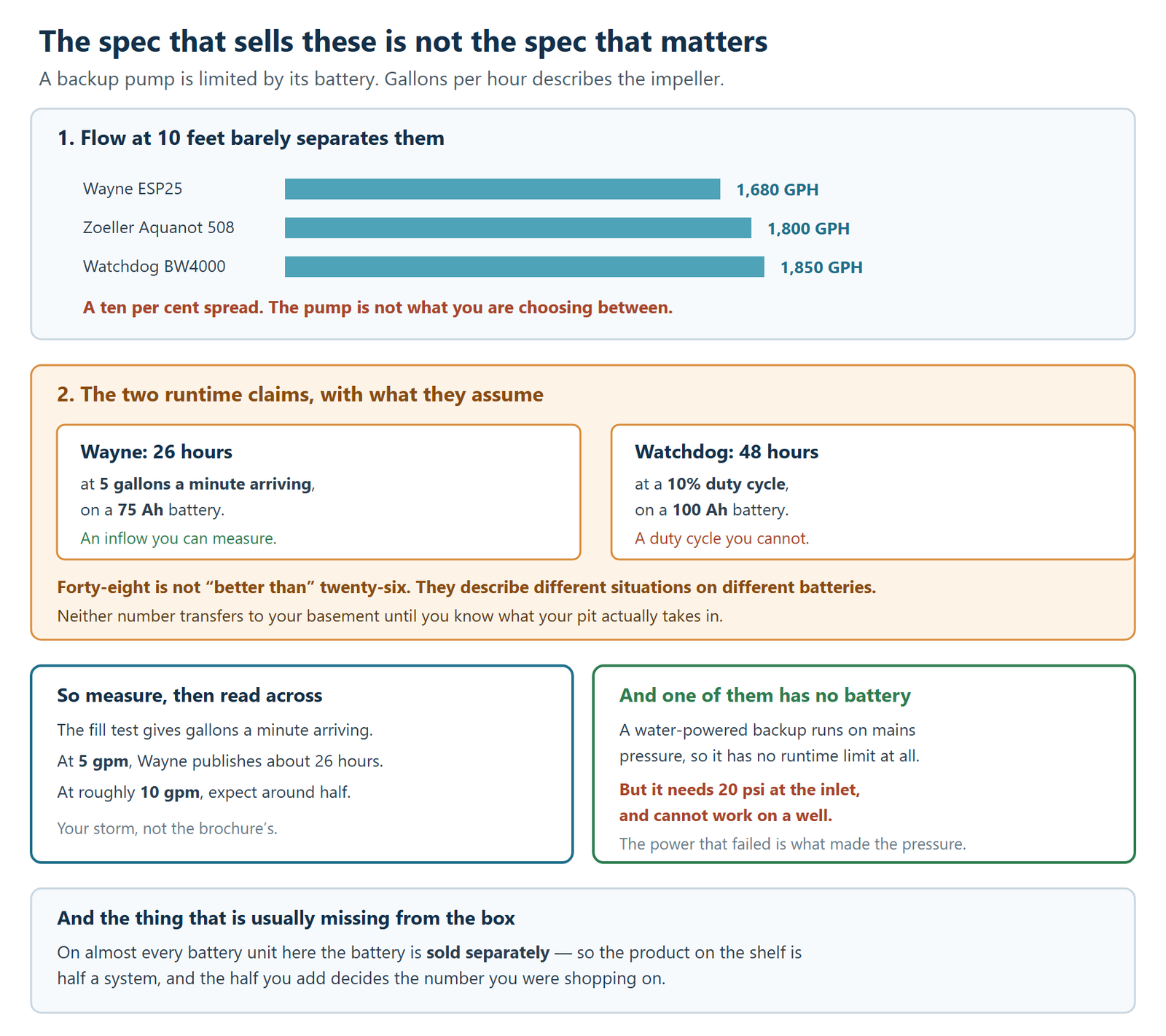
Wayne, on the ESP25: “up to 26 continuous hours of protection” at “5 gallons of incoming water per minute, using a WAYNE 75 amp hour battery.”
Basement Watchdog, on the BW4000: “Up to 48 hours of protection (based on a 10% duty cycle)” — with a 100 Ah battery.
One states an inflow. The other states a duty cycle. On different battery capacities.
Forty-eight is not “better than” twenty-six. They describe different situations, and a round-up that ranks them against each other is comparing numbers that were never measured the same way.
Wayne’s is the one you can use
Because inflow is something you can measure, and this site already published how: the fill test gives you gallons a minute arriving during a storm.
So you can read Wayne’s figure against your own pit. At 5 gpm arriving, about 26 hours. At roughly 10 gpm, expect around half. Not the brochure’s storm — yours.
The other thing to know before you shop
On almost every battery unit here, the battery is sold separately.
The product on the shelf is half a system, and the half you add is the one that determines the runtime figure you were shopping on. A 26-hour claim quoted on a 75 Ah battery is not a 26-hour claim on whatever is in the garage.
Battery or water-powered? They are not the same product
This is where the round-ups blur two different things.
A battery backup stores energy and runs a 12-volt pump from it. It works anywhere, and it stops when the battery is flat.
A water-powered backup uses your municipal water pressure to drive an ejector. It has no battery to charge, maintain or replace, and no runtime limit at all — it will run for as long as the outage lasts.
But it has a hard gate. The Liberty SJ10 accepts 20 to 100 psi of inlet supply pressure, and below that it does not work.
And it cannot work on a well. A well makes its pressure with a pump, and the pump needs the power that just failed.
Two further cautions this site can give and the round-ups cannot. A water softener may legally take up to 15 psi out of your supply, and a house already sitting near the bottom of its range is a marginal candidate. Check your static pressure before you buy one, not after.
It also uses water to move water, which matters if you are on a meter.
The six
Wayne ESP25 — the one that publishes a usable runtime
Wayne ESP25 — 12 V, max flow 2,500 GPH and 1,680 GPH at 10 feet of lift. 1½ or 1¼ inch discharge. Reinforced thermoplastic pump and battery box. User-adjustable reed float switch. Audible alarm when the DC pump is running, plus an LED charge-status light. Two-year limited warranty. Battery sold separately; Wayne specifies its own 75 Ah unit.
Who it is for: anyone who wants to know what they are buying. It is the only unit here whose runtime claim is tied to a measurable inflow, which makes it the only one you can check against your own pit.
The honest drawback: a two-year warranty and the lowest flow figure here at ten feet. And a reed float needs its travel kept clear — Wayne notes the design suits smaller pits, which is a benefit and a constraint at once.
Zoeller Aquanot Fit 508-0014 — the longest warranty
Zoeller Aquanot Fit — 12 V, 1,800 GPH / 30 GPM at 10 feet. Non-corrosive construction. Battery not included. Three-year warranty, the longest on this page.
Who it is for: the buyer who expects the thing to sit unused for years and still work. Zoeller’s three years against everyone else’s two is the clearest single differentiator in this group.
The honest drawback: Zoeller does not publish a runtime figure in the form the others do, so you cannot read it against your inflow. You are buying the pump and the warranty, and estimating the rest.
Zoeller Aquanot Spin 508-0005 — same pump, different controller
Zoeller Aquanot Spin — the same 1,800 GPH at 10 feet, in a different system configuration. Three-year warranty.
Who it is for: the same house as the Fit, where the controller and charger arrangement suits the installation better.
The honest drawback: the family is genuinely confusing. Fit, Spin and Active are sold alongside each other with different chargers, and reseller listings quote charger amperage in a way that reads like pump current. Get the model number right and read Zoeller’s own data sheet for it, not the listing.
Basement Watchdog BW4000 — a whole system rather than an addition
Basement Watchdog BW4000 — a combination unit. Primary: 1/2 hp cast iron, up to 4,400 GPH and 3,200 GPH at 10 feet. Backup: 1,850 GPH at 10 feet — the highest backup flow here. “Up to 48 hours of protection (based on a 10% duty cycle)” with a 100 Ah AGM battery. Two-year warranty.
Who it is for: anyone replacing the primary pump anyway. Buying both together removes the question of whether your existing pump and a new backup will share a discharge sensibly.
The honest drawback: the 48-hour figure rests on a duty cycle you cannot measure, and it assumes a larger battery than Wayne’s claim does. It is not comparable to the 26 hours above, in either direction.
Liberty StormCell 442-10A — the high-head option
Liberty StormCell 442-10A — 12 VDC, 10 A. 46 GPM maximum and 21 feet of maximum head — the highest shut-off figure in this group.
Who it is for: a deeper pit or a longer lift, where a backup rated near the top of its curve at ten feet would have little margin left.
The honest drawback: maximum head and maximum flow are not the same as flow at your lift, and Liberty publishes a curve rather than a table here — the same pattern its primary pumps follow. You are reading a graph where Wayne and Zoeller give you a number.
Liberty SJ10 SumpJet — no battery at all
Liberty SJ10 SumpJet — water-powered. 990 GPH at 10 feet, 11 GPM, 1½ inch discharge. Accepts 20 to 100 psi inlet supply pressure. Three-year warranty.
Who it is for: a house on municipal water with solid pressure, and an owner who does not want a battery to maintain. In a multi-day outage it is the only unit here that does not eventually stop.
The honest drawback: it is the lowest flow on this page by a wide margin, it needs at least 20 psi, and it is useless on a well. It also consumes supply water while it runs.
Side by side
| Unit | Type | At 10 ft | Published runtime | Warranty |
|---|---|---|---|---|
| Wayne ESP25 | Battery | 1,680 GPH | 26 h at 5 gpm inflow, 75 Ah | 2 yr |
| Zoeller Aquanot Fit | Battery | 1,800 GPH | — | 3 yr |
| Zoeller Aquanot Spin | Battery | 1,800 GPH | — | 3 yr |
| Watchdog BW4000 | Battery, combo | 1,850 GPH | 48 h at 10% duty, 100 Ah | 2 yr |
| Liberty StormCell 442-10A | Battery | 46 GPM max, 21 ft max head | — | — |
| Liberty SJ10 SumpJet | Water-powered | 990 GPH | No limit, needs 20 psi | 3 yr |
A dash means the manufacturer does not publish that figure in a comparable form. Nothing here is borrowed from a reseller, and the two runtime figures are shown with their assumptions attached because they cannot be compared without them.
How to choose
Measure your inflow first. Everything else is guesswork without it, and it takes a minute.
Then decide what you are protecting against. A few hours of outage is a different problem from a two-day storm, and the water-powered option only makes sense for the second — and only if your pressure clears 20 psi.
Then read the warranty, because it is the one figure every manufacturer here states the same way.
And check the pit will take it. A backup pump means two pumps sharing one discharge, and that arrangement has its own rules about check valves.
When this needs a pro
The discharge plumbing, which is where a backup installation most often goes wrong.
Anything electrical, including the charger and its circuit.
Battery siting and ventilation. Lead-acid batteries in a basement are a considered decision rather than a shelf.
What you can do yourself: run the fill test, note your pit diameter and lift, and check your static water pressure if a water-powered unit is on the list. Three numbers, and they narrow this page to one or two rows.
FAQ
How long will a battery backup sump pump run?
It depends on your inflow and your battery, which is why the manufacturers’ figures differ so much. Wayne publishes about 26 hours at 5 gallons a minute of inflow on a 75 Ah battery; Basement Watchdog publishes up to 48 hours at a 10% duty cycle on a 100 Ah battery. The two are not comparable.
Is a higher GPH battery backup pump better?
Not meaningfully. Flow at ten feet across these units spans about ten per cent, from 1,680 to 1,850 GPH. A faster pump also draws the battery down faster, so the figure that matters is how long it keeps going at your inflow.
Does a battery backup sump pump come with a battery?
Usually not. On almost every unit here the battery is sold separately, and since the runtime claims are quoted against a specific battery capacity, the one you choose determines whether those claims apply.
Is a water-powered backup better than a battery one?
It is different rather than better. It never runs out, because it uses mains pressure instead of stored energy, but it needs at least 20 psi at the inlet, moves less water, consumes supply water, and cannot work on a well.
Can I use a water-powered backup on a well?
No. A well system makes its pressure with an electric pump, and in a power cut that pump is the thing that has stopped. Water-powered backups only work on municipal supply.
What size battery do I need for a backup sump pump?
Follow the figure the manufacturer quoted its runtime against — 75 Ah for Wayne’s 26-hour claim, 100 Ah for the Basement Watchdog figure. Fitting a smaller battery than the one the claim assumed changes the claim.


