On this page
Last Updated on September 30, 2026 by Muhammad Toqeer
Look into the pit while the pump is running, before you touch anything. If water is visibly streaming in, the pump is working correctly and you have a source problem. If the pit is nearly empty and it is still running, the water was never the issue — it is the float.
And if it has not rained, the most likely source is the pipe the pump is filling. Water dumped too close to the house soaks back down to the drain tile and arrives in the pit again.
The loop most people never consider
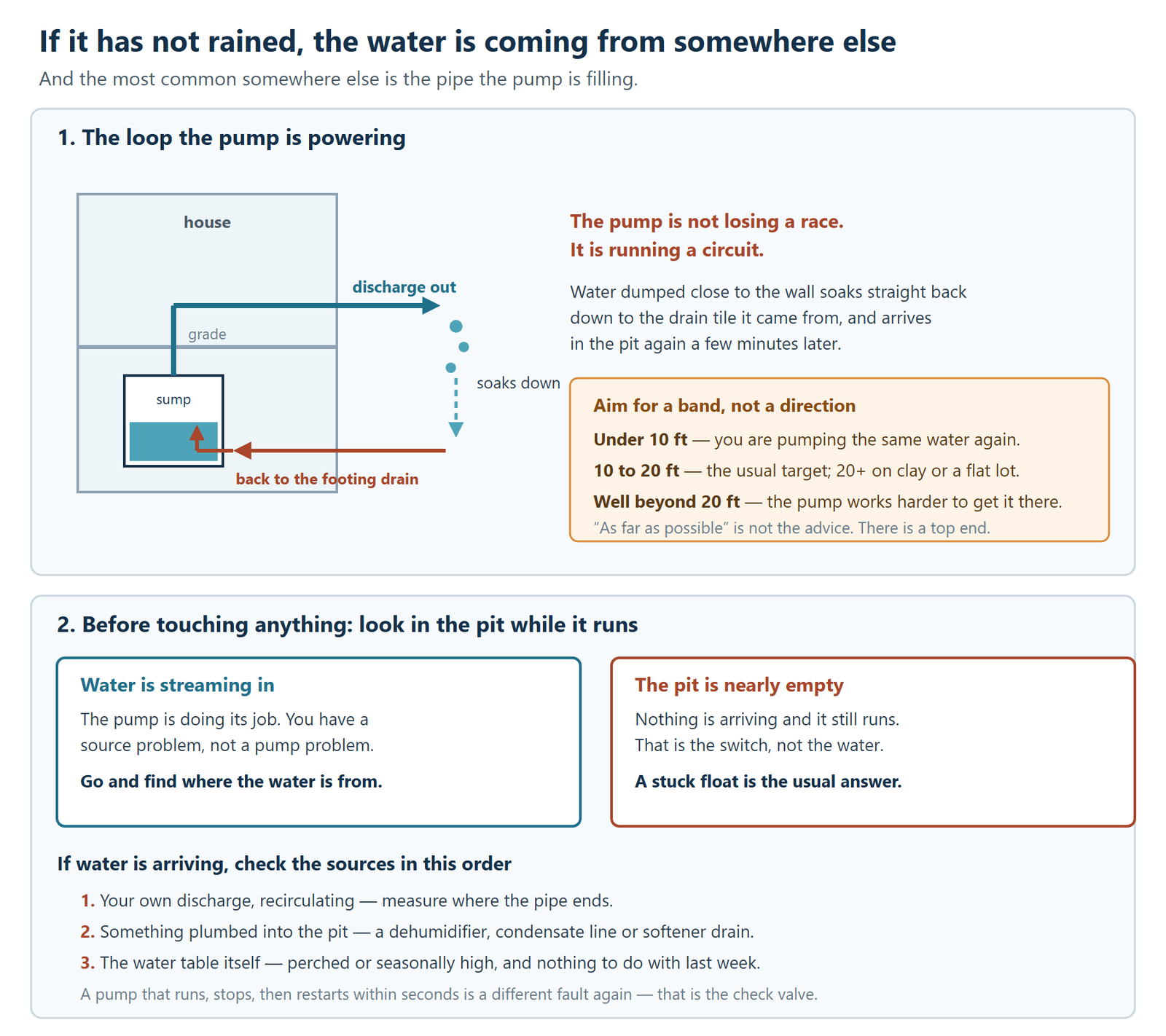
A sump pump discharges into the ground beside your house, not into the sewer. If that pipe ends too close to the wall, the water it just removed soaks down through the soil, reaches the drain tile around your footings, and comes straight back.
The pump is not losing a race against groundwater. It is running a circuit it powers itself, and it will keep doing it in a dry week, a dry month, and until somebody moves the pipe.
The distance is a band, not a direction
- Under 10 feet from the foundation — you are pumping the same water again
- 10 to 20 feet — the usual target, and 20 or more on clay soil, a flat lot, or where the water table is high
- Well beyond 20 feet — the pump now works noticeably harder to push water that far
“As far as possible” is not the advice. There is a top end, and pushing past it costs you in pump life what you gained in distance.
One-minute check: walk outside and find where the pipe ends. If you can touch the house from it, you have found your problem.
Look in the pit first
This splits everything before you spend money.
Water streaming in while it runs → the pump is doing its job. Something is feeding the pit and the pump is the messenger.
A nearly empty pit and a running pump → nothing is arriving. The switch is not telling it to stop. A float jammed against the basin wall, tangled in the power cord, or caught on the pump housing is the single most common cause of this, and it is what you are looking at.
Runs, stops, then restarts within seconds → a third thing entirely. The column of water in the discharge pipe is draining back down and being pumped again. That is the check valve, and the mechanism is the same one a sewage pit shows.
If water is arriving, check the sources in this order
1. Your own discharge
Covered above, and it is first because it is common, free to check, and invisible from inside the house.
2. Something plumbed into the pit
A pit is a convenient hole, and things get routed into it. A dehumidifier hose, a condensate line from the furnace or air handler, a water softener’s regeneration discharge.
Any of those feeds the pit year-round with no weather involved at all. A dehumidifier working hard in a damp basement produces a meaningful volume every day.
Whether a condensate line is even allowed to go there is a separate question worth knowing the answer to, and it is not the one most people assume.
3. The water table itself
Groundwater does not track last week’s weather. A high or perched water table can keep a pit working for weeks after the rain stopped, and some sites simply sit in wet ground all season.
If the discharge is properly sited, nothing is plumbed in, and water is still arriving steadily — this is the answer, and it is not a fault. It is what the pump is for.
What matters then is whether the pump is keeping up, and whether you have any protection if it stops.
When it is the float
A stuck float is a mechanical problem in a pit full of water and a live electrical device. The pump is running continuously, which means it is hot.
Kill the power at the breaker first — not at the plug, if reaching the plug means reaching over the pit.
Then look, without reaching in. Most stuck floats are visible: a tether wrapped around the discharge pipe, a vertical float riding against the basin wall, or debris wedged under the arm.
Freeing it is not always the fix. A float that catches once will catch again, and a pit that is too narrow for a tethered float is a pit that needs a different switch — which is a decision about hardware rather than a repair.
What running constantly costs the pump
Sump pumps are not rated for continuous duty. The motor is cooled by the water it moves and by the pauses between cycles, and it has neither when it never stops.
A pump that has run continuously for days has been damaged whether or not it is still working, which is worth knowing before you fix the source and assume you are finished. If it is due for replacement, the published flow at your lift matters more than the horsepower on the box.
When this needs a pro
Moving or extending the discharge line. It is drainage work, where it terminates is often regulated, and getting it wrong sends the water somewhere worse.
Anything electrical in or near the pit, including a pump that has been running hot.
A genuinely high water table. If the pit is working continuously because the ground is saturated, that is a drainage and waterproofing question rather than a pump question.
And a pit that keeps destroying pumps. Something is doing it, and fitting a third pump is not a diagnosis.
What you can do yourself: look in the pit while it runs, note whether water is arriving, walk outside and find where the discharge ends, and check whether anything else drains into the pit. That is four observations and no tools, and it selects the cause.
FAQ
Why is my sump pump running when it has not rained?
Most often because the water it is pumping out is coming back. A discharge line ending within about ten feet of the foundation lets the water soak down to the drain tile and return to the pit. Other sources are things plumbed into the pit and a naturally high water table.
How far should a sump pump discharge be from the house?
At least 10 feet, with 15 to 20 feet preferred, and 20 or more on clay soil or a flat lot. Beyond roughly 20 feet the pump has to work harder to push the water, so it is a band rather than a case of as far as possible.
How do I tell if my sump pump float is stuck?
Look in the pit while it is running. If water is visibly arriving, the pump is doing its job. If the pit is nearly empty and it still runs, nothing is telling it to stop and the float is the suspect.
Can a dehumidifier make a sump pump run constantly?
Yes, if its hose drains into the pit. So can a condensate line or a water softener discharge. All three feed the pit continuously regardless of weather, and all three are easy to miss because they look like they belong there.
Is it bad for a sump pump to run continuously?
Yes. Sump pumps are not rated for continuous duty and rely on the water they move and the pauses between cycles for cooling. A pump that has run non-stop for days may be damaged even if it is still working.
Why does my sump pump run, stop, then start again seconds later?
That is usually the check valve rather than the water source. The column of water standing in the discharge pipe drains back into the pit after each cycle and gets pumped again straight away.


