On this page
Last Updated on September 30, 2026 by Muhammad Toqeer
Two 1/3 hp sump pumps on the same shelf are within two gallons a minute of each other at five feet of lift. At fifteen feet, one moves twice what the other does. Same nameplate, different curve — and the curve is the thing nobody compares.
Every figure below is from the manufacturer’s own published sheet, converted into one unit so the pumps can actually be set against each other.
Compare them at the height your pit actually lifts to
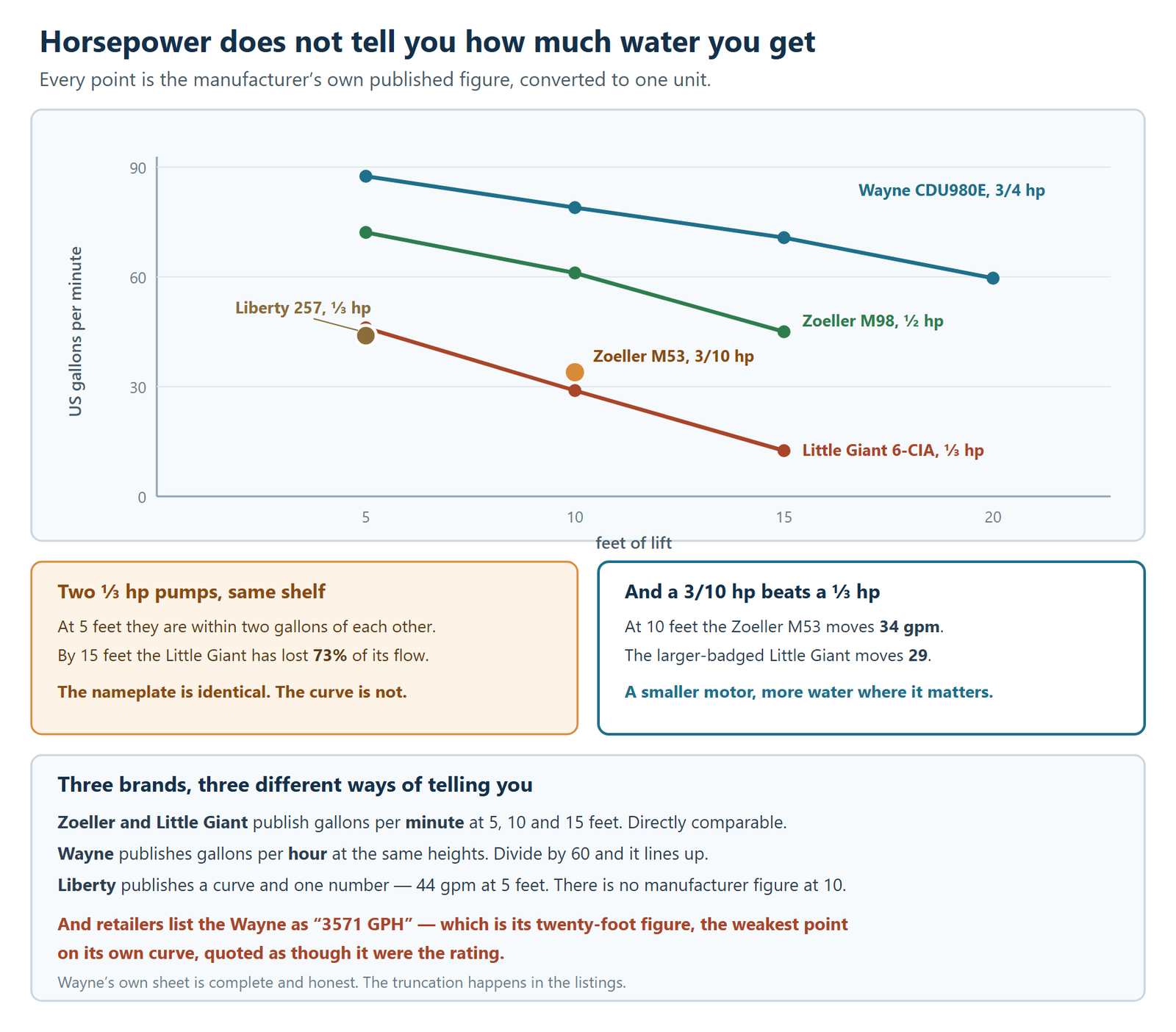
A sump pump’s rating means nothing without the lift it was measured at. A basement pit typically lifts eight to twelve feet to get above grade, then runs horizontally. Ten feet is the honest place to compare.
Here is what that does to the line-up:
| Pump | HP | 5 ft | 10 ft | 15 ft | Shut-off | Warranty |
|---|---|---|---|---|---|---|
| Wayne CDU980E | 3/4 | 87 | 79 | 71 | 60 gpm at 20 ft | 5 yr |
| Zoeller M98 | ½ | 72 | 61 | 45 | 23 ft | 3 yr |
| Liberty 257 | 1/3 | 44 | — | — | 23 ft | 3 yr |
| Zoeller M53 | 3/10 | — | 34 | — | 19 ft | 3 yr |
| Little Giant 6-CIA | 1/3 | 46 | 29 | 12.5 | 18 ft | 3 yr |
US gallons per minute. Wayne’s figures converted from the gallons per hour its sheet uses. A dash means the manufacturer does not publish that figure — nothing here is borrowed from a reseller.
The comparison that should end horsepower shopping
Liberty 257 and Little Giant 6-CIA are both 1/3 hp. At five feet they are two gallons apart — 44 against 46.
By fifteen feet the Little Giant is down to 12.5 gpm, having lost 73% of its five-foot flow. Its shut-off head is 18 feet, the lowest here.
And the Zoeller M53 is a 3/10 hp pump — smaller than either — yet at ten feet it moves 34 gpm against the Little Giant’s 29.
A smaller motor, more water, at the height your pit actually works at. Horsepower is a motor rating, not a flow rating.
Read the units before you read the number
Three brands, three conventions:
- Zoeller and Little Giant publish gallons per minute at 5, 10 and 15 feet. Directly comparable.
- Wayne publishes gallons per hour at the same heights. Divide by 60 and it lines up.
- Liberty publishes a performance curve plus one figure — 44 gpm at 5 feet — and a 23-foot shut-off. There is no manufacturer number at ten feet, so this page leaves it blank rather than filling it from a reseller.
One retail habit is worth naming. Listings routinely give the Wayne CDU980E as “3571 GPH.” That is Wayne’s twenty-foot figure — the weakest point on its own curve — quoted as though it were the pump’s rating. Wayne’s own sheet is complete and honest; the truncation happens downstream, and it makes the strongest pump on this page look like the weakest.
The five
Wayne CDU980E — the most pump here, and the longest warranty
Wayne CDU980E — 3/4 hp, 120 V PSC oil-filled motor, 1½-inch NPT discharge, cast iron and stainless steel. 5245 GPH at 5 feet, 4743 at 10, 4240 at 15, 3571 at 20 — which is 87, 79, 71 and 60 gpm. Integrated vertical float, 9-inch on and 4-inch off. 8-foot cord. Five-year limited warranty.
Who it is for: a pit that fills faster than a smaller pump can empty it, a long or high discharge run, or a basement where the consequence of the pump losing the race is serious.
The honest drawback: an 8-foot cord, the shortest here, on a pump that needs a dedicated outlet — and it is a physically larger, heavier unit than a 1/3 hp pump in a narrow pit. Check your pit diameter and your outlet distance before ordering.
Zoeller M98 Flow-Mate — the balanced one
Zoeller M98 — ½ hp, 115 V, 9.4 A, 1½-inch NPT discharge, cast iron. 72 gpm at 5 feet, 61 at 10, 45 at 15. Shut-off 23 feet. Three-year warranty.
Who it is for: most houses with a genuinely wet basement. It holds 61 gpm at the height a real pit lifts to, which is nearly double the common 1/3 hp pumps, without stepping up to the Wayne’s size.
The honest drawback: it loses 37% of its flow between 5 and 15 feet, so on an unusually high lift the margin narrows faster than the headline suggests. And at ½ hp it draws 9.4 A — worth knowing if the circuit is shared.
Liberty 257 — the best-documented small pump
Liberty 257 — 1/3 hp, 115 V, 5.2 full load amps, 1½-inch discharge, ½-inch solids, vortex engineered polymer impeller, class 25 cast iron, oil-filled motor, vertical magnetic float, 10-foot cord. 44 gpm at 5 feet; shut-off 23 feet. Three-year warranty.
Who it is for: a normal basement with a normal water problem, where 5.2 amps and a 10-foot cord matter more than peak flow. Its 23-foot shut-off is the same as the ½ hp Zoeller’s, which tells you the curve holds up rather than collapsing.
The honest drawback: Liberty publishes a curve, not a table. There is no manufacturer figure at ten feet to set against the others, so you are reading a graph where the competition gives you numbers.
Zoeller M53 Mighty-Mate — the one that beats its own badge
Zoeller M53 — 3/10 hp (not 1/3, whatever the listings say), 115 V, 9.7 A, 1½-inch NPT discharge, passes ½-inch solids, cast iron with powder-coated epoxy. 34 gpm at 10 feet, 43 gpm maximum, 19-foot maximum head, 9-foot cord. Three-year warranty.
Who it is for: the default small sump pump, and deservedly so. It outperforms nominally larger pumps at working height.
The honest drawback: 19 feet of maximum head is the second-lowest here, so a high discharge or a long vertical run eats its margin quickly. And it draws 9.7 A — nearly double the Liberty 257’s 5.2, despite both being small pumps — which is counterintuitive and worth checking against your circuit.
Little Giant 6-CIA — included because its curve is the lesson
Little Giant 6-CIA — 1/3 hp, 115 VAC, 9 A, 1½-inch female thread discharge, under ½-inch solids, epoxy-coated cast iron, diaphragm switch, 10- or 25-foot cord options. 46 gpm at 5 feet, 29 at 10, 12.5 at 15. Shut-off 18 feet. Three-year warranty.
Who it is for: a shallow lift and a pit that does not fill fast. Little Giant notes it fits and operates in a 5-gallon bucket, which is genuinely useful in a tight or shallow pit.
The honest drawback: the steepest decline on this page. It loses 73% of its flow between 5 and 15 feet and shuts off at 18. If your discharge lifts more than about ten feet, this is not the pump — and its nameplate will not warn you.
How to choose in two minutes
Measure the lift. From the pump to the point where the discharge leaves the house and starts running downhill. That is the row of the table to read.
Read across, not down. The 10-foot column is the one that describes your basement. The horsepower column describes the motor.
Check the cord reaches the outlet, because a sump pump must never run on an extension cord, and cords here run from 8 to 25 feet.
Then check the warranty, which is the only figure on this page that every manufacturer states the same way — and it ranges from three years to five.
Before you buy
Confirm which pit you have. A sump pit and a sewage ejector pit look alike and are legally separate systems — none of these pumps belongs in a sewage pit.
And if you were planning to use something you already own, the utility pump substitution question has a specific answer that is worth reading first.
When this needs a pro
The discharge line and where it terminates. That is drainage work, it is inspected in many places, and it determines whether the water comes back.
Electrical work in or near the pit, including adding a dedicated outlet.
A pit that keeps killing pumps. Replacing the same pump again is treating a symptom — something about the pit, the switching or the discharge is doing it.
FAQ
What size sump pump do I need?
Measure the vertical lift from the pump to where the discharge leaves the house, then read each pump’s flow at that height rather than its horsepower. For a typical basement lifting around ten feet, 30 to 60 gpm at ten feet covers most situations.
Is a 1/2 hp sump pump better than a 1/3 hp?
Usually but not always, and the gap is smaller than it sounds. Two 1/3 hp pumps here differ by more than double at fifteen feet, and a 3/10 hp Zoeller outperforms a 1/3 hp Little Giant at ten feet. Compare the published flow at your lift.
How many GPM should a sump pump deliver at 10 feet?
The pumps here range from 29 to 79 gpm at ten feet. What you need depends on how fast your pit fills, but anything under about 30 gpm at ten feet is a light-duty pump and will struggle in a genuinely wet basement.
Why do some sump pumps list GPH and others GPM?
It is a manufacturer convention rather than anything technical. Wayne publishes gallons per hour, Zoeller and Little Giant gallons per minute. Divide GPH by 60 to compare them, and always check what head the figure was measured at.
Which sump pump has the longest warranty?
Of the pumps here, the Wayne CDU980E carries a five-year limited warranty. The Zoeller and Liberty models and the Little Giant all carry three years.
Can I put a sump pump in a sewage ejector pit?
No. A sump pump is built for groundwater, and the code prohibits sumps handling subsoil drainage from receiving sewage and vice versa. A sewage pit needs a pump rated for solids and a sealed, vented basin.


