On this page
Last Updated on September 27, 2026 by Muhammad Toqeer
Buy on gallons per minute at your own cut-out pressure, not on horsepower. Every listing prints one flow figure per pump, and those figures are measured at different pressures, at different suction lifts, and in one case in different units entirely.
Restate them at matched conditions and the ranking changes. The pump that looks strongest on a category page is usually the one measured furthest from where it will actually run.
The number on the box
Here is the whole problem in one table, using each manufacturer’s own published figures.
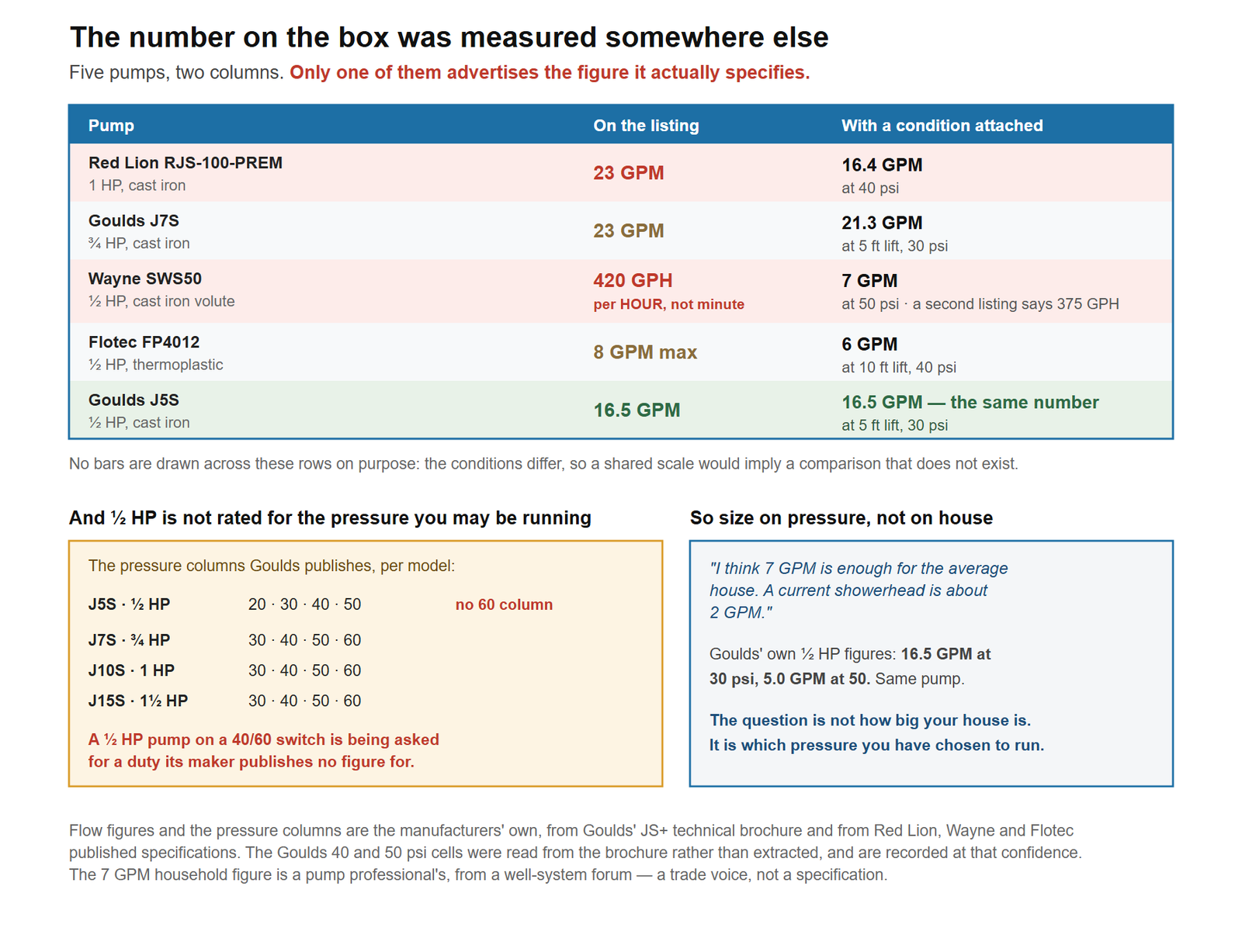
Three things worth pulling out of that.
A 1 HP pump advertised at 23 GPM is specified at 16.4 GPM at 40 psi. Not a lie — just a maximum, measured at a condition nobody runs at.
**Wayne publishes in gallons per hour.** “Up to 420 gallons of fresh water per hour at 50 PSI” is 7 GPM. Next to a competitor’s “8 GPM” on a shelf, 420 looks like a different class of machine. It is the smaller number.
And two Amazon listings for that same Wayne pump say 420 and 375. Same model, same manufacturer.
The comparison
Every figure below is the manufacturer’s, with the measuring condition attached wherever one was published. Where no condition was given, that is stated rather than guessed.
| Pump | HP | Body | Flow, as published | Lift | Warranty |
|---|---|---|---|---|---|
| Goulds J5S | ½ | Cast iron | 16.5 GPM @ 5 ft, 30 psi | 25 ft | — |
| Goulds J7S | ¾ | Cast iron | 21.3 GPM @ 5 ft, 30 psi | 25 ft | 3 yr |
| Red Lion RJS-100-PREM | 1 | Cast iron | 16.4 GPM @ 40 psi | 25 ft | 3 yr |
| Red Lion RJS-50-PREM | ½ | Cast iron | 12 GPM, no condition given | 25 ft | 3 yr |
| Wayne SWS50 | ½ | Cast iron volute | 420 GPH @ 50 psi (= 7 GPM) | 25 ft | 3 yr |
| Flotec FP4012 | ½ | Thermoplastic | 6 GPM @ 10 ft, 40 psi | 25 ft | — |
All six share the same hard limit: 25 feet. That is not a product difference, it is atmospheric pressure, and no jet pump beats it. If your water sits deeper than that, none of these is your pump.
If that is you, the submersible guide is the one you want — and it is a different buying decision, because there horsepower buys depth rather than flow.
The picks
Goulds J5S — ½ HP, the reference
Who it is for: an average house on a 30/50 switch with water within about 10 feet of the surface.
It is the only pump here whose advertised number is its specified number — 16.5 GPM at 5 feet of lift and 30 psi, condition attached, on the listing. The JS+ range is NSF/ANSI 61 and 372 listed for drinking water, still built in the USA, with a glass-filled Noryl impeller and a Lexan diffuser carrying a stainless wear ring. The shallow well adapter is cast into the casing rather than bolted on, and the back pullout design lets it come apart for service “without disturbing piping” — which matters more than it sounds like when the pump is plumbed into a tank tee.
A well contractor on Terry Love’s forum put the brand question bluntly:
“In my humble but experienced opinion nobody makes a better jet pump than Gould’s.”
The honest drawback: Goulds does not publish a 60 psi rating for it. If you run a 40/60 switch, this is not the model in the range for you — and that is the manufacturer telling you, not a reviewer.
Goulds J7S — ¾ HP, the one for a 40/60 switch
Who it is for: anyone running higher pressure, or with two bathrooms in use at once.
21.3 GPM at 5 feet and 30 psi, and — the part that actually decides it — Goulds rates it at 30, 40, 50 and 60 psi. The same contractor’s advice on sizing:
“I would go with the 3/4 hp”
because it keeps pressure up while water is being used. He reserves the ½ HP for livestock wells.
The honest drawback: you are paying for 50% more motor to get about 29% more flow at 30 psi. If you run 30/50 and have one bathroom, that is money spent on headroom you may never use.
Red Lion RJS-100-PREM — 1 HP, the complete package
Who it is for: someone replacing a whole failed setup who wants the switch and gauge already fitted.
Cast iron body and volute, 1-1/4″ FNPT suction and 1″ FNPT discharge, dual voltage at 115/230 V (13 A / 6.5 A), and it ships with a factory pre-set 30/50 pressure switch and a pressure gauge. Three-year limited warranty.
The honest drawback: the one on the listing. Advertised at 23 GPM, specified at 16.4 GPM at 40 psi. And its maximum pressure is given as 65 psi by one retailer and 71 psi by another — a spec its own sellers do not agree on.
Red Lion RJS-50-PREM — ½ HP, the same build, smaller
Who it is for: a smaller house wanting Red Lion’s cast iron and 3-year warranty without the 1 HP motor.
Same construction, same 25-foot limit, same warranty.
The honest drawback: Red Lion publishes 12 GPM with no condition attached — no pressure, no lift. That number cannot be compared with anything else on this page, and this guide will not pretend otherwise.
Wayne SWS50 — ½ HP, assembled in the USA
Who it is for: a straightforward 30/50 installation where a dedicated priming port earns its keep.
Cast iron volute, dual voltage with a 115 V factory default, a 30–50 psi pre-set switch, a three-year warranty, and “a dedicated priming port for volute filling” — genuinely useful, because priming is where jet pumps go wrong.
The honest drawback: the units. 420 GPH at 50 psi is 7 GPM, and Wayne is the only maker here publishing in gallons per hour. Worth knowing that the second figure on another of its own listings is 375 GPH.
Flotec FP4012 — ½ HP, the most honest spec sheet
Who it is for: corrosive or mineral-heavy water, where thermoplastic outlasts cast iron.
The reason it is here: “maximum capacity of 8 GPM and flow at 10′ lift and 40 psi of 6 GPM.” That is a complete specification — a maximum, a working figure, a lift and a pressure. Nobody else on this page publishes all four.
The honest drawback: it is punished for that honesty. 6 GPM is the smallest number on the shelf, so it loses to pumps quoting maximums, and thermoplastic is genuinely less tolerant of a dry run than cast iron.
½ HP or ¾ HP?
The usual answer is “size it to your house”. That is the wrong variable.
Household demand is smaller than people think. From the same forum:
“I think 7 GPM is enough for the average house. A current showerhead is about 2 GPM.”
Every ½ HP pump here meets that comfortably at 30 psi. The variable that breaks them is pressure, and the manufacturer’s own figures show it: the Goulds J5S delivers 16.5 GPM at 30 psi and 5.0 GPM at 50. Same pump, same lift. The switch setting did that.
So the rule is:
- 30/50 switch, one bathroom, water within ~10 ft → ½ HP is genuinely enough.
- 40/60 switch, or two bathrooms in use together, or lift approaching 25 ft → ¾ HP or more, and note that raising the switch costs you flow twice over.
What about the 1.6 HP stainless pumps?
They dominate the marketplace listings, and this guide does not recommend any of them.
Not because imported pumps are automatically bad, but because none published what a recommendation requires: a flow figure at a stated pressure and lift, a spec sheet, or verifiable warranty terms. A horsepower number with nothing attached to it is not a specification — and on this page you have already seen that even the established brands’ headline numbers need a condition before they mean anything.
There is also a cautionary note from the forum thread that started this research. The homeowner was replacing a budget ½ HP pump that never delivered adequate pressure and developed shaft seal leaks after a year.
Before you buy, get three numbers from your own system
None of the above helps until you know these, and all three come from your house rather than a catalogue.
- Your cut-out pressure. Printed on the pressure switch, or read it off the gauge when the pump stops. This is the column you read the pump’s table at.
- Your suction lift — the vertical distance from the water surface up to the pump, not the depth of the well. Pump tables are indexed on it, and every figure above gets worse as it rises.
- What your well actually yields. A pump cannot deliver more than the well makes, and that ceiling overrides both of the other numbers.
With those three, the tables on this page stop being marketing and start being a specification.
FAQ
What size shallow well jet pump do I need?
Work from your cut-out pressure and suction lift rather than your house size. An average house needs around 7 GPM, which a ½ HP pump delivers comfortably at 30 psi. If you run a 40/60 switch or have water near the 25-foot limit, move up to ¾ HP.
How deep can a shallow well jet pump go?
About 25 feet of suction lift, and that is physics rather than a product limit — every pump on this page carries the same figure. Below that depth you need a convertible jet with a downhole ejector, or a submersible.
Why do two pumps with the same GPM perform differently?
Because the figures are measured at different conditions. One maker’s 23 GPM is a maximum at low pressure; another’s 21.3 GPM is measured at 5 feet of lift and 30 psi. Compare only figures that state the same pressure and lift.
Is cast iron better than thermoplastic for a jet pump?
Cast iron is more tolerant of heat and a dry run, which makes it the safer default. Thermoplastic resists corrosion better and is worth considering if your water is mineral-heavy or aggressive.
Is a 1 HP jet pump better than a ½ HP?
Only if you are running higher pressure or drawing from near the suction limit. More horsepower does not add flow at a given pressure the way people expect — and it cannot make the well yield more than it has.
Do these pumps come with a pressure switch?
Several do. The Red Lion RJS-PREM models ship with a factory pre-set 30/50 switch and a gauge, and the Wayne SWS50 has a 30–50 psi switch fitted. Check the listing before comparing two models, because one may already include parts the other expects you to buy.


