On this page
Last Updated on September 28, 2026 by Muhammad Toqeer
Pressure and flow are two different faults and almost every article on this subject treats them as one. Pressure is what the gauge reads, and your pressure switch sets it. Flow is what arrives at the shower. A restriction can strangle the flow while the gauge sits at a perfectly healthy 50 psi.
One gauge and one running tap tell you which you have, and the answer decides whether the problem is in your well or in your hallway cupboard.
The test
Fit a hose-thread pressure gauge to a boiler drain, a laundry connection, or an outside tap. Then open a fixture and watch the needle while the water is running.
That last part is the whole thing. Goulds says it in its own sizing guidance:
“Verify the incoming pressure with the water flowing to find the dynamic suction pressure, static pressure is what you see with no water flowing. Use the dynamic suction pressure to calculate pump performance and selection.”
A reading taken with the house shut tells you nothing. Three outcomes:
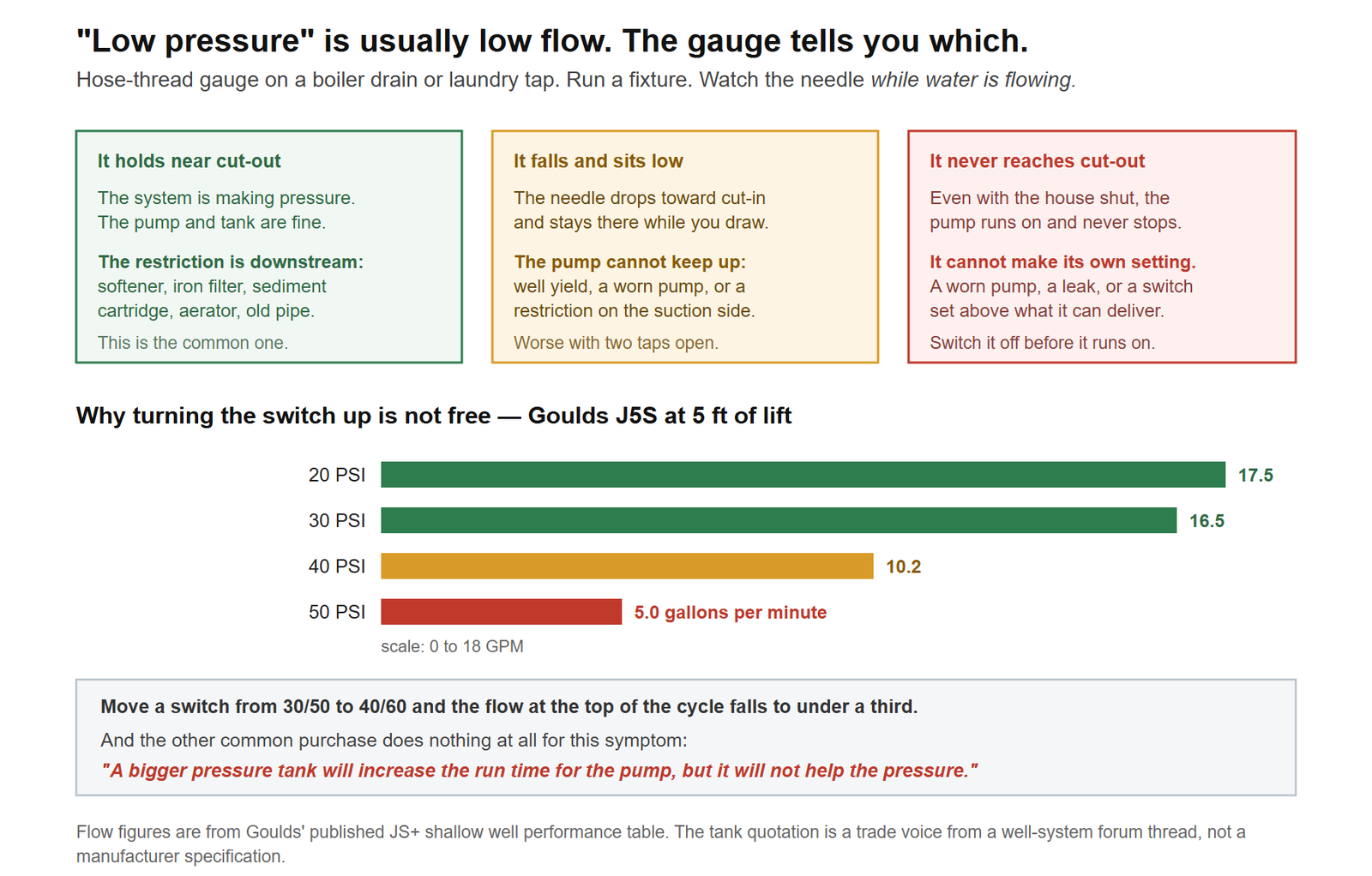
If the needle holds
The pump built pressure, the tank is holding it, and the gauge stays up near cut-out while water runs. The pump and tank are fine. Whatever is strangling your shower is between that gauge and the fixture.
On a well, that list is longer than on city water, because there is usually treatment equipment in the way.
Start with the water softener and the filters. This is the one people never suspect and it is extremely common. A homeowner on Terry Love’s forum chased weak upstairs pressure for weeks before finding it:
“When I bypass the softener, water pressure is noticeably improved.”
The resin bed had degraded and was restricting flow, and iron in the softener valve showed that an upstream iron filter had stopped doing its job too.
One-minute test: if your softener has a bypass, put it in bypass and run the tap again. A noticeable improvement is your answer. Sediment cartridges are the same story — a cartridge at the end of its life is a restriction long before it looks dirty.
Then the cheap stuff. Aerators and shower heads silt up, especially on well water carrying iron or hardness. Unscrew one and look.
Then the pipe. Old galvanised pipe closes up from the inside over decades. If it is worst at the furthest or highest fixture and the house is old, that is the shape of it.
If the needle falls and sits low
The gauge drops toward cut-in and stays there for as long as you keep drawing. The pump is running flat out and losing.
It is worse with two fixtures open — a shower going to a trickle when the washing machine fills is the classic report.
Causes, roughly in order:
- The well cannot supply it. Yield falls in dry seasons and under heavy draw. If it recovers after an hour of rest, that is what you have.
- The pump has worn. Impellers lose efficiency gradually, and a pump that managed the house five years ago may not now.
- A restriction on the suction side, if it is a jet pump — the same suction-side problems that stop a pump entirely can throttle it short of that. The suction-leak test is here.
If it never reaches cut-out
Shut everything off and the pump still will not stop. It cannot make its own setting, which is a different and more urgent problem.
Either the pump has lost enough performance that it cannot reach the cut-out figure, something is leaking as fast as it pumps, or the switch has been set above what the pump can deliver.
Switch it off rather than letting it run on. A pump that never reaches shut-off is a pump running continuously, and that is how a fixable fault becomes a replacement.
If that is your actual complaint — the pump simply will not stop — one gauge reading separates a failed switch from a system that cannot reach cut-out, and they need completely different repairs.
The two fixes that will not help
Both are common, and one of them makes things worse.
Turning the pressure switch up
This looks free. It is not, and the manufacturer’s own numbers show why. Goulds’ published table for the J5S at 5 feet of lift:
| Discharge pressure | Flow |
|---|---|
| 20 PSI | 17.5 GPM |
| 30 PSI | 16.5 GPM |
| 40 PSI | 10.2 GPM |
| 50 PSI | 5.0 GPM |
Between 30 and 50 psi the flow falls to under a third. Moving a switch from 30/50 to 40/60 raises the number on the gauge and takes away most of the water at the top of the cycle — which is exactly why people do it and then report the shower got worse.
If you do change the settings, the tank’s pre-charge has to be reset to match, or you have created a second fault: the charge must sit 2 psi below cut-in, and that is covered with the tank.
Buying a bigger pressure tank
A larger tank stores more water between cycles, which means the pump runs less often. It does not change the pressure at all. The blunt version, from the same forum thread:
“A bigger pressure tank will increase the run time for the pump, but it will not help the pressure.”
Worth spending on for pump life. Useless for this symptom.
When this needs a pro
Anything that means pulling the pump, including establishing that it has worn out.
Deciding whether a well’s yield has dropped permanently. Seasonal recovery and a failing well look identical over a weekend and different over a year, and a driller answers it.
Any work inside the pressure switch with power on — line voltage, often 240 V, in a damp place.
Water treatment that has failed closed. Bypassing a softener to test it is reasonable. Rebuilding one, or working out why an iron filter stopped regenerating, is its own trade — and if iron is reaching the softener, it may also be behind other symptoms.
And if the pump really has lost capacity, the flow figures on the listings are not comparable with each other — restate them at your own cut-out pressure first.
FAQ
Why is my well water pressure low?
Check whether it is pressure or flow. Put a gauge on a hose bib and run a fixture: if the needle holds near cut-out, your pump and tank are fine and something downstream is restricting flow. If it drops and stays down, the pump cannot keep up.
Will a bigger pressure tank increase my water pressure?
No. A bigger tank lengthens the pump’s run time and reduces how often it starts, which is good for the pump, but it does not raise the pressure by a single psi.
Should I turn up my pressure switch to get better pressure?
Be careful. Flow falls sharply as discharge pressure rises — Goulds’ own table for a half-horsepower jet pump shows 16.5 GPM at 30 psi against 5.0 GPM at 50. You may gain pressure and lose most of the water. If you do change it, reset the tank’s pre-charge to 2 psi below the new cut-in.
Can a water softener cause low water pressure?
Yes, and it is one of the most missed causes on well systems. A degraded resin bed or a fouled valve restricts flow while the gauge upstream still reads normal. If the softener has a bypass, test it.
Why does my shower go weak when the washing machine runs?
That is the signature of a supply that cannot meet combined demand — the well’s yield, a worn pump, or a restriction on the suction side — rather than a pressure setting. Watch the gauge while both are running.


