On this page
Last Updated on September 22, 2026 by Muhammad Toqeer
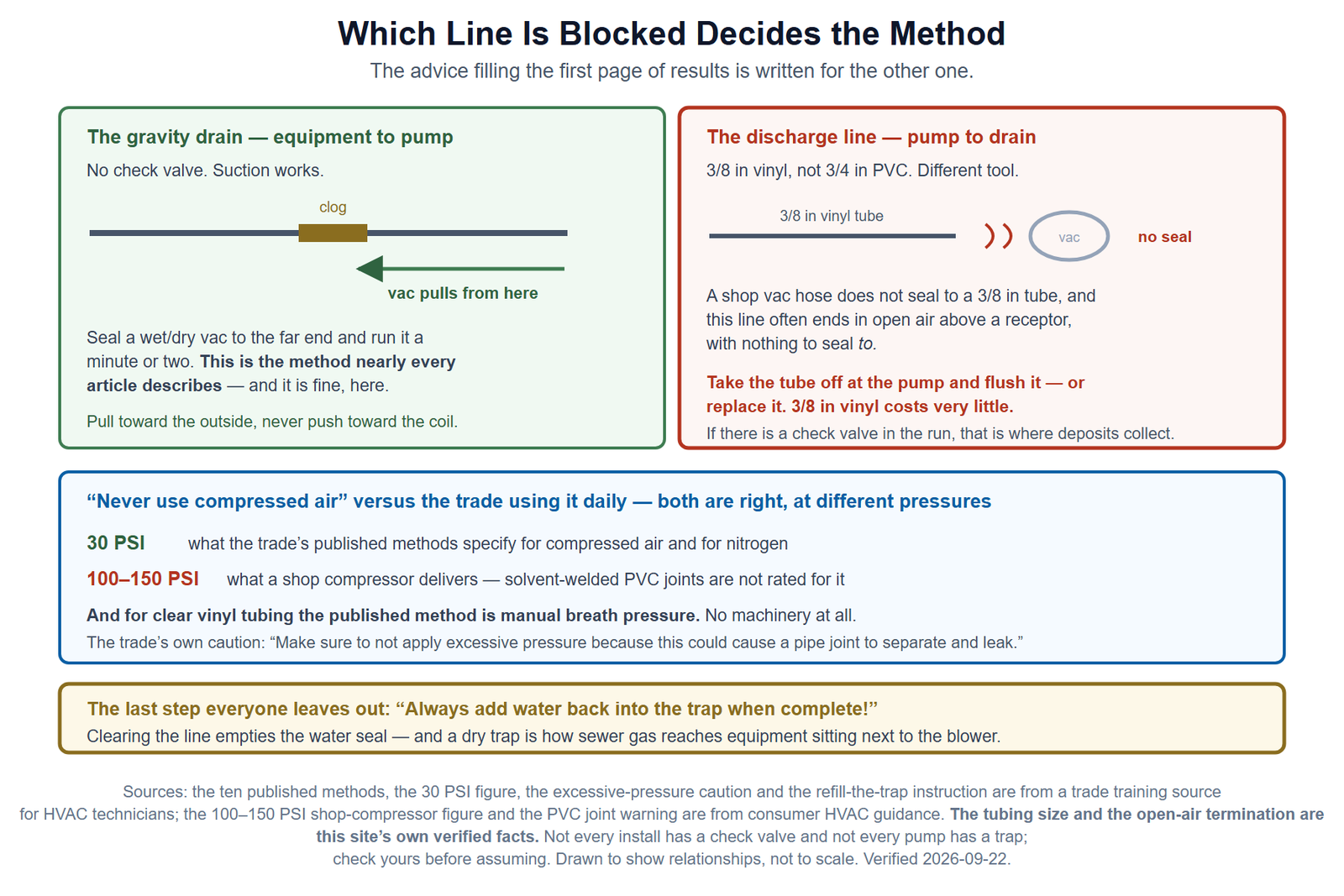
Work out which line is blocked first, because the two need different tools. The gravity drain from the equipment down to the pump is the one the wet/dry vac method was written for. The pump’s discharge — 3/8 inch vinyl — is not, and the trade’s published method for that tubing is your own breath.
Then the number that settles the argument you will find everywhere: the trade does use compressed air, at 30 PSI. A shop compressor delivers 100 to 150.
First, which line
A pumped install has two, and almost every article you will find is about the first one.
The gravity drain, from the equipment’s trap down to the pump. Usually 3/4 inch PVC, no pressure, open at both ends. This is the line a wet/dry vac clears, and the method is exactly as described everywhere: seal the vac to the far end with a rag or tape, run it a minute or two, check.
The discharge, from the pump up to wherever it terminates. Usually 3/8 inch clear vinyl. A shop vac hose does not seal to a 3/8 inch tube, and this line often ends in open air above a receptor — which is what the code requires of it — so there is frequently nothing to seal to.
One-minute test: pull the tube off the pump outlet and blow through it. If it fights back, the discharge is the problem. If it is clear, the blockage is upstream and you are working on the other line. That test is where the whole diagnosis starts.
Clearing the discharge: take it off and flush it
For 3/8 inch vinyl, the honest answer is unglamorous.
Disconnect it at the pump, take it outside or to a sink, and flush it through. If a section is stubborn, replace it. Clear vinyl tubing costs very little and comes in twenty-foot lengths, and a tube that has scaled up once at a particular bend will do it again.
The trade’s own published method for this tubing is listed plainly among ten ways of clearing condensate drains: clear vinyl tubing with manual breath pressure. No machinery. The same action as the diagnostic test, applied harder.
If there is a check valve in the run, that is worth pulling and looking at while the tube is off — it is the part deposits collect against, and a check valve stuck shut behaves exactly like a blocked line.
Clearing the gravity drain: pull, don’t push
Here the standard advice is right, with one rule attached.
Work from the far end, pulling. Seal a wet/dry vac to the termination, run it for a minute or two, then check whether water moves. Pulling takes the debris out of the building.
Do not blow toward the equipment. Anything you push up the line goes into the drain pan or onto the coil, which turns a blocked pipe into a dirty coil and a pan full of the sludge you were trying to remove. One consumer source makes the same point about garden hoses — running water backward up the line pushes it toward the air handler.
The compressed air argument, and the number that resolves it
You will read that you must never put compressed air near a condensate drain. You will also find technicians using it every day. Both are right, and the difference is a figure neither side usually states.
| Pressure | |
|---|---|
| What the trade’s published methods specify, for air and for nitrogen | 30 PSI |
| What a typical shop compressor delivers | 100–150 PSI |
Solvent-welded PVC fittings on a condensate line are not rated for shop-compressor pressure, and the joints that give way are the ones inside a ceiling. The trade source’s own caution is blunt: “Make sure to not apply excessive pressure because this could cause a pipe joint to separate and leak.”
So: if you have a regulator and can set 30 PSI, air is a legitimate tool. If your only option is a compressor at whatever it happens to be set to, use the vac instead.
And skip these entirely: a plumber’s snake, which can damage a residential condensate system, and bleach, which neither Little Giant nor Sauermann calls for — the reasoning on that is in the float article, which covers the same deposits.
The last step almost everyone leaves out
From the same trade source, and easy to miss because it comes at the end:
“Always add water back into the trap when complete!”
Clearing the line empties the trap’s water seal. An empty trap is not a small thing — it is the path by which sewer gas reaches equipment sitting right next to the blower, which is why a rotten-egg smell means something different from a musty one.
Skip this and you have swapped a drainage complaint for a smell complaint, two or three weeks later, and you will not connect the two.
One-minute test: after the water runs freely, pour a cup or two down the drain the line discharges into and listen. If it gurgles and then goes quiet, the seal has re-formed.
When this needs a pro
If the line runs through a ceiling or an attic, the joints you cannot see are the ones that leak, and a blockage up there has somewhere expensive to go.
If it clogs again within a season, clearing it is treating a symptom. Something is feeding it — biofilm, a sagging section holding water, or a line that never drains fully — and the slope article covers the most common structural cause.
If the pump has been running against a blocked line for a while, check it before trusting it. A small motor pushing against a closed system has been working hard, and if the tank is scaled or the housing is cracked, the buying guide covers replacement. For how the parts fit together, start with the condensate pumps guide.
One caveat worth stating: not every install has a check valve, and not every pump has a trap. Look at yours before assuming either. The methods above are from a trade training source for technicians and from consumer HVAC guidance, and they describe typical residential arrangements rather than yours specifically.
FAQ
How do I clear a clogged condensate drain line?
Decide which line first. A 3/4 inch PVC gravity drain is cleared by sealing a wet/dry vac to the far end and pulling for a minute or two. A pump’s 3/8 inch vinyl discharge tube is not — a vac will not seal to it — so disconnect it at the pump and flush it, or replace it, since the tubing is inexpensive.
Can I use compressed air on a condensate line?
At a regulated 30 PSI, which is what the trade’s published methods specify, yes. At the 100 to 150 PSI a shop compressor delivers, no — solvent-welded PVC joints are not rated for it, and the ones that separate are inside your ceiling.
Should I blow the line out toward the furnace or away from it?
Away. Pull from the termination with a vac rather than pushing from the equipment end, because anything pushed up the line ends up in the drain pan or on the coil.
Do I need to do anything after the line is clear?
Refill the trap. Clearing the drain empties its water seal, and a dry trap lets sewer gas into the space beside the blower. Pour a cup or two down the drain the line discharges into once water is running freely.
Why does my condensate line keep clogging?
Because the condensate carries dust and coil residue into a permanently wet pipe, and a bacterial film builds on every surface it touches. If it returns within a season, look for a structural cause — a sagging section that holds water is the usual one — rather than clearing it again.


