On this page
Last Updated on September 17, 2026 by Muhammad Toqeer
A floor sink, a floor drain, a trench drain, a mop sink, a hub drain, a standpipe, a utility sink or a laundry sink. That is the list, and the code writes it as a closed one — “shall not discharge into a plumbing fixture other than” those eight. Reach any of them indirectly, through an air gap.
Which means the two places people most often send a condensate line — a sump pit, and a plumbing vent pipe in the attic — are not on it. One is prohibited by name. The other is simply absent, which amounts to the same thing at an inspection.
The list, and the sentence that closes it
Most pages answer this question in general language: a floor drain, a laundry sink, outside, away from the foundation. The code does not speak in general language here. It enumerates, and then it shuts the door:
“Condensate drains shall not directly connect to any plumbing drain, waste or vent pipe.”
“Condensate drains shall not discharge into a plumbing fixture other than a floor sink, floor drain, trench drain, mop sink, hub drain, standpipe, utility sink or laundry sink.”
Two more sentences in the same section do specific work. The first carves out two connections that would otherwise be ambiguous:
“Condensate drain connections to a lavatory wye branch tailpiece or to a bathtub overflow pipe shall not be considered as discharging to a plumbing fixture.”
That is not a loophole — it is the code deciding, deliberately, that those two count as receptors rather than fixtures. They are allowed.
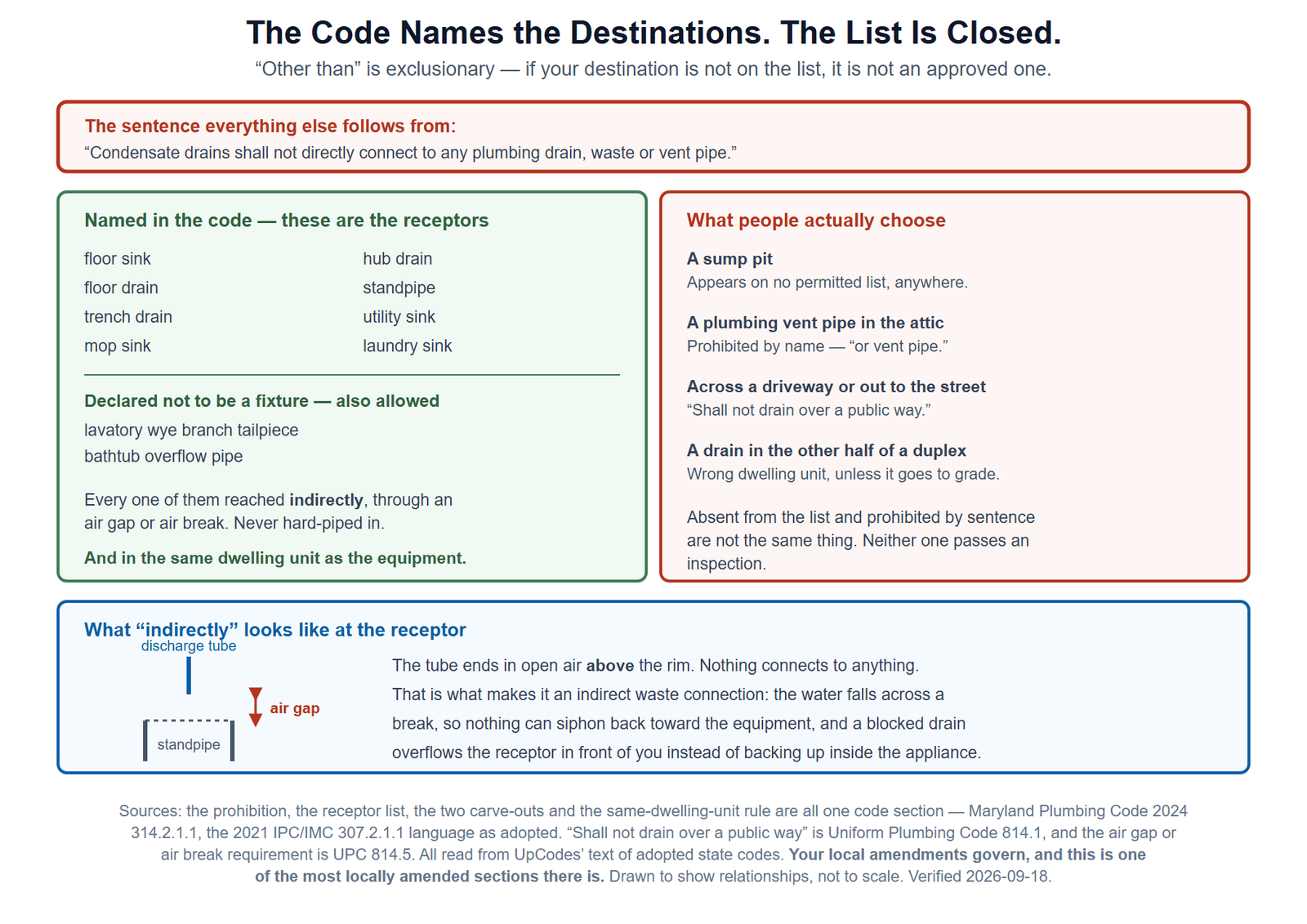
The phrase doing the heavy lifting is “other than.” It makes the list exclusive rather than illustrative. Every article that says “a floor drain or similar” has quietly added a word the code does not contain.
What “indirectly” means, and why it is the whole mechanism
Every destination on that list is reached the same way: “through an air gap or air break to trapped and vented receptors, dry wells, leach pits, or the tailpiece of plumbing fixtures.”
An air gap is exactly what it sounds like — the tube ends in open air above the rim of the thing it is draining into, touching nothing. Nothing is glued, clamped or threaded to anything.
That gap is not fussiness. It does two jobs at once:
- Nothing can come back up. No siphon can form toward the equipment, and sewer gas has no continuous path into the air handler’s cabinet.
- A blockage announces itself. If the receptor plugs, it overflows in front of you, on the floor, where you will find it. A hard-piped line that plugs backs the water up inside the appliance instead.
An installer on Heating Help puts it as a standing habit: “I always put an air gap on the condensate as the drain comes out of the boiler.” The failure he is describing is a blocked drain pushing water back into the heat exchanger — an expensive component protected by a two-inch gap of nothing.
One-minute test: look at where your discharge tube ends. If it is pushed into a pipe, taped to a fitting, or disappears into a hole, it is a direct connection, whatever else it is. It should be hanging in the air above something.
The four places people actually send it
A sump pit
Extremely common, and it is on no permitted list anywhere — not in the enumerated receptors, not in the indirect-waste list. That is not the same as a sentence prohibiting it, and plenty of jurisdictions have historically tolerated it, but it is worth knowing that it has no positive authorisation to point at.
The separate question is what it does to the pump sitting in that pit. Furnace condensate is mildly acidic, which the condensate pumps guide covers properly. What is useful here is the volume, because it turns a vague worry into arithmetic: a condensing furnace produces roughly a gallon of condensate per therm burned. At 100 therms a year that is about 100 gallons through the pit; a heavy-use house is several times that, landing on a submerged pump year after year.
The trade’s own threshold, from a discussion of exactly this: “If you go through only 100 therms/year…it’s probably going to be fine” — and above that, neutralise it. Cartridge neutralisers are “on the market for <$100.”
A plumbing vent pipe in the attic
This one is not ambiguous and does not depend on local tolerance. “Shall not directly connect to any plumbing drain, waste or vent pipe.”
It is popular because it looks ideal — there is a pipe, it goes to the sewer, it is right there in the attic next to the air handler. What it actually creates is a hole in a dry pipe that carries sewer gas. A vent is not a drain, it has no trap protecting the house from it, and a line tapped into it gives that gas a path back toward the equipment and into the airstream. Some installs add a trap to solve this, which then dries out over a season because a vent never carries water.
If you have an attic air handler and someone offered you this, it is worth pushing back on.
Outside, onto the ground
Legitimate, and often the simplest answer — but with two boundaries that are written down. The UPC states flatly that “condensate or wastewater shall not drain over a public way,” and New Jersey’s subcode bars outdoor discharge “where it will flow across paved surfaces, accumulate in exposed locations, or otherwise create a nuisance.”
So: onto your own ground, away from the walking route and the foundation, not across the driveway and not to the street. And if the climate freezes, a line that terminates outdoors is a line that can seal itself with ice, which is a failure mode worth planning for rather than discovering in January.
A laundry standpipe or utility sink
The one the trade reaches for first, because it is named in the list, it is already trapped and vented, it is usually in the same room as the equipment, and it is easy to reach with a small tube. If you have one within reach of the pump’s rated lift, it is almost always the right answer.
One-minute test: before committing to a destination, measure from the pump outlet to the highest point the tube will reach on the way there. That height, not the horizontal distance, is what decides whether the pump can do it — and how far a condensate pump can actually push water is where that gets worked out. If you are buying a pump around a fixed destination rather than the reverse, the buying guide has the shut-off figures to check it against.
The rule almost nobody knows
Buried in the same section, and genuinely obscure:
“Except where discharging to grade outdoors, the point of discharge of condensate drains shall be located within the same occupancy, tenant space or dwelling unit as the source of the condensate.”
In a single-family house this never comes up. In a duplex, a converted two-family, a condo or anything with a shared basement, it rules out the obvious convenient answer — the floor drain twenty feet away that happens to belong to the other unit. The exception is telling: discharging to grade outdoors is carved out, because outdoors belongs to nobody’s unit.
What this does not decide
Where the line terminates and how it gets there are two different problems, and it is worth being clear which one you are solving.
The shape of the run — up to a high point and then down, so it drains itself between cycles — is what stops a pump short-cycling or fighting a standing column, and that is covered in what to check when the pump runs but no water moves. The pitch rules only ever apply to the gravity sections, never to the pressurised riser, which is a distinction worth getting right before you try to slope anything.
This article only answers the last question: what the far end is allowed to be.
When this needs a pro
If the answer involves opening up drainage piping. Adding a wye, a tailpiece connection or a trapped receptor is plumbing work, it is inspected, and getting a trap or a vent wrong creates a sewer-gas path rather than a drainage one.
If your equipment is in an attic or above a finished ceiling. The destination question and the overflow-protection question are the same question up there — a condensate failure has a finished ceiling underneath it — and whether that install needs a secondary pan, a secondary drain or a shutoff float switch is code territory covered in whether your furnace needs a pump at all.
If you are in a multi-unit building. The same-dwelling-unit rule, shared stacks and building-specific amendments make this one to confirm rather than assume.
And the standing caveat, which matters more on this topic than on any other in this silo: these are model-code figures, and this is one of the most locally amended sections there is. Some jurisdictions name additional approved destinations; some prohibit ones listed here. Your local authority governs, and on a discharge point they will have an opinion.
FAQ
Can a condensate pump discharge into a sump pit?
It appears on no permitted list in the model codes — not among the named receptors, not in the indirect-waste provisions. Many jurisdictions have tolerated it, but there is no positive authorisation to cite. Separately, a condensing furnace puts roughly a gallon of condensate per therm into that pit, and it is mildly acidic, so a neutraliser cartridge is worth fitting if the volume is significant.
Can I connect a condensate drain to a plumbing vent pipe?
No. The code prohibits it by name: “shall not directly connect to any plumbing drain, waste or vent pipe.” A vent carries sewer gas and never carries water, so a trap added to the connection dries out and stops sealing. It is one of the most common attic installs and one of the clearest prohibitions.
Does a condensate line need an air gap?
Yes — the connection has to be indirect, “through an air gap or air break.” The tube ends in open air above the receptor rather than being piped into it. That stops anything siphoning back toward the equipment, and it means a blocked drain overflows where you can see it instead of backing up into the appliance.
Can I drain condensate into a laundry sink or washing machine standpipe?
Both are named in the list, and the standpipe is the destination the trade reaches for first — already trapped and vented, usually in the same room. Keep the connection indirect, with the tube ending above the rim.
Can a condensate line discharge onto the ground outside?
Generally yes, on your own property, provided it does not run over a public way and does not “flow across paved surfaces, accumulate in exposed locations, or otherwise create a nuisance.” In a freezing climate, plan for the terminus icing over.
Does it matter which unit of a duplex the drain belongs to?
It does. Except where it discharges to grade outdoors, the discharge point has to be “within the same occupancy, tenant space or dwelling unit as the source of the condensate.” A convenient floor drain belonging to the neighbouring unit is not an option.


