On this page
- The manual says the noise is expected, and puts it somewhere important
- Three things sound like grit. One is.
- Cavitation is the transfer pump's version
- When it really is debris
- The last eighth of an inch, and a free fix for it
- One noise it makes on purpose
- What the noise is telling you about time
- When this needs a pro
- FAQ
Last Updated on September 14, 2026 by Muhammad Toqeer
If the noise started as the water got low, and the pump is still moving water, it is almost certainly air rather than grit — and the manufacturer says so in the manual. A WaterBUG “may become noisy” as the level drops, “due to air being drawn into the pump in addition to water.” The pump is working correctly. The moment to stop is not when it gets loud; it’s when water stops coming out of the hose.
Every page you will find on this tells you to shut the pump down and open it up. On the commonest version of this problem, that means dismantling a pump that is doing its job.
The manual says the noise is expected, and puts it somewhere important
Here is the passage in full, because where it sits matters as much as what it says:
“Do not allow pump to run dry. The shaft seal depends on water for lubrication. Operating the pump without water will damage the shaft seal and cause pump failure. When the water level is approaching the minimum pumping limit, the water removal rate may slow, and the pump may become noisy. This is due to air being drawn into the pump in addition to water. During this time the pump may still remove water. Once water has stopped coming out of the hose unplug pump to avoid running dry.”
Four things come out of that, and none of them appear on a single page currently ranking for this problem.
The noise is explained — it is air mixing with water at the intake. The pump is still working while it does it. The stopping rule has nothing to do with the sound; it is about whether water is still leaving the hose. And the reason for the rule is the shaft seal, which is lubricated by water and is destroyed by running without it.
So the noise is the audible edge of the one thing that will actually kill the pump. Not the damage itself — the warning that you are approaching it.
Three things sound like grit. One is.
The trap is that these all produce roughly the same noise. A pump-repair trade source describes cavitation as making “a characteristic rattling or crackling sound often described as gravel passing through the casing.” Air does much the same. So does gravel.
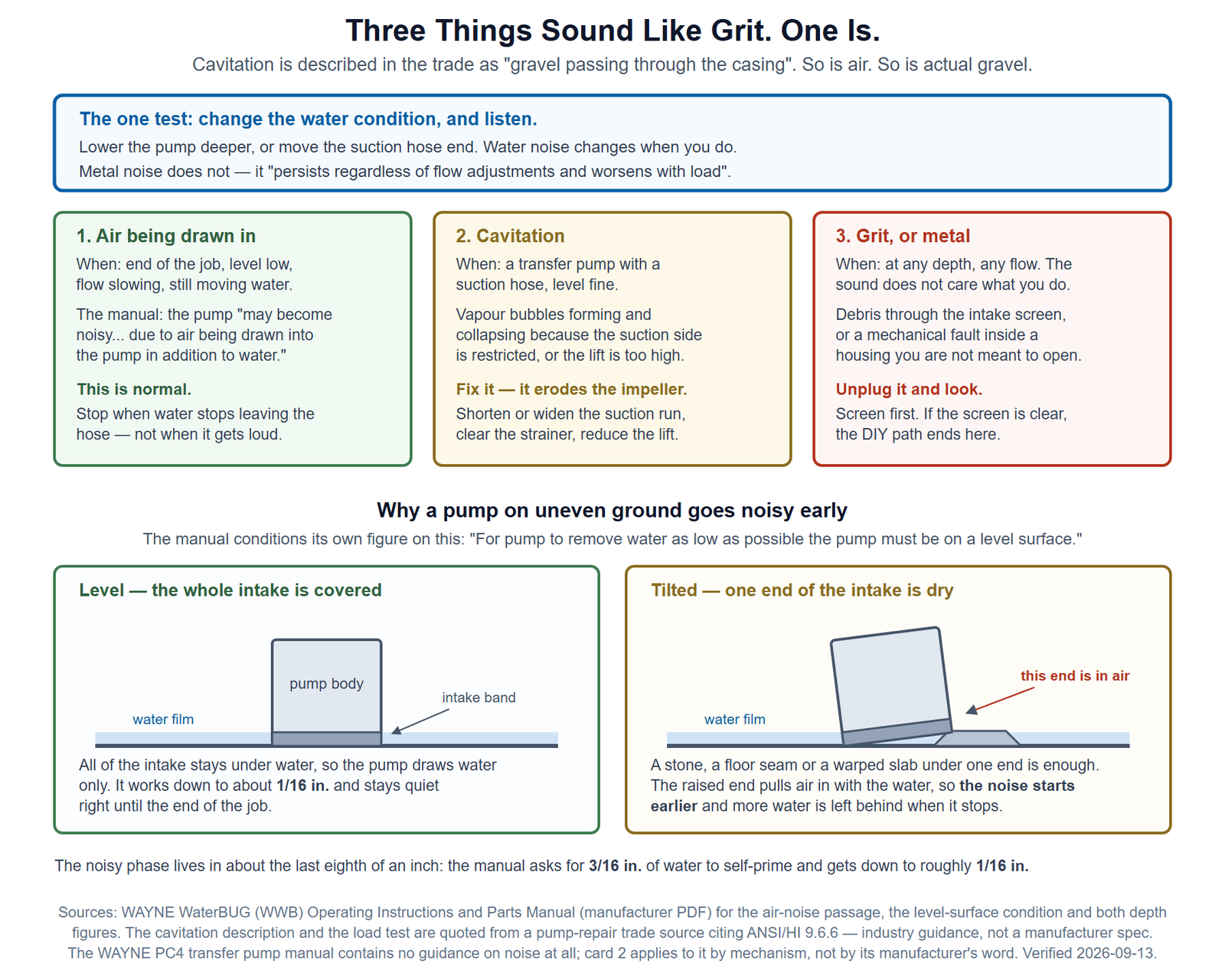
One-minute test, and it settles all three: change the water condition and listen. Lower the pump deeper, or move the end of the suction hose, or drop the discharge hose lower.
- The noise changes → it is water. Air or cavitation, and both are free to fix.
- The noise is identical → it is not water. The trade description is exact: mechanical grinding “persists regardless of flow adjustments and worsens with load.”
That single distinction is worth more than any amount of listening carefully, because the two categories genuinely do sound alike and they behave completely differently.
There’s a second version of the same test for a pump that clatters on startup. If the rattle clears within about half a minute as flow establishes, it was air in the suction line, not the mechanical assembly.
Cavitation is the transfer pump’s version
If your pump sits beside the water with a suction hose rather than in it, the noise has a different cause and it is not benign.
Cavitation is vapour bubbles forming in the water and then collapsing as they reach the impeller. It happens when the suction side cannot deliver water as fast as the pump wants it — the trade description is that available suction head falls below what the pump requires, governed by “suction lift, fluid temperature, and inlet pipe diameter.” In a garage, that means: the hose is too long, too narrow, kinked, the strainer is blocked, or the pump is lifting too far.
The reason to care is that the collapse “exerts localized pressure spikes that erode impeller surfaces.” Unlike the air noise at the end of a job, this one is grinding something away while you listen to it.
One-minute test: shorten the suction run or lower the pump closer to the water. If the sound eases immediately, that’s your answer, and the fix is the suction side rather than the pump. The same territory is covered from the flow angle in why a utility pump won’t prime.
When it really is debris
It does happen, and the tell is that nothing you do to the water changes the sound.
Wayne’s maintenance instruction is one line and it prevents most of this: “Keep pump inlet clean and free of all foreign objects. Inspect inlet at beginning of each use.” An intake screen exists to stop stones reaching the impeller, and it works — right up until it is blocked enough that something slips past the edge, or the pump gets set down on a bed of grit.
Unplug it at the receptacle, then look at the screen. That is the whole first step, and on most pumps it is visible without tools.
If the screen is clear and the noise is unchanged, you are into the impeller, and that is where the DIY path narrows sharply. Running but not moving water carries the cleaning procedure and — importantly — which screws you may remove and which hold the sealed motor housing together. The outer ones are not a homeowner job on a pump at this price.
The last eighth of an inch, and a free fix for it
The noisy phase has numbers on both ends, and they are surprisingly tight.
A WaterBUG needs 3/16 inch of water to self-prime, and it will take a floor down to about 1/16 inch. So the whole business of slowing down, drawing air and getting loud happens inside roughly the last eighth of an inch of the job.
Which is why this line in the manual is worth more than it looks:
“Removing water down to 1/16 inch is based on many factors. For pump to remove water as low as possible the pump must be on a level surface.”
A pump sitting on a slab seam, a stone, or a sloped garage floor is tilted. One end of its intake band lifts clear of the film while the other end is still submerged — so it starts pulling air in earlier, gets noisy sooner, and leaves more water on the floor when you finally stop it.
One-minute test: pick the pump up and set it down somewhere flat, even if that means moving it a foot. If the noise quietens and the flow picks back up, the floor was the problem, not the pump. It costs nothing and nobody mentions it.
One noise it makes on purpose
Worth knowing so you don’t misread it.
On WaterBUG models with the automatic shut-off, the manual notes: “This pump may create a high pitched sound prior to shutting off.”
That is a designed warning, not a fault. A rising whine immediately before the pump stops itself is the protection working. If yours has done that and won’t restart yet, it is in its cool-down rather than broken — the same territory as a pump that keeps shutting off on heat.
What the noise is telling you about time
A useful way to hold all of this: the sound is rarely the problem. It’s a timer.
Air noise means minutes left in the job. Cavitation means you are wearing the impeller for as long as you leave it. Grinding on debris means stop now. In none of those cases does the volume tell you the severity — what tells you is whether the sound responds to the water, and how long you have been listening to it.
When this needs a pro
A grinding noise that survives the water test is the end of the home path. Not because it is dangerous to investigate, but because the parts it points at — bearings, a shaft, an impeller running against its housing — are inside a sealed motor assembly that the manual instructs you not to open. On a pump in this price range, that is a replacement decision — the buying guide covers what separates the options.
Do not keep running a pump to “see if it clears”. If it is cavitating, you are eroding the impeller. If it has debris in it, you are grinding the debris into the impeller. Either way the cost of listening for another twenty minutes is paid in parts.
A new noise plus a new smell is different from a new noise alone. Hot insulation has a distinct smell and means the problem is electrical or thermal rather than hydraulic. Unplug it and stop there.
And the standing one for this class of pump: unplug it at the receptacle before you touch the intake, so you can see it is disconnected. For what these pumps are built to do and where their limits actually sit, the utility and transfer pumps guide has the background.
FAQ
Why does my utility pump get loud when the water gets low?
Because it is drawing air in along with the water. The manufacturer describes exactly this — the pump “may become noisy” as the level approaches its minimum, and notes it “may still remove water” while it happens. It is normal behaviour at the end of a job, not damage.
When should I actually switch it off?
When water stops coming out of the hose, not when the noise starts. That is the manual’s own rule, and the reason is the shaft seal — it relies on water for lubrication, and running the pump dry is what destroys it.
How do I tell air from debris in the impeller?
Change the water and listen. Lower the pump deeper or move the suction hose. Noise caused by water changes when the water changes; mechanical grinding persists regardless of flow and gets worse under load. If the sound is identical after you have moved things, unplug the pump and check the intake screen.
My pump sounds like it is chewing gravel. Is there gravel in it?
Probably not. Cavitation — vapour bubbles collapsing at the impeller — is commonly described as sounding like gravel passing through the casing, and so is air entrainment. Actual debris is the third possibility and the least likely of the three, though it is the one every article names first.
Does the noise mean the pump is damaged?
Not by itself. Air noise at the end of a job does no harm as long as you stop when the water stops. Cavitation does cause damage while it happens, because the collapsing bubbles erode the impeller. Grinding from debris or a mechanical fault means stop immediately.


