On this page
Last Updated on September 15, 2026 by Muhammad Toqeer
One sentence in the installation sheet settles most of this: “Pump must be level and the inlet must be below the coil drain.” Level, because the float is a float. Below the drain outlet, because nothing pushes the condensate into the pump — gravity does. Get those two right and you are most of the way there.
What the guides leave out is the other three, which quietly rule out the spot you were probably going to choose.
The two hard rules, from two different manufacturers
Little Giant’s installation sheet for the VCMA series says the pump “should be mounted either on the side of the air conditioner unit or nearby wall”, and then gives the rule quoted above.
DiversiTech’s manual for its own pump says: “Pump must be level and the inlet must be below the boiler drain point.”
Same rule, different company, near-identical wording. When two competitors phrase a constraint the same way, it is not a preference.
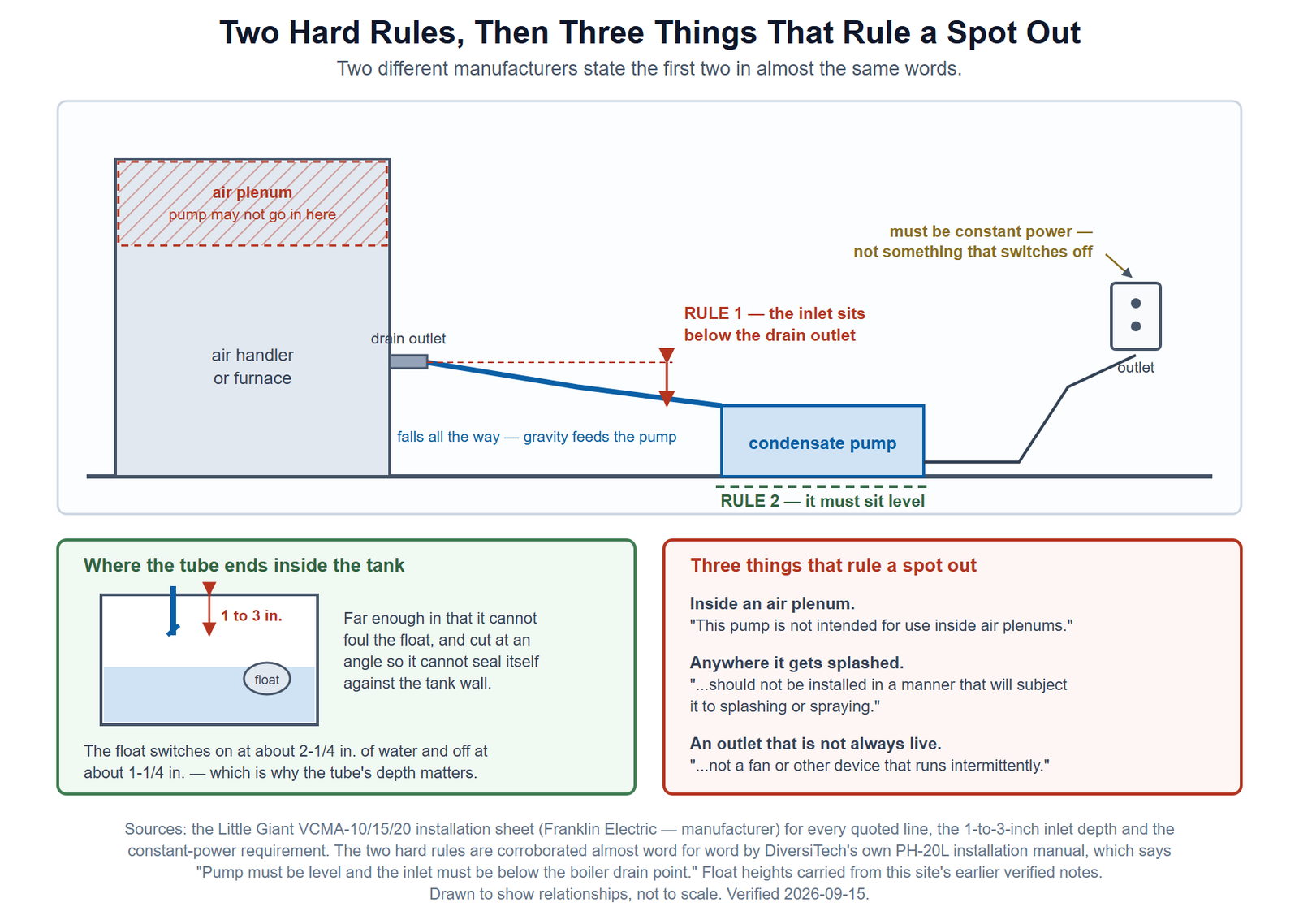
Level matters because everything inside the pump is referenced to the water surface. The float switches on at roughly 2-1/4 inches of water and off at roughly 1-1/4. Tilt the tank and you have moved both of those points relative to the tank walls, the inlet and the safety float. A pump on a sloping floor or a warped shelf is a pump whose switching points you have quietly changed.
Below the drain outlet matters because the inlet line is not pressurised. It is a tube with water falling down it. If the pump’s inlet ends up level with the equipment’s drain stub — or above it, which happens when someone mounts the pump on a wall at a convenient height — the water has nowhere to go and it backs up in the pan instead.
One-minute test: before you fix anything, hold the pump where you intend it to go and sight along the drain stub. If you cannot see a continuous fall from the stub to the pump’s inlet, the position is wrong however convenient it is.
The outlet is part of the decision
This is the one nobody mentions, and it is in the electrical section rather than the mounting section, which is probably why.
“Power cord must be connected to a constant source of power (not a fan or other device that runs intermittently).”
Read that twice. It is not about reach, and it is not about having a spare socket. It is that the pump must be powered by something that never switches off on its own.
The tempting outlet is often the one already there for the air handler, or a switched receptacle, or something fed off the furnace’s own fan circuit. Any of those means the pump stops when that device stops — and condensate does not stop at the same moment. A high-efficiency furnace keeps draining for a while after the burner shuts down, and an air conditioner’s coil keeps shedding water after the compressor cuts.
One-minute test: plug a lamp into the outlet you are planning to use and leave it on. Run the heating or cooling through a full cycle, including the off part. If the lamp ever goes out, that outlet is not the one.
Three things that rule a spot out
Short, because each is one line in the manual and none of them is negotiable.
Inside an air plenum. “This pump is not intended for use inside air plenums.” If the pump has to live inside the air handler cabinet or a return-air space, a standard pump is the wrong product — that needs one built of plastics tested to UL Standard 2043, and the buying guide covers which models carry that listing.
Anywhere it gets splashed. “The pump should not be installed in a manner that will subject it to splashing or spraying.” Under a humidifier fitting, beside a water heater’s relief discharge, or on a floor that gets hosed down all count.
Any spot you cannot get back to. Since 2015 the model code has required condensate drains to be “configured to permit the clearing of blockages and performance of maintenance without having to cut the line” (IMC 307.2.5 / IRC M1411.3.3). A pump wedged behind ductwork where you cannot lift the cover or reach a union satisfies nobody — not the code, and not you in three years when the reservoir needs cleaning.
That last one is worth taking seriously because the cover has to come off routinely. Cleaning the tank is the normal maintenance on these, and a float that has gummed up is the most common fault there is.
Two things to do before you mount anything
Both are step one and step two in the manual, and both get skipped.
Run the system first and throw that condensate away. In Little Giant’s words: “Before installing pump, allow air conditioner to cycle several times, collecting condensate in a separate container to help flush any residual oils that may remain in the system.”
New equipment sheds manufacturing oils into the first condensate it makes. The instruction is to let that go into a bucket rather than into the pump you are about to install, where it will coat the float and the tank.
Take the cardboard out. The VCMA ships with packing in the motor cover air slots to stop the switch moving in transit. It is not obvious once the pump is in place, and a pump run with it still in is a pump whose switch cannot move properly.
Getting the inlet tube right
The tube is part of the placement decision because where the pump sits determines how the tube arrives.
Run it from the equipment’s drain into one of the pump’s inlet openings, sloping down the whole way. Then the detail nobody repeats:
“Extend the inlet piping into the tank from 1 to 3 inches to ensure that it will not interfere with proper float operation. Be sure that the inlet piping is cut at an angle where it enters the tank.”
Both halves have a reason. One to three inches in keeps the tube end away from the float arm’s travel — a tube that stops flush with the tank wall can sit exactly where the float wants to be. Cut at an angle means the tube cannot seal itself flat against the tank wall or the water surface and airlock.
While you are there: the manual also notes that “conduit fittings are not compatible with the plastic pump housing.” If someone plans to run the cord in conduit into the pump body, they are about to crack it.
What this article deliberately leaves out
Four neighbouring questions get mixed into “where do I put it”, and each has a different answer.
How high it can push is a sizing question, not a placement one — the number on the box is a shut-off head where flow is zero, which which condensate pump you need works through properly.
Whether it can sit above the furnace, what to mount it on, how much slope the drain line needs, and where the discharge is allowed to terminate are each their own decision, and none of them is settled by the two rules above.
When this needs a pro
The safety switch is low-voltage work on your equipment’s control circuit. The manual is specific: the overflow switch “should be connected to a class II low voltage circuit”, with COM and NO wired in series with the thermostat circuit to shut the system down — and it notes the factory leaves the leads on COM and NO. Landing those on the wrong terminals of a furnace board is how you end up with a switch that trips and changes nothing, which is exactly how a pump overflows with the equipment still running.
If the only workable spot is inside a plenum or a return-air ceiling, that is a different product and usually an inspection. Do not solve it by putting a standard pump there.
And if the equipment is in an attic or over finished space, the model code may require secondary overflow protection regardless of what pump you fit — an auxiliary pan, a secondary drain, or a UL 508 water-detection switch wired to shut the system down. That is a code question for your jurisdiction, not a preference. The condensate pumps guide has the background on what these systems are doing.
FAQ
Where should a condensate pump be installed?
Beside the equipment — on the side of the air handler or a nearby wall — with two conditions the manufacturer states plainly: the pump must sit level, and its inlet must be below the equipment’s drain outlet so condensate reaches it by gravity. Everything else is about what rules a spot out.
Can a condensate pump be mounted higher than the furnace drain?
No. The inlet has to be below the drain outlet. The line feeding the pump is not pressurised — it relies entirely on fall — so a pump mounted at a convenient height above the drain stub will not fill, and the water backs up in the pan instead.
Does a condensate pump have to be perfectly level?
It has to be level, yes. The float switches the pump on at about 2-1/4 inches of water and off at about 1-1/4 inches, and those points are referenced to the tank. Tilting it moves them relative to the inlet and the safety float, which is why “on a level surface” is in every manual.
Can I plug a condensate pump into any outlet?
Not any. The manual requires a constant source of power and specifically rules out “a fan or other device that runs intermittently”. If the outlet is switched, or fed from the air handler’s fan circuit, the pump stops when that stops — while condensate is still arriving.
How far should the drain tube go into the condensate pump?
One to three inches into the tank, cut at an angle. Far enough in that the tube end cannot interfere with the float’s travel, and angled so it cannot seal flat against the tank wall and airlock.


