On this page
Last Updated on November 5, 2026 by Muhammad Toqeer
The two numbers on the box were measured under conditions that cannot both be true at once.
A condensate pump is sold on two figures. Gallons per hour, measured at no lift. Maximum lift, measured at no flow. Both are honest. Neither describes your installation, because your installation has lift and needs flow.
This is why a pump rated “20 feet” disappoints at 18 feet, and why people conclude a new pump is faulty when it is working to specification at a point on its curve nobody showed them.
At high lift the pump is not the only thing that matters either — the tubing bore and the check valve take a share of what is left. So a high-lift job is a system decision, and that is what this page is about.
Which symptom brought you here?
| What is happening | Usual cause | Is a bigger pump the fix? |
|---|---|---|
| Reservoir fills faster than the pump clears it, on a long rise | Pump working past its useful point on the curve | Yes — this is the job |
| Pump runs and almost nothing leaves | Blockage, airlock or impeller. Running but not pumping | No |
| Pump runs constantly in hot weather | Often normal — high condensate load | No |
| Pump restarts a second after stopping | Discharge draining back — check valve | No |
| Equipment shuts down on the safety switch | Level rising past what the pump clears | Maybe — find out which cause first |
| Flow fell off after the discharge was rerouted | The new run added lift or length. Where to route the discharge | Sometimes — shorten the run first |
| Pump is below the equipment and struggling | A pump above the furnace has its own arrangement | No — fix the arrangement |
| Tubing is long, thin and kinked | Restriction, not capacity. Tubing size | No — and a bigger pump hides it |
Five of those eight rows say a bigger pump is the wrong answer. Only the first row is unambiguously a high-lift capacity problem.
What do the two ratings actually mean?
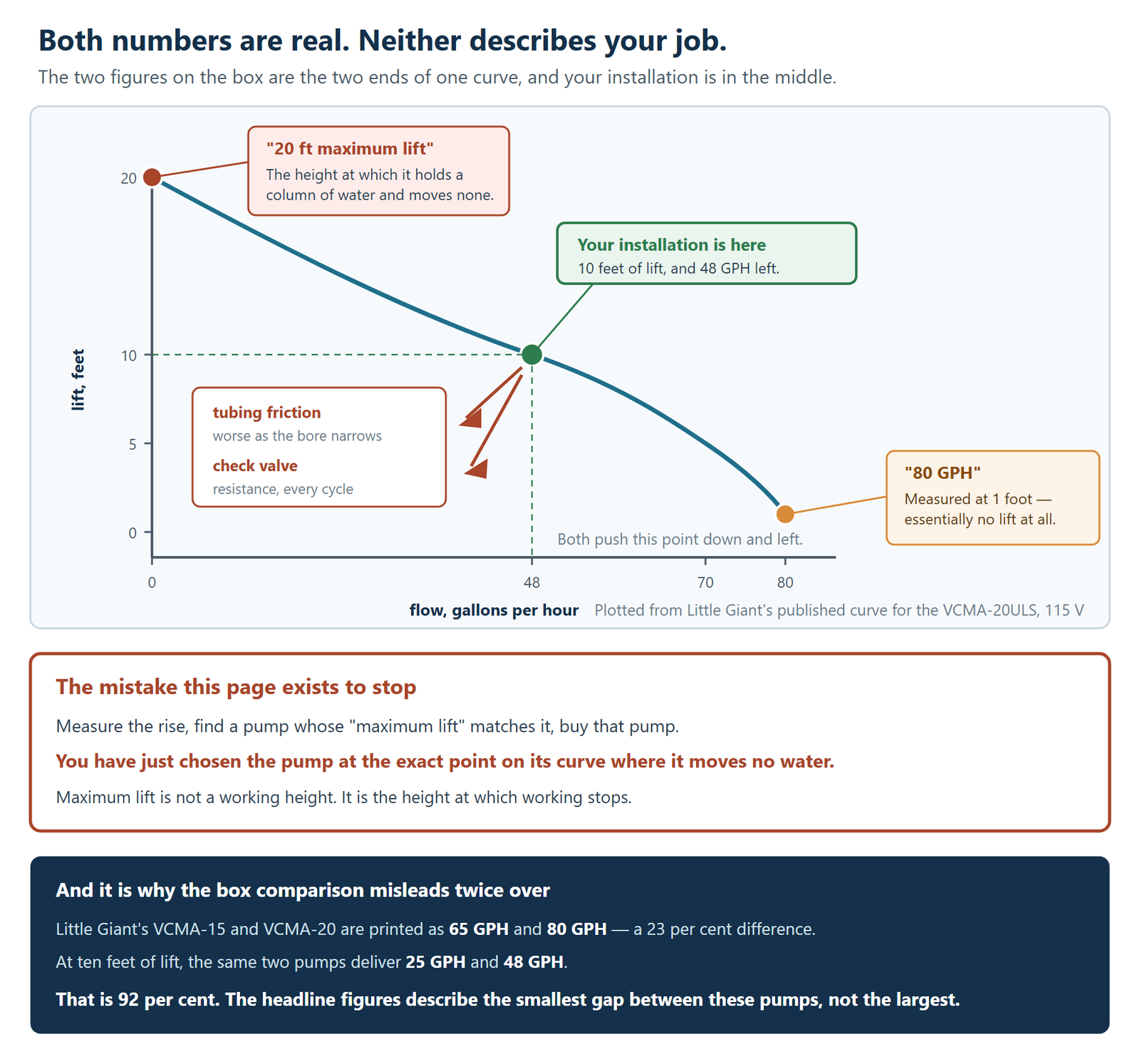
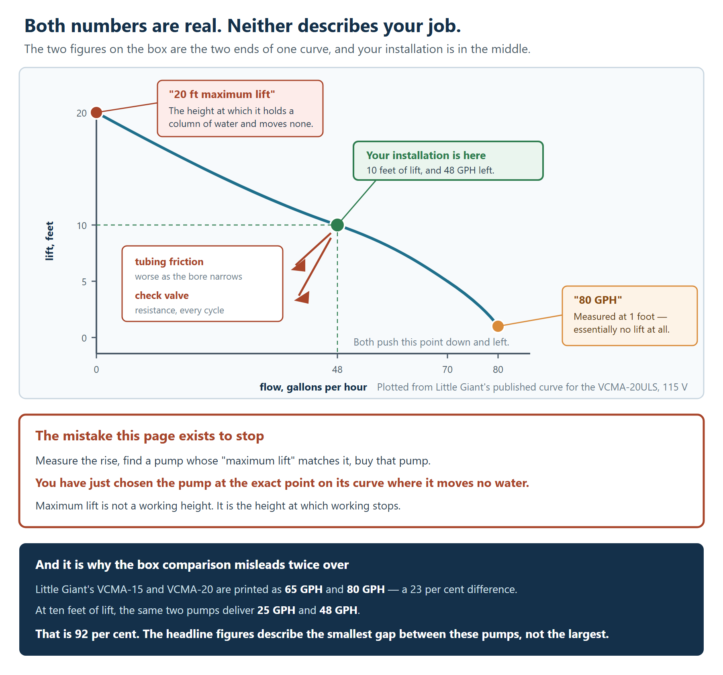
A pump’s performance is a curve, not two numbers, and the two numbers are its endpoints.
- The gallons-per-hour figure sits at the right-hand end — zero lift, maximum flow. The outlet is level with the pump.
- The maximum-lift figure sits at the left-hand end — the height at which the pump can just hold a column of water and move none of it.
Your installation sits somewhere in the middle, and that is where you need to know the flow. Choosing a pump by matching its maximum lift to your height puts you at the end where no water moves.
Then two more things pull the operating point further down:
- Tubing friction, which rises sharply as the bore narrows. Tubing size is not a detail on a high-lift job.
- The check valve’s resistance, paid on every gallon.
So the practical rule: choose on flow at your actual lift, with margin — not on maximum lift. How far a condensate pump can really push water covers this from the other direction and is worth reading alongside.
How do you work out the lift you have?
From the pump’s reservoir water level to the highest point the tubing reaches — not to where it terminates.
That distinction catches people out. A tube that climbs to a ceiling joist and then runs level for twenty feet before dropping into a drain is lifting to the joist. The horizontal run adds friction, not lift, but it still costs flow.
- Measure the vertical rise to the high point
- Measure the horizontal run separately — it costs friction
- Count the fittings and elbows — each one costs a little more
- Note the tubing bore, because this is where high-lift installations are most often compromised
What actually decides the choice?
1. Flow at your lift, with margin. The only figure that matters, and the one you have to look for rather than read off the front of the box. If the maker publishes a curve or a table, use it.
2. Reservoir volume. On a high-lift job the pump works harder for longer, so a larger reservoir means fewer starts for the same condensate. Volume buys you cycles, and cycles are what wears the switch.
3. A safety switch, and terminals for it. At high lift the consequence of falling behind is an overflow, so the switch that shuts the equipment down matters more here than on a short run, not less.
4. Tubing bore the pump can actually fill. A pump with a larger outlet is wasted on narrow tube.
5. Check valve quality. At high lift the standing column is tall, so a valve that does not hold returns a lot of water and restarts the pump on its own discharge.
Is a bigger pump always the answer?
No, and this is worth saying plainly on a page that exists to sell pumps.
Shorten the lift first if you can. A discharge rerouted to a nearer drain, or a gravity run found where none was thought to exist, beats any pump. Where to route the discharge is the cheapest improvement available on a high-lift installation.
Widen the tubing second. Going up a bore size recovers flow across the whole run and costs very little.
Then buy the pump — chosen on flow at the lift that remains after you have reduced it.
Products
This list is short, and the reason it is short is the whole point of the page.
Every pump below publishes flow at a stated lift in its own documentation. That was the only entry requirement, because this article argues that the headline number is the one figure you cannot size from — and a product that publishes nothing else cannot be compared. Applying that one rule to the category removed two of the largest names in it. They are named at the bottom, with what they do and do not publish.
All five were checked on 5 November 2026, and every figure comes from the maker’s own sheet or product page, not from a retail listing.
Little Giant VCMA-15ULS (554405)
Here for the first row of the symptom table, on a short rise. It is the smaller of the two Little Giant tank pumps, and on anything under about ten feet it is usually enough.
| Lift | Flow |
|---|---|
| 1 ft | 65 GPH |
| 5 ft | 50 GPH |
| 10 ft | 25 GPH |
| 20 ft | 0 |
Reservoir ½ gallon · 3/8″ barbed outlet with a built-in check valve · 140 °F maximum liquid temperature · safety-switch terminals: yes.
One thing Little Giant’s own page does not reconcile: it states a shut-off head of 15 feet and also prints 0 GPH at 20 feet in the curve above it. Those cannot both be the point where flow stops. Size on the curve, not on the shut-off line.
Little Giant VCMA-20ULS (554425)
Here because it is the same pump one size up, and the 10-foot figure is where the difference actually lands. Not at 1 foot, where the two look similar on a box.
| Lift | Flow |
|---|---|
| 1 ft | 80 GPH |
| 5 ft | 70 GPH |
| 10 ft | 48 GPH |
| 20 ft | 0 |
Shut-off 20 ft at 115 V, 17 ft at 230 V · reservoir ½ gallon · 3/8″ barbed outlet · 140 °F · safety-switch terminals: yes.
Look at the two tables together. At 1 foot the bigger pump gives you 23 per cent more. At 10 feet it gives you 92 per cent more. The headline figures — 65 against 80 — describe the smallest difference between these two pumps, not the largest.
That the 230 V version stops at 17 feet rather than 20 is the kind of thing nobody reads until the discharge will not clear.
Little Giant VCMA-20ULST (554435)
Here for one reason only: it ships with 20 feet of 3/8″ ID tubing. Identical pump, identical curve to the 554425 above. If your run is long, buying the tubing with the pump costs less than buying it separately, and matched tubing removes one variable from the install.
Its overflow switch is dual-function NO/NC, factory set to normally open, which shuts the equipment down on high water.
Do not buy this one expecting more pump. It is not more pump.
Sauermann Si-83, 120 V (SI83UL03UN12)
Here because its datasheet is the most honest document in the category, and it will change how you size. This is the pump to read before you buy any pump on this page.
Sauermann publishes two things almost nobody else does.
First, a table with two axes. Flow is given against discharge head and total tube length together, because both restrict it:
| Discharge head | 16 ft of tube | 30 ft | 60 ft | 100 ft |
|---|---|---|---|---|
| 3 ft | 7.6 GPH | 6.6 | 4.8 | 3.9 |
| 10 ft | 6.4 GPH | 5.9 | 4.3 | 3.4 |
| 16 ft | 4.6 GPH | 3.8 | 2.8 | 2.1 |
| 20 ft | 2.5 GPH | 2.2 | 1.8 | 1.2 |
Same pump, same lift, and running 100 feet of tube instead of 16 costs you more than half the flow at 20 feet. That is the seventh row of the symptom table, in numbers.
Second, a duty cycle. The sheet gives operating conditions as 7 per cent — 16 seconds on, 212 seconds off. This is what reconciles a table topping out around 8 GPH with the much larger flow figures quoted on retail pages: the pump moves water quickly and is only meant to run a small fraction of the time. The number you size on is the condensate rate it can keep up with, not the rate it moves while running.
Shut-off head 22 ft at zero flow · maximum discharge head 21 ft, quoted at 15 GPH, which does not reconcile with the 20 ft row above — use the table · tank ½ gallon (2 L) · integrated barbed check valve, 3/8″ · built-in safety switch, NC, 5 A / 42 V peak · 131 °F maximum condensate, 176 °F for peaks of ten minutes · tolerates pH above 2.5, so it suits condensing boilers · 120 V, 84 W.
Sauermann Si-30, 120 V
Here as the extreme case, and as the clearest proof of what a “maximum lift” number is worth. It is a piston pump for mini-splits, not a tank pump, and its published figures are these:
| Maximum flow | 5 GPH (19 l/h at 60 Hz) |
| At 33 ft of head | 1 GPH |
| At 46 ft | 0 GPH — this is the shut-off figure |
| Maximum suction lift | 10 ft |
| Reservoir | none — float-less electronic detection, on at 5/8″, off at 7/16″, safety at 3/4″ |
A pump sold on “46 feet” delivers one gallon an hour at 33 feet. No pump on this page illustrates the article’s argument better, and nothing about that is a criticism of the Si-30 — Sauermann published both numbers plainly. It is a criticism of reading only the first one.
An availability note, stated rather than hidden: on 5 November 2026 the 120 V listing was present but no price was visible to confirm it was in stock, and a separate Sauermann mini-pump listing was showing as unavailable. The 230 V version was listed normally. Check it is actually purchasable before you plan around it — that check is the one thing this page cannot do for you.
What is not here, and exactly why
Two of the biggest names in condensate pumps were researched and left off. Neither was excluded for being a bad pump. Both were excluded by the same rule, and the fact that the rule caught them is worth more to you than a sixth entry would have been.
DiversiTech CP-22. DiversiTech publishes flow at zero head — 1.6 GPM, about 96 GPH — a maximum flow of 132 GPH that is not tied to any lift, and a lift rating of 22 feet. There is no figure anywhere joining the two. On top of that, DiversiTech’s own documents give the tank as ½ gallon in one sheet and 1/3 gallon in another. You cannot size a high-lift job from any of that.
Aspen Mini Orange. Aspen’s current product page gives 20 l/h maximum flow and 10 m maximum recommended head. No head-versus-flow table is published for it. An older datasheet for a superseded part number did pair a head with a flow, but publishing a discontinued model’s curve as if it were the current pump’s is exactly the error this page exists to avoid.
If you are set on either, ask the manufacturer for flow at your lift before you buy. They may well have it. It simply is not published, and this site does not print a figure it could not fetch.
When does this need a pro?
- The lift exceeds what any condensate pump will do with useful flow. At that point the answer is a different arrangement, not a different pump.
- The equipment has already shut down on its safety switch.
- There is no drain within reach and the route needs designing.
- Water has appeared anywhere other than the drain.
- The pump is above the equipment or otherwise arranged unusually, where the inlet side needs assessing too.
FAQ
How do I choose a condensate pump for a high lift?
On flow at your actual lift, with margin — not on the maximum lift figure. The maximum lift is the height at which the pump moves no water at all, so matching it to your run puts the pump at the useless end of its curve. Look for a curve or a table in the maker’s documentation giving gallons per hour at a stated height.
Why does my condensate pump move less water than its rating?
Because the gallons-per-hour rating is measured with no lift at all, with the outlet level with the pump. Every foot of rise reduces flow, and tubing friction and the check valve take more. A pump delivering well under its headline figure on a tall run is usually working exactly as designed.
How do I measure condensate lift?
From the water level in the pump’s reservoir to the highest point the tubing reaches, not to where it ends. A tube that climbs to a ceiling and then runs level before dropping into a drain is lifting only to the ceiling, though the horizontal run still costs flow through friction.
Does tubing size matter for a high-lift condensate pump?
A great deal, and more than on a short run. Friction loss rises sharply as the bore narrows, and on a tall lift the pump has little margin left to absorb it. Going up one bore size is often a bigger improvement than going up a pump size, and costs far less.
Should I buy a bigger pump or shorten the run?
Shorten the run if you can, then widen the tubing, then buy the pump. A rerouted discharge to a nearer drain removes lift permanently and costs nothing to run, while a bigger pump accepts the lift and works harder against it for its whole life.
Is a reservoir size important on a high-lift installation?
Yes, more so than on a short run. The pump works harder and longer against a tall lift, and a larger reservoir means fewer starts for the same amount of condensate. Switch wear is counted in operations, so fewer starts is a direct gain in service life.