On this page
Last Updated on September 7, 2026 by Muhammad Toqeer
No. Most furnaces ever installed produce no condensate whatsoever, so there is nothing for a pump to move. The ones that do — high-efficiency models at 90% AFUE and above — only need a pump if there is nowhere downhill for the water to drain. Two questions, in that order, and the first one you can answer from across the room.
Search this and you will be told that standard furnaces produce “much less” condensate than high-efficiency ones. That is not right, and it sends people looking for a drain line that was never fitted.
It is not less. It is none.
The difference is not a matter of degree. It is whether the exhaust ever gets cold enough to rain inside the appliance.
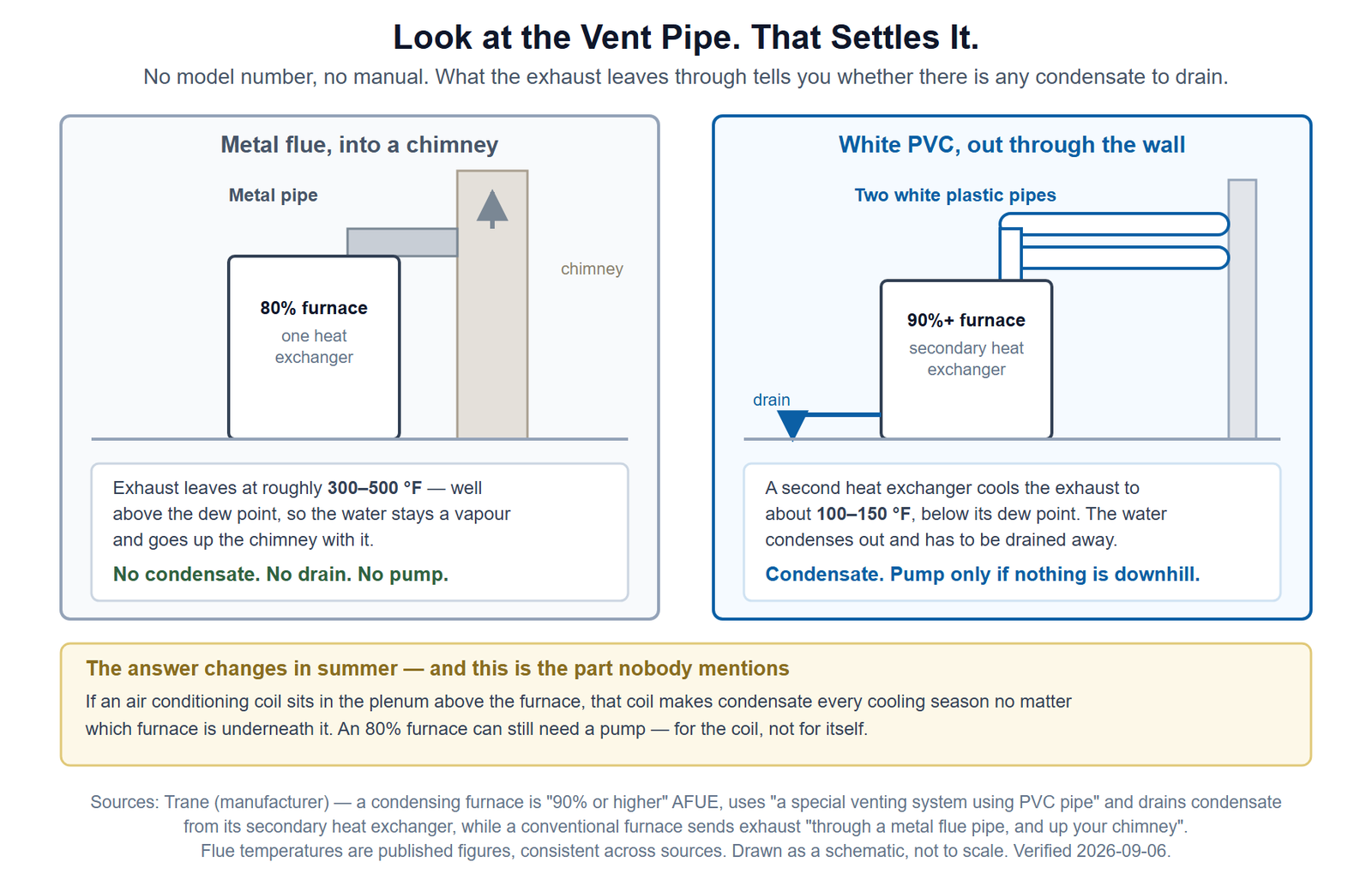
A conventional furnace burns gas, takes heat out of the flue gas once, and sends what is left outside at roughly 300 to 500 °F. That is far above the dew point of the exhaust, so the water in it stays a vapour the whole way and leaves up the chimney as gas. Nothing condenses. There is no drain, no trap and no pump, because there is no liquid.
A condensing furnace adds a second pass. Trane describes it plainly: “When the combustion exhaust gases leave the primary heat exchanger, instead of exhausting to the outside, they enter the secondary heat exchanger,” where “additional heat is released from the flue gas and water vapor begins to form.” The exhaust comes out at around 100 to 150 °F — cool enough that the water falls out of it as liquid, which then has to go somewhere.
The ten-second test
You do not need the model number, the manual, or the AFUE sticker. Look at what the exhaust leaves through.
Trane again, on a conventional furnace: “A conventional furnace needs to send the exhaust through a metal flue pipe, and up your chimney (if you have one) to the outside.” A condensing furnace instead uses “a special venting system using PVC pipe”, and “the liquid that results from the secondary heat exchange process drains out of your furnace and into a small PVC pipe that drains to the outside.”
One-minute test: find where the furnace vents. Metal pipe heading into a chimney means a conventional furnace and no condensate at all. One or two white plastic pipes running out through a sidewall means a condensing furnace, and there will be a small drain line coming off it.
If it does make condensate, it still might not need a pump
A pump is not part of a condensing furnace. It is what you fit when gravity cannot finish the job.
The condensate leaves the furnace at whatever height the furnace sits, and it needs a continuous fall to somewhere it is allowed to go. A basement floor drain a few feet away, a laundry standpipe, a utility sink — any of those and the water runs there on its own.
You need a pump when there is nothing below it: no floor drain, and the nearest acceptable termination is up a flight of stairs or across a finished basement. That is the whole condition.
How much is coming out is easy to underestimate. A condensing furnace at full output produces about one gallon per hour for every 100,000 BTU of input — a figure the manufacturer HTP publishes and one an HVAC tech on Heating Help gave independently, word for word.
The part nobody mentions: summer
Here is where the straightforward answer stops being straightforward, and it is the reason a lot of 80% furnaces have a pump sitting next to them anyway.
If your system also does cooling, there is an evaporator coil in the plenum directly above the furnace. That coil makes condensate every cooling season, regardless of what the furnace below it is. Its drain pan has exactly the same problem — it needs somewhere downhill — and in a basement with no floor drain, that means a pump.
So the honest answer changes with the season:
| Setup | Winter | Summer |
|---|---|---|
| 80% furnace, no cooling | No condensate at all | Nothing running |
| 80% furnace with an AC coil | No condensate | Coil condensate — pump if no gravity drain |
| 90%+ furnace, no cooling | Furnace condensate — pump if no gravity drain | Nothing running |
| 90%+ furnace with an AC coil | Furnace condensate | Coil condensate, usually the same pump |
A pump beside an 80% furnace is not a mistake. It is almost certainly there for the air conditioner.
What the code actually says
Most articles stop at “check your local codes”. Two lines are worth quoting, because you can hold your own install up against them.
Condensate has to reach an approved place by an indirect route: the Uniform Mechanical Code asks for it to be “collected and discharged to an approved plumbing fixture or disposal area” through an “indirect waste pipe” of “corrosion-resistant material”, sloped at a minimum of 1/8 inch per foot. Corrosion-resistant is not decorative language — condensing furnace condensate is acidic, and a tech on Heating Help put the consequence bluntly: “The water is acidic and will eventually ruin paint, copper, brass, concrete and cast iron.”
And the one that is genuinely useful to look at, from IMC 307.2.5 and IRC M1411.3.3: “Condensate drains shall be configured to permit the clearing of blockages and performance of maintenance without having to cut the line.”
Stand in front of your furnace and ask whether clearing a blocked drain would mean sawing through a glued pipe. If it would, the install does not meet what the code asks, and that is worth raising before it blocks rather than after.
When this needs a pro
Deciding whether you need a pump is a look, not a job. What follows it is not always.
Tying a condensate line into household plumbing needs a proper trap and vent arrangement with jurisdiction-specific spacing — a homeowner on Green Building Advisor got five contractors and three different answers, one of which was to give up on a high-efficiency furnace altogether and fit an 80% chimney-vented model instead. The first piece of advice they got was the right one: ask the building department what is normal where you live.
Wiring a pump’s safety switch into the furnace is low-voltage control work. What happens when nobody wires it is its own article.
If you have established that you do need one, which condensate pump do I need covers choosing it, and how far one can push water covers the case where the drain is a long way up. For how the pieces fit together, start at the condensate pumps guide.
FAQ
How do I know if my furnace makes condensate?
Look at the vent. A metal flue pipe going into a chimney means a conventional furnace, which produces none. One or two white PVC pipes going out through a sidewall means a condensing furnace at 90% AFUE or higher, which does — and it will have a small drain line coming off it.
Why does my old furnace not have a condensate pump?
Because it almost certainly has nothing to pump. Conventional furnaces send their exhaust out at 300 to 500 °F, well above the dew point, so the water leaves as vapour up the chimney. Condensate only appears once a second heat exchanger cools the exhaust below that point.
My furnace is 80% but there is a pump next to it. Why?
Almost certainly for the air conditioning. The evaporator coil above the furnace produces condensate through the cooling season no matter what the furnace is, and if there is no floor drain nearby that pan needs a pump to empty.
Does a high-efficiency furnace always need a condensate pump?
No. It always needs a drain, but gravity handles it whenever there is a floor drain, standpipe or sink below the furnace with a continuous fall to it. The pump is only for installs where nothing suitable sits lower than the equipment.
How much water does a condensing furnace produce?
About one gallon an hour for every 100,000 BTU of input when it is running at full output. So a 100,000 BTU furnace makes roughly a gallon an hour while it is firing hard, which is why the drain matters and why a blocked one shows up quickly.


