On this page
Last Updated on November 5, 2026 by Muhammad Toqeer
Before you decide the pump is weak, find out what the number on the box was measured under.
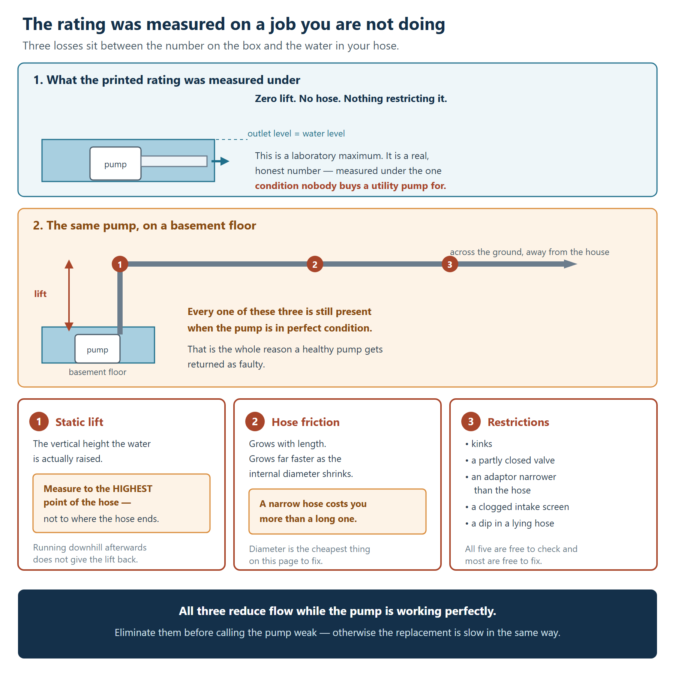
A utility pump’s headline flow figure — the gallons per hour printed largest on the packaging — is almost always measured at zero lift, through the shortest possible outlet, with no hose at all. It is a laboratory maximum, and it is honest as a comparison between pumps.
It is not a prediction of what will come out of your hose.
Your installation has lift, and it has hose. Both take flow away, and they take a surprising amount. So the first question on this symptom is not “what broke?” — it is “is this pump actually underperforming, or is it doing exactly what it was rated to do under conditions nobody quoted?”
For a lot of people reading this, the pump is fine and the expectation was wrong. That is worth knowing before buying another one that will do the same thing.
Where did the flow go?
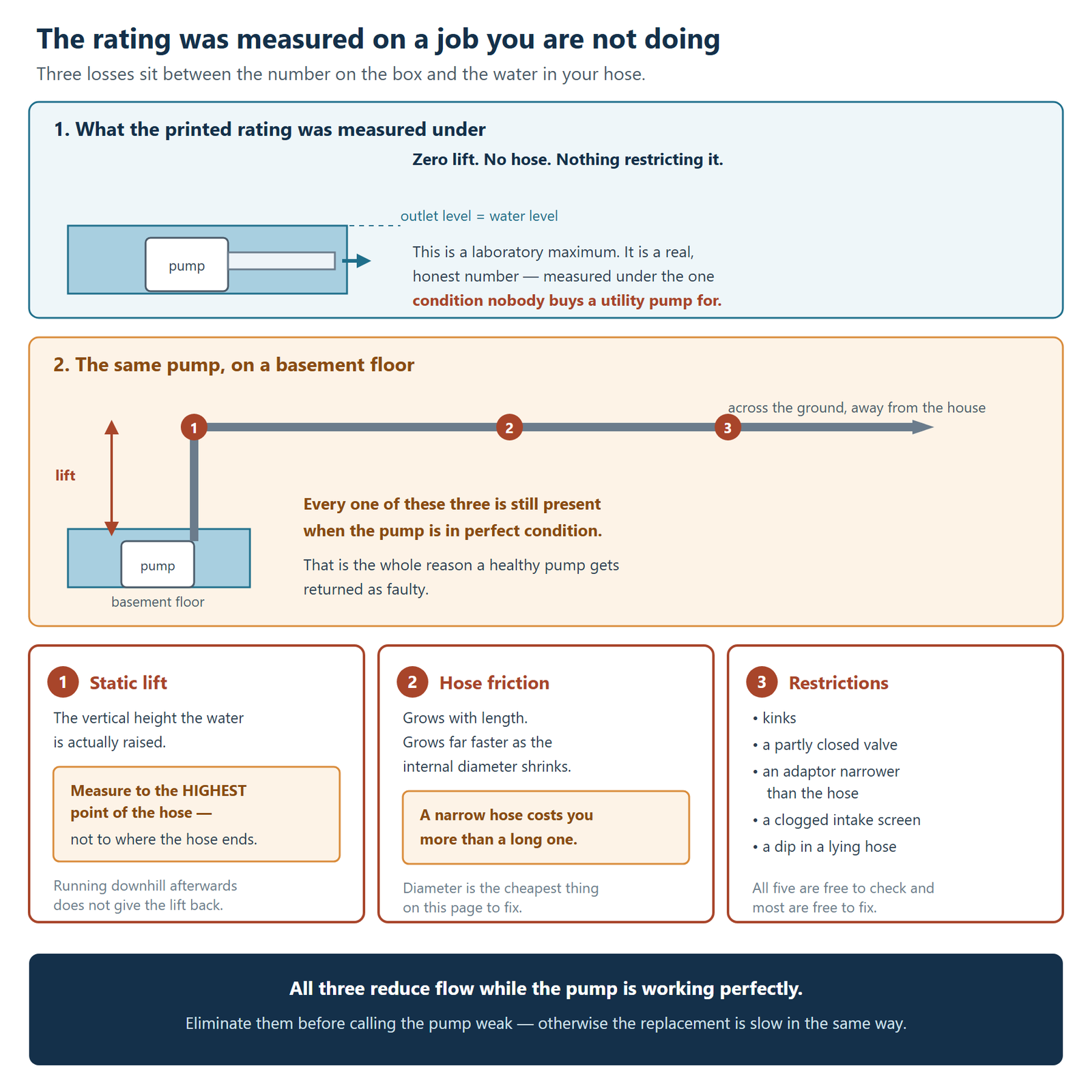
Three things take flow away, and only the third is a fault.
Static lift. The vertical distance the water has to be raised. Measured from the water surface to the highest point the hose reaches — not to where the hose ends. A hose that goes up a stairwell and then runs downhill across the garden is still lifting to the top of the stairs. Every pump loses flow as lift increases, and small utility pumps lose it steeply.
Hose friction. Flow falls as the hose gets longer, and it falls much faster as the hose gets narrower. Internal diameter matters more than length, which is the opposite of most people’s intuition — a long wide hose often beats a short narrow one. How much a hose run actually costs you is worth reading before you blame the pump, because this is the single most common cause of this complaint.
Restrictions. These are faults, and they are the part worth hunting:
- A kink, or a coil of hose with a tight bend in it
- A partly closed valve
- An adaptor or quick-connect narrower than the hose itself — a brass fitting with a small bore undoes a wide hose completely
- A clogged intake screen at the pump
- A dip in the hose holding standing water the pump has to push through
How do you find out which it is?
Shorten the problem until it either goes away or does not.
- Pull the intake screen and look at it. Debris here is free to fix and it is common. On a flooded floor it clogs within minutes.
- Run the pump with the hose off, or with a short length only, discharging into a bucket at pump level. This is the decisive test. You have just removed lift and friction.
- Compare. A strong flow into the bucket means the pump is sound and the installation is taking the flow. A weak flow into the bucket with no lift and no hose means the pump or its intake is at fault.
- If it was the installation, add things back one at a time — the hose, then the lift — and watch where the flow falls off.
Step two is the whole diagnosis. Everything before and after it is detail.
What if it is weak with no hose and no lift?
Then it is the pump or the water around it, and there are only a few candidates.
The intake is starved. A utility pump sitting flat on a floor with very little water over it pulls air as much as water. Most of these pumps need a minimum depth to work properly, and below it the flow collapses. Check the water depth before you check the pump.
The impeller is worn or damaged. Utility pumps live in gritty water. A worn impeller moves less water at every lift, and it usually arrives gradually. If there is also a noise, a grinding utility pump points at the same place.
Something is wrapped around or lodged in the impeller. This is recoverable, and it is worth looking for before concluding the pump is finished.
It is drawing air from the inlet side, which on a non-submersible transfer pump is a different fault entirely. If the pump sits outside the water rather than in it, a pump losing suction is the list to use.
If nothing at all is coming out rather than a weak stream, this is not your symptom — a utility pump running but not moving water is a separate fault with separate causes.
Was the pump ever big enough?
This is the uncomfortable question, and it deserves a straight answer rather than a reassurance.
A utility pump chosen on its headline gallons-per-hour figure, for a job with real lift and a long hose, was very likely undersized from the day it was bought. Nothing has failed. The pump is doing what it can at the lift it is being asked for.
How to tell the difference:
| Undersized from new | Degraded | |
|---|---|---|
| When it started | It was always like this | It used to be better |
| Flow with no hose, no lift | Reasonable | Weak |
| Intake screen | Clean or irrelevant | Often fouled |
| Noise | Unchanged | Often changed |
“It used to be faster” is the single most useful sentence in this diagnosis. If it was never faster, the pump is not broken and replacing it with the same rating will produce the same result.
Sizing a utility pump against the lift and run you actually have is how you avoid repeating that, and it is a different calculation from reading the biggest number on the box.
When does this need a pro?
- You are draining something that must not overflow and the pump cannot keep up. That is a capacity emergency, not a diagnosis.
- The water is contaminated or there is sewage involved. A utility pump is the wrong machine and the exposure is the problem.
- The pump trips a breaker or GFCI while running weakly. That combination is electrical and should not be worked around.
- You can feel anything in the water. Stop, cut the power at the breaker, and do not touch the pump.
- The lift genuinely exceeds what any utility pump will do — at that point the answer is a different class of pump, chosen against a measured head.
FAQ
Why is my utility pump pumping so slowly?
Most often because of lift and hose, not a fault. The flow figure on the box is measured at zero lift with no hose attached, and both the vertical height and the hose take substantial flow away. Run the pump with the hose off, discharging into a bucket at pump level — if the flow is strong, the pump is fine and the installation is taking it.
Does hose length reduce utility pump flow?
Yes, and hose diameter reduces it more. Flow falls as the hose lengthens, but it falls far faster as the internal diameter shrinks, so a long wide hose will often outperform a short narrow one. A narrow adaptor or quick-connect fitting can undo a wide hose on its own.
How do I measure the lift for a utility pump?
From the surface of the water being pumped to the highest point the hose reaches, not to where the hose ends. A hose that climbs a stairwell and then runs downhill across a garden is still lifting to the top of the stairwell, and that height is what the pump works against.
My utility pump was always slow — is it broken?
Probably not. A pump chosen on its headline flow figure for a job with real lift and a long hose was likely undersized from the start. The test is whether it was ever faster. If it never was, nothing has failed and a replacement of the same rating will behave identically.
Can a dirty intake screen cause weak flow?
Yes, and it is the cheapest thing to rule out. On a flooded floor a screen can clog within minutes, and the pump then starves while running normally. Pull it and look at it before testing anything else.
How much water does a utility pump need over it to work properly?
More than people expect, and the figure depends on the pump. Sitting on a floor with only a shallow film of water over it, a submersible utility pump draws air along with water and the flow collapses. The minimum depth is given in the pump’s own documentation and is worth checking, because below it the pump cannot perform at any rating.