On this page
Last Updated on November 5, 2026 by Muhammad Toqeer
“Will not shut off” describes two faults that have nothing in common. One test tells you which one you have, and it takes two minutes.
A condensate pump that runs continuously is either being fed water continuously, or it cannot get its own tank down to the level where the float switches off. Those are opposite problems. In the first the pump is working perfectly. In the second the pump or its discharge is at fault.
Almost every troubleshooting list opens with the float, because the float is the usual suspect on this symptom. But on a pump that is simply being fed, checking the float is checking a part that is behaving correctly.
So start by removing the water, not by opening the pump.
What is the one test?
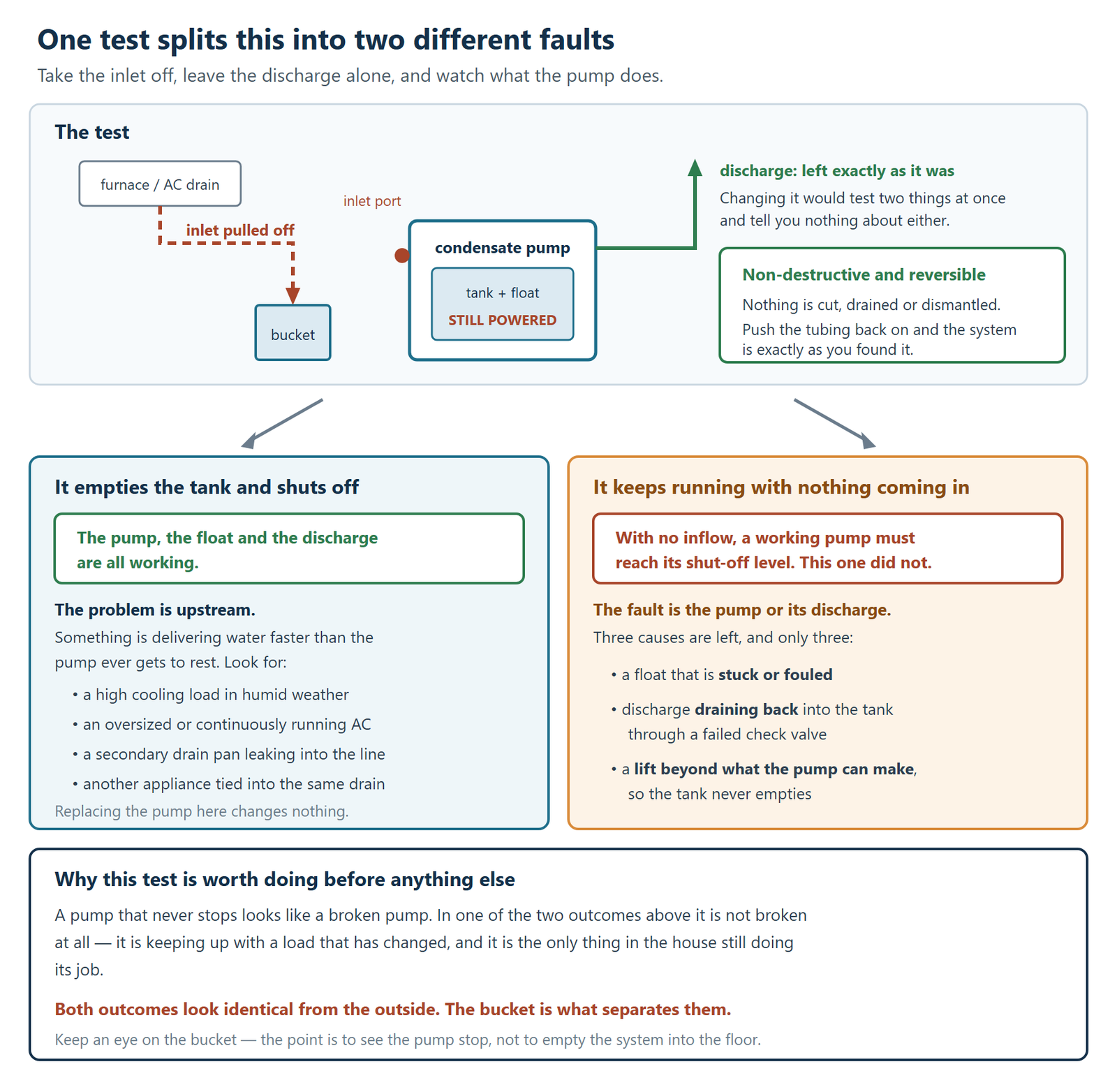
Pull the inlet tubing off the pump and put it in a bucket. Leave the pump powered and leave the discharge exactly as it is.
That is the whole test. It removes the one variable that makes this symptom ambiguous, and it costs nothing.
| What happens | What it means |
|---|---|
| The pump empties and shuts off | The pump, float and discharge all work. Something upstream is feeding it. |
| The pump keeps running | The fault is in the pump or the discharge. With no inflow, a working pump must reach shut-off. |
Two branches, and the rest of this page follows them separately. Do not read both.
Branch one: it shut off, so what is feeding it?
The pump is fine. Resist the urge to replace it. Something is delivering water faster than the pump needs a rest, and there are only a few candidates.
It is cooling season and the load is high. This is the most common answer and the least satisfying one. A high-efficiency air conditioner in humid weather pulls a great deal of moisture out of the air, and a small condensate reservoir fills quickly. A pump cycling every few minutes in July can be entirely normal. If this is new behaviour that arrived with hot weather and will leave with it, nothing is broken.
The equipment is running continuously. An oversized system that never satisfies the thermostat, or a system left on a fan setting that keeps air moving over a cold coil, produces condensate without pause.
A secondary or auxiliary drain pan is draining into the same line. If the primary drain is partly blocked and the overflow pan is doing the work, the pump is receiving water it should never see. This one matters, because it means something else has already failed.
Something else is tied into the drain. A humidifier, a second air handler or a high-efficiency furnace sharing the line adds volume the pump was not sized for.
There is standing water in the pan or line. A long run with a dip holds a slug of water that releases unevenly, so the pump gets fed in surges long after the equipment stops.
Note the difference between this and a pump that is short cycling — a short-cycling pump starts and stops rapidly, which is a float travel problem. A fed pump runs long and steady.
Branch two: it kept running with nothing coming in
Now the fault is in the pump or what it is pushing into. Three causes, in the order worth checking.
The float is stuck up. By far the most likely. Condensate carries biological growth and dust, and the float guide fouls. The float does not have to be jammed solid — enough drag to stop it falling the last few millimetres is sufficient, because that is where the switch opens. A stuck condensate pump float is a cleaning job far more often than a parts job.
The discharge is draining back into the tank. The pump pushes water up a vertical column. If the check valve at the outlet leaks, that column comes back down the moment the pump stops, refilling the tank and restarting the pump. The taller the lift, the more water comes back, and the more convincingly it looks like the pump will not shut off.
The tell: the pump runs, stops for a second or two, and restarts, over and over, with nothing coming in.
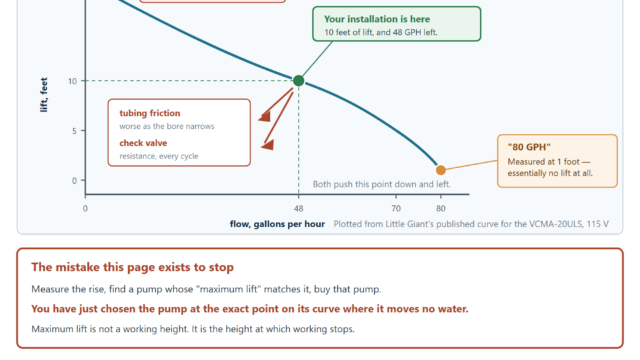
The lift is beyond what the pump can do. A pump working at or past its maximum head moves water slowly or not at all, so the tank level barely falls. How far a condensate pump can actually push water is set by the pump and the run, and a pump that has always struggled was installed on the wrong job rather than broken.
If the pump is running and no water is leaving at all, that is a different symptom with its own list — running but not pumping points at a blockage, an airlock or a failed impeller.
Why should you not just leave it running?
Because a continuously running condensate pump is consuming the only life it has.
These are small motors with a duty cycle in mind, and the switch contacts are rated in operations. A pump running without pause is being used in a way it was not designed for, and whichever branch you are on, that is true.
On branch one there is a second reason, and it is the more serious one. If the pump is running because an overflow pan is draining into it, the pump is masking a blocked primary drain. It will keep masking it until it cannot keep up, and the thing that then overflows is the pan above the ceiling or the equipment.
A pump that runs constantly is doing you a favour by being noticeable. It is worth acting on that before it stops.
Does the equipment shut down if this gets worse?
On most installations, yes — and that is by design rather than a fault.
A safety switch in the pump or the pan is wired to interrupt the equipment’s control circuit when the level rises past the pump’s ability to clear it. That is why an air conditioner shuts off when the condensate pump is full rather than quietly flooding a ceiling.
So a pump that will not shut off is often the warning before a shutdown, not an unrelated nuisance. The sequence is: inflow exceeds outflow, the pump runs continuously, the level still rises, the switch opens, the equipment stops.
When does this need a pro?
- Branch one, and you cannot find what is feeding it. Tracing a shared drain or confirming a blocked primary drain means getting at the air handler and the pan.
- Water is appearing anywhere other than the drain. That is an overflow in progress.
- The equipment has already shut itself down on the safety switch.
- The lift looks marginal and the real answer is a different pump on a different route. That is a sizing decision against a measured run.
- The pump is on a shared circuit that is tripping. That is an electrical fault, not a level fault.
FAQ
Why does my condensate pump run constantly?
Either it is being fed water continuously or it cannot lower its own tank to the float’s shut-off point. Disconnect the inlet tubing into a bucket and leave the pump powered. If it empties and stops, the pump is fine and something upstream is feeding it. If it keeps running with no inflow, the fault is the float, a discharge draining back, or too much lift.
Is it normal for a condensate pump to run often in summer?
Yes. A high-efficiency air conditioner in humid weather removes a lot of moisture, and condensate reservoirs are small, so frequent cycling in hot weather is ordinary. What is not ordinary is running without pause, or continuing at that rate once the weather cools.
Can a stuck float make a condensate pump run continuously?
Yes, and it is the most likely cause once inflow has been ruled out. The float does not need to be jammed solid — enough drag from biological growth or dust to stop it falling the last few millimetres is enough, because that is the point at which the switch opens.
Why does my condensate pump restart a second after it stops?
That pattern points at the discharge draining back into the tank through a leaking check valve. The pump lifts a column of water, the valve fails to hold it, and the column returns and refills the tank. The taller the lift, the more pronounced this is.
Will a condensate pump that runs constantly burn out?
It will wear far faster than one that cycles. These are small motors intended for intermittent duty, and the switch contacts are rated in operations rather than hours. Continuous running is outside the design intent on either branch of this fault.
Does a condensate pump running constantly mean something else has failed?
Sometimes, and this is the reason not to ignore it. If a secondary or overflow drain pan is draining into the pump because the primary drain is partly blocked, the pump is quietly covering for a blockage. It will keep covering for it until it cannot keep up.