On this page
- Did the battery run out, or did the pump shut down?
- Why does it stop with water still available?
- Is heat being mistaken for a dead battery?
- How should you measure real runtime?
- Can a hose make the pump seem to have less battery life?
- When should you buy a different pump or battery?
- When this needs service
Last Updated on October 25, 2026 by Muhammad Toqeer
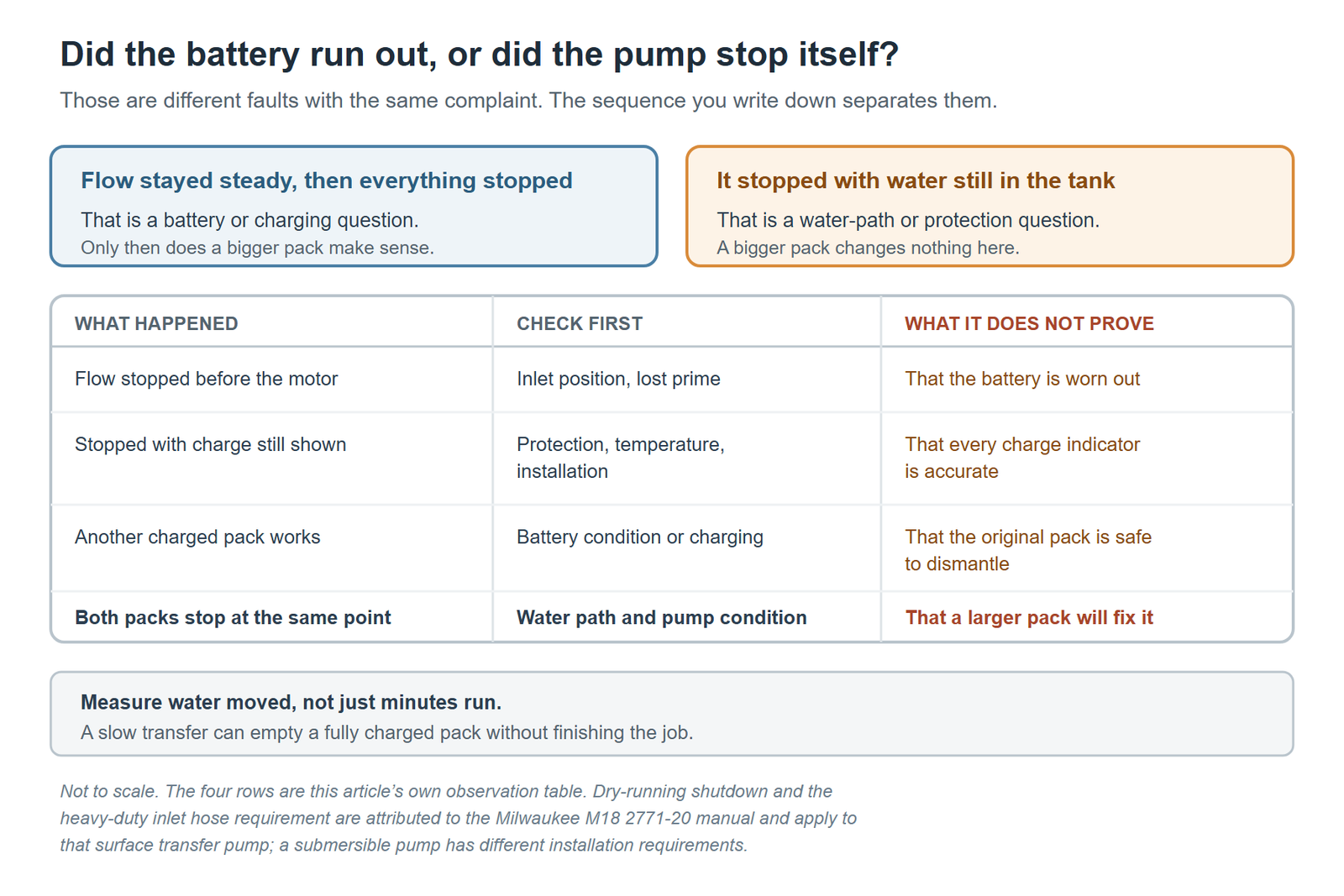
Short battery-pump runtime can mean an empty battery, but it can also mean the pump stopped protecting itself. Check whether water flow failed before the motor stopped, whether the battery still indicates charge, and whether cooling restores operation. Measure water moved as well as minutes run; a slow transfer can waste a charged pack without finishing the job.
Did the battery run out, or did the pump shut down?
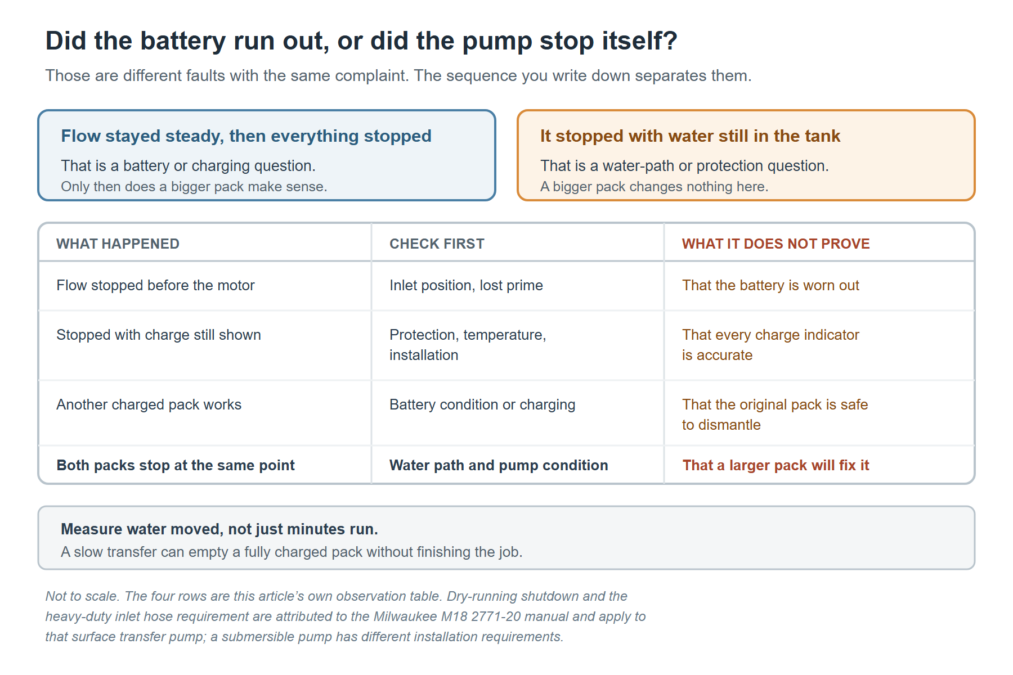
Write down the sequence. “Stopped after a few seconds with water still in the tank” is different from “flow remained steady until the battery was depleted.”
| What happened | Check first | What the observation does not prove |
|---|---|---|
| Flow stopped before the motor | Inlet position and loss of prime | That the battery is worn out |
| Pump stopped with charge indicated | Protection, temperature and installation | That every remaining charge indicator is accurate |
| Another compatible charged pack works under the same conditions | Battery condition or charging | That the original pack is safe to dismantle |
| Both packs stop at the same point | Water path and pump condition | That buying a larger pack will solve it |
One-minute check: switch the pump off, remove the battery and inspect the inlet position and accessible hoses. Keep electrical parts dry. Follow the manual before restarting, and never bypass a protection feature to finish a transfer.
Why does it stop with water still available?
The water can be present without reaching the pump. An inlet can lift above the water, a soft suction hose can flatten or a connection can admit air.
One-minute check: with the pump stopped, verify the inlet remains properly submerged and that the hose is not kinked. Inspect the accessible connection for a missing or damaged seal. A suction-side leak can admit air without leaving an obvious puddle, so “it does not leak water” is not a complete test.
The Milwaukee M18 2771-20 manual describes dry-running shutdown and directs the user to stop the pump as soon as it takes in air. It also specifies a heavy-duty inlet hose to resist collapse.[1] Those details are specific to a surface transfer pump; a submersible pump has different installation requirements.
Is heat being mistaken for a dead battery?
One-minute check: note any temperature or overload indication and whether the unit was in direct sun or had obstructed ventilation. Let the equipment cool as directed by its manual. Do not immediately put a hot pack back under load just because its charge indicator remains lit.
If it restarts only after cooling, record that pattern for service. It is evidence of a temperature-dependent fault or protective stop, not proof of which component is at fault. The separate utility-pump overheating guide explains why cooling arrangements depend on pump type.
Do not cool a surface transfer pump by placing it in the water. “Battery powered” does not mean waterproof.
How should you measure real runtime?
Use the same charged pack, pump, hose and water route for a meaningful comparison. Record active pumping minutes, approximate volume moved, vertical rise and any interruptions. A comparison made after changing both battery and hose cannot tell you which change mattered.
For an illustrative measurement, suppose a transfer moves 60 gallons in 15 minutes. That is 4 GPM for that setup. The arithmetic says nothing about how the pump would behave with a longer hose or greater lift.
Manufacturers may publish both an “up to” flow and an “up to” volume per charge. Dividing those maxima produces a calculated time, not automatically a manufacturer-tested runtime. Unless the test conditions match, presenting that quotient as a guarantee overstates the evidence.
For example, the manufacturer’s [product page][2] gives an up-to-240-gallon-per-charge claim tied to an XC5.0 pack. Keep the battery and the qualifier attached to that figure. Do not turn it into a promise for every pack or installation.
Can a hose make the pump seem to have less battery life?
Yes: the job may take longer even if the battery behaves normally. Extra resistance changes the transfer rate. The effect on electrical load and total runtime depends on pump design, so “more restriction always drains the battery faster” is too broad.
One-minute check: inspect the whole accessible hose for pinches and unnecessary loops. Compare the actual diameter and route with the manual. Only change the route if you can keep the outlet secured and discharge safely.
Read how hose length affects utility-pump flow before buying a larger battery to compensate for a poor route. An inlet hose and an outlet hose do different jobs; a hose that holds discharge pressure can still collapse under suction.
When should you buy a different pump or battery?
If a known-good compatible pack completes the same job while the original repeatedly fails, have the original pack assessed or replaced through an approved channel. Do not rebuild a swollen, damaged or wet pack.
If both packs behave normally but the transfer exceeds the practical capacity of the system, choose by the job’s measured duty. The battery-powered utility-pump comparison is the next step, with one caution: treat calculated runtimes as estimates unless matching test conditions are documented.
When this needs service
Stop after recurrent overheating, burning smells, damaged battery housings or an unexplained protective shutdown that persists with a clear water path. Keep the observations and pack identifiers for service. A larger battery cannot repair a damaged pump.
[1]: https://documents.milwaukeetool.com/58-14-0049d6.pdf [2]: https://www.milwaukeetool.com/products/details/m18-transfer-pump/2771-20