On this page
Last Updated on September 2, 2026 by Muhammad Toqeer
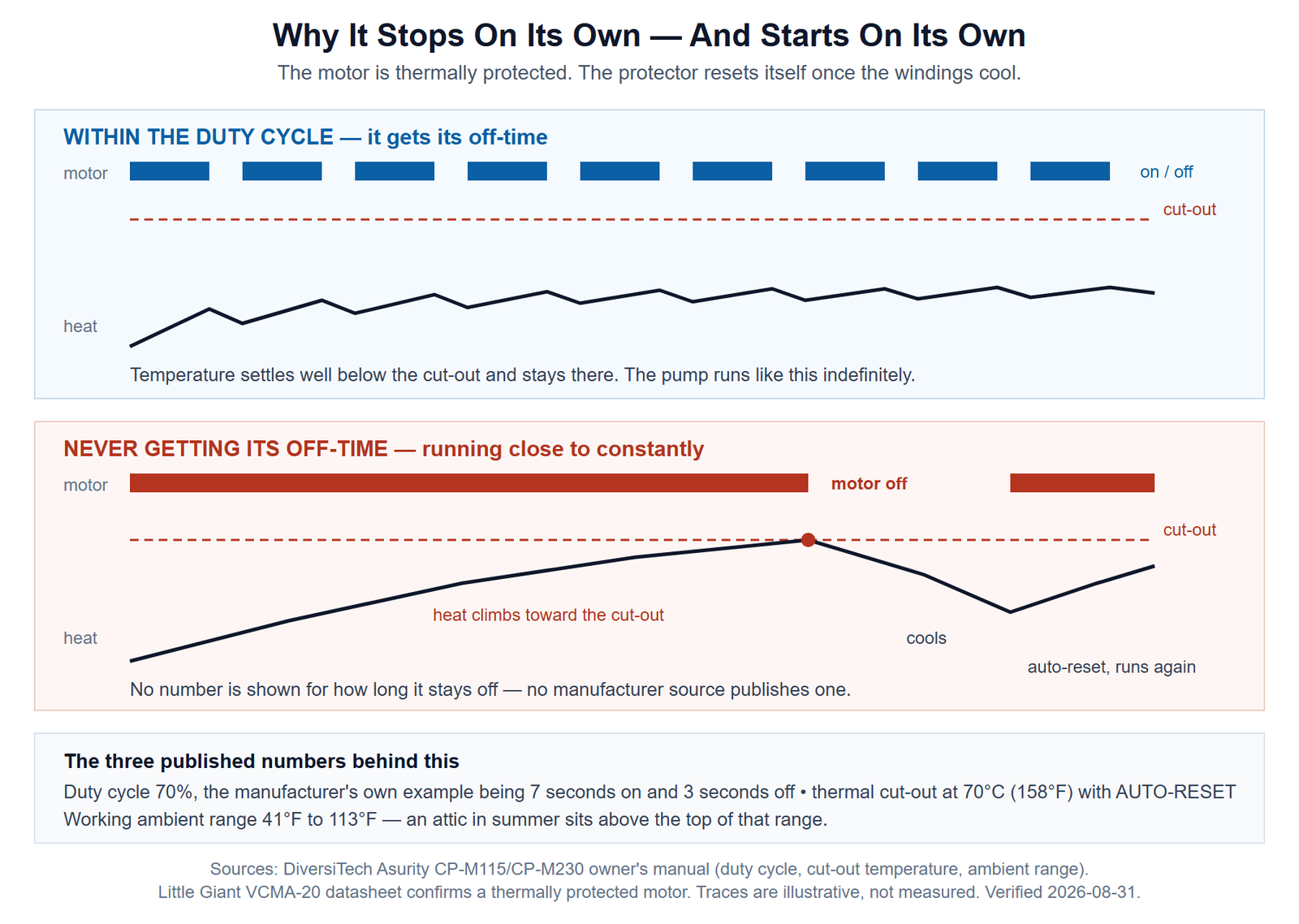
A condensate pump that stops partway through a cycle and starts again a few minutes later usually hasn’t failed. These motors are thermally protected and the protector resets itself once the windings cool, so what you’re watching is the pump saving itself. The question worth answering is what is making it work hard enough to get that hot.
First, confirm that’s what you’re seeing
The thermal cut-out has a signature that’s hard to mistake once you know it.
The pump runs, stops before the tank is empty, and stays silent for a while — minutes, not seconds. Then it starts again on its own with nobody touching it, runs, and may stop again. Nothing you do makes it restart faster.
One-minute test: when it cuts out, put the back of your hand on the motor housing, not the tank. A pump that has tripped its thermal protector is noticeably warm — warm enough that you’d notice it against a basement’s ambient temperature. A pump that stopped for any other reason is cool.
If it stops and restarts within seconds rather than minutes, that’s a different fault: water is falling back into the tank and refilling it, and the pump is doing the same lift over and over. That one is covered separately, and it’s worth reading, because it’s also one of the things that causes the overheating described here.
And if the pump is silent and never comes back at all, you’re in different territory again.
These pumps have a duty cycle, and it’s published
This is the part almost nobody knows. A condensate pump is not built to run continuously.
DiversiTech publishes the number for its mini-split pump: a 70% duty cycle, with the manufacturer’s own worked example given as 7 seconds on, 3 seconds off. Little Giant’s VCMA-20 datasheet lists the motor as “thermally protected” and UL and CSA listed, and rates the tank for intermittent liquid temperature up to 120°F. The word doing the work in both cases is intermittent.
DiversiTech also publishes what the protector actually does: “The pump module features a thermal cut-out set at 70°C with AUTO-RESET.” Seventy degrees Celsius is about 158°F. That’s the winding temperature at which the motor takes itself offline, and the auto-reset is why it comes back without you doing anything.
So the pump isn’t broken. It’s telling you it’s being run past what it was designed for.
What’s making it run that much
Three things do it, and the first is by far the most common.
Water is coming back into the tank. A failed check valve, discharge tubing wider than the 3/8 inch maximum, or a line with no downhill run all let the water the pump just lifted fall straight back down. The float rises again, the pump runs again, and it never gets the off-time its duty cycle assumes. This is the single most common route to a thermal trip, and the fix is in the article on that fault rather than here.
One-minute test: watch the tank after the pump stops. If the level climbs back on its own within a few seconds, that’s your answer and this article isn’t the one you need.
The line is partly blocked, or the lift is too high. Both make the pump work harder for longer to move the same water. A VCMA-20 shuts off entirely at 20 feet of lift, and it’s already down to 48 GPH at ten — a pump near its ceiling runs a long time to clear a small tank. There’s more on how that curve falls away in the condensate pump guide.
One-minute test: pull the discharge tube off the outlet and blow through it. If it fights back, the line is restricted. Then measure from the pump up to the highest point the tube reaches and compare that with what the pump is rated for.
There’s genuinely more water than the pump is sized for. Less common in a house, but real on an oversized system in a humid climate, or where two pieces of equipment have been teed into one pump. If the pump is running almost constantly in July and behaving perfectly in October, that’s volume, not a fault.
Where it’s installed matters more than people expect
These pumps have an ambient temperature ceiling, and it’s lower than you’d guess. DiversiTech gives a working range of 41°F to 113°F.
An attic in an American summer goes well past 113°F. So does the top of a mechanical room in a badly ventilated space. A pump sitting in that air has nowhere to dump its own heat, and a motor that would never trip in a basement will trip repeatedly in an attic doing identical work.
Worth being straight about what that number is: it’s the manufacturer’s published working range, not a measured failure threshold. A pump at 115°F won’t necessarily trip. Treat it as the conditions the pump was designed around. If yours is in an attic, cutting out in August and behaving in spring, the ambient is the first thing to suspect.
One-minute test: put a thermometer next to the pump on a hot afternoon. If it reads above 113°F, the install location is at least part of the problem, and no replacement pump will behave differently in the same spot.
The mistake to avoid while testing
DiversiTech’s manual carries a blunt caution: “Never run the pump without water. This can destroy or decrease the pump performance.”
This matters because the obvious way to test a pump is to switch it on and watch it. Do that with an empty tank and you can damage the thing you’re diagnosing. Always test with water in the reservoir, above the level that trips the float.
When this needs a pro
If the pump is cutting out and you’ve ruled out backflow, a blocked line and the ambient, what’s left is either a motor whose protector is tripping early because the winding insulation is going, or a genuine sizing mismatch. Both are worth a tech’s opinion rather than another replacement pump.
Get someone in sooner if the pump serves a high-efficiency furnace and has been cutting out for a while. Every minute it’s offline the tank is filling, and the safety switch that shuts your heating down is the only thing standing between that and an overflow. A pump that keeps stopping is a pump that will eventually stop at the wrong moment.
FAQ
Is a condensate pump supposed to get warm?
Warm, yes. Hot enough that you don’t want to keep your hand on it means it’s near its cut-out, and something is making it run more than it should.
How long does a condensate pump take to reset itself?
There isn’t a published figure for these pumps, so anyone quoting you an exact number is guessing. What the manufacturers do state is that the reset is automatic — you wait, you don’t press anything.
Can I just replace the pump?
You can, and if the old motor is genuinely failing it’s the right call. But if the cause is water falling back down the discharge line, or an attic sitting well above the pump’s working range, a new pump does exactly the same thing within a season.
Does a bigger pump fix it?
Only if the problem is genuinely volume, which is the least common of the three causes. Sizing up to solve a backflow or a blocked line just gives you a bigger pump doing the same wasted work.
My pump keeps shutting off and now my furnace won’t run either. Are those related?
Almost certainly. The pump’s safety switch is wired into the low-voltage circuit that shuts the equipment down when the tank fills. If the pump keeps stopping, the tank keeps filling, and the switch does its job.


