On this page
Last Updated on August 31, 2026 by Muhammad Toqeer
Every guide opens by telling you to check that it’s plugged in. It is plugged in — that’s why you’re still reading. The check that actually finds this fault is whether that outlet is live all the time, because Little Giant’s manual requires a constant power source, and plenty of these pumps aren’t on one.
This is the pump that does nothing: no hum, no click, no movement when the tank is full. If yours hums but doesn’t move water, that’s a different fault with a different fix.
What “plugged in” doesn’t prove
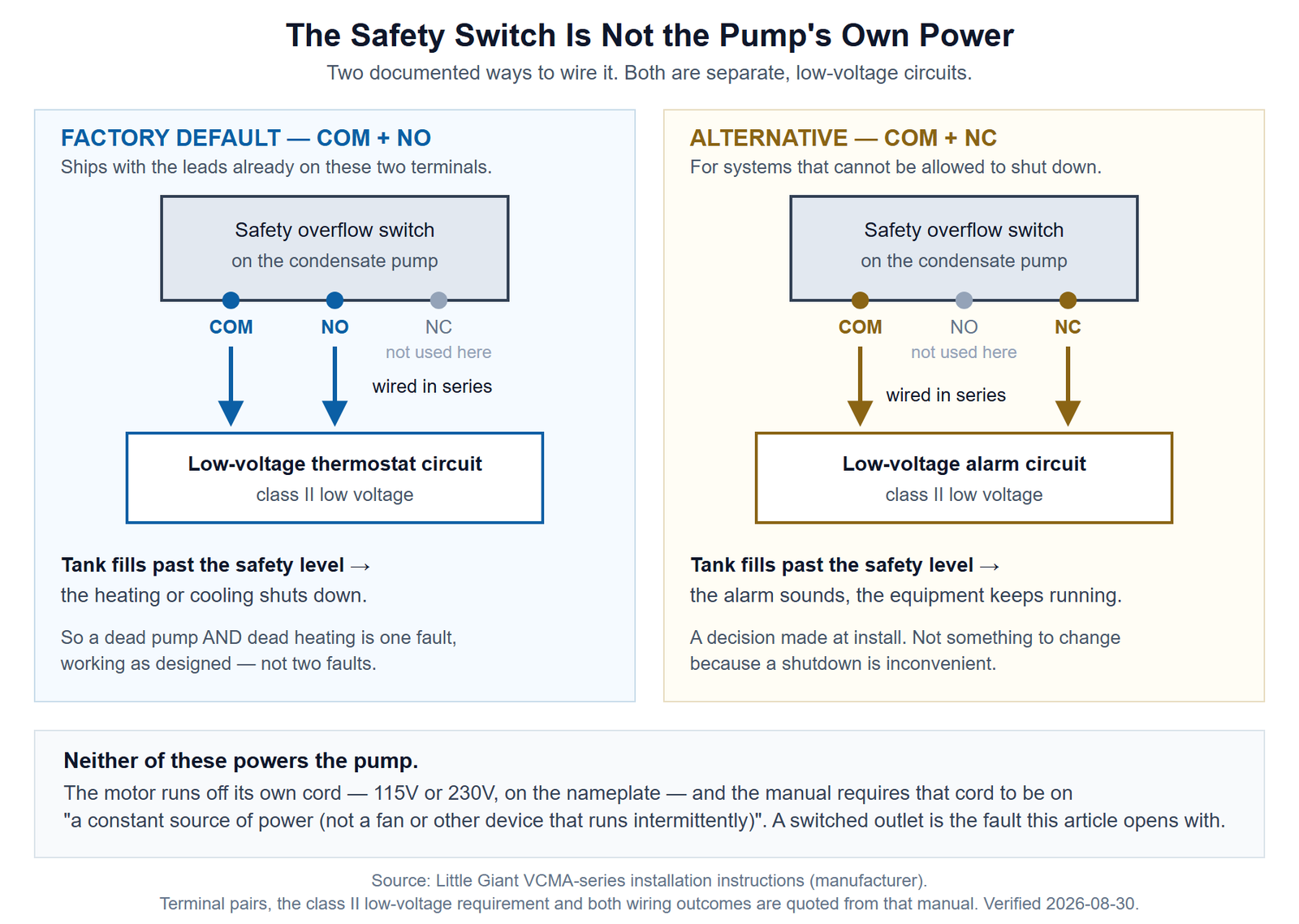
The manual’s wording is worth quoting, because nobody repeats it: the power cord “must be connected to a constant source of power (not a fan or other device that runs intermittently).”
That rules out more outlets than you’d think. Some condensate pumps get plugged into a receptacle inside the air handler cabinet that’s only live when the blower runs. Some are on the furnace service switch — the light-switch-looking one on the side of the unit that anyone can knock off while carrying laundry past. Some share a switched outlet with something else entirely.
A pump on any of those is genuinely dead for long stretches, and it is dead in exactly the way that makes you think the pump has failed. The tank fills while the equipment is off, and there’s nothing to empty it.
One-minute test: unplug the pump and plug a phone charger or a lamp into the same outlet. Leave it there and go turn the furnace or AC off at the thermostat. If the lamp dies with it, you’ve found the fault, and the pump is fine. Also flip the service switch on the side of the furnace while you watch.
The fix is an electrician moving the pump to a constant-power receptacle. It isn’t a pump problem and buying a new pump will reproduce it exactly.
If the outlet is live and stays live, move on.
The float test, and the number that makes it a test
Every article says to pour a little water into the reservoir and see if the pump kicks on. None of them tells you how much, which is a problem, because “a little” often isn’t enough to reach the trigger and you end up diagnosing a working pump as dead.
On Little Giant’s VCMA series the float switches the motor on at about 2-1/4 inches of water in the tank and shuts it off again at about 1-1/4. So the test has a number in it: pour clean water in until it’s clearly above two inches deep. Below that, nothing happening tells you nothing at all.
If it starts — the pump works, and what you actually have is a float that isn’t rising on its own. That’s usually algae or scale binding the float on its post, and it’s the most common single cause behind a pump that seems dead. Unplug it, lift the float by hand and feel for grit or drag. Clean the tank and the float with a soft brush; rinsing alone leaves biofilm behind, which is why these come back.
If it doesn’t start, keep going.
The float rises, and still nothing happens
Now you’ve narrowed it to two parts: the switch the float pushes, or the motor behind it.
There’s a test technicians use that costs nothing. With the tank filled above the trigger level, tap the microswitch — the small switch body the float arm bears on — lightly with the plastic handle of a screwdriver. Failed microswitches often come back to life for a moment under a light tap. If the motor bursts into life when you tap it, the switch is the failed part, not the pump.
If tapping does nothing and the outlet is confirmed live, the motor is finished. Little Giant’s own parts list sells the volute and motor as a single assembly, which tells you how these are meant to be serviced — replaced, not opened up.
Two things worth doing before you buy. Note the voltage on the nameplate — these come as 115V 60Hz and 230V 50/60Hz, and they are not interchangeable. And on a 230V unit with a fused plug, the manual asks for a 1.0 amp fuse, which is a detail that gets lost when a pump is swapped in a hurry.
Measure how high your discharge line climbs before you pick the replacement, too. A pump’s rated output collapses as lift increases, and the condensate pump guide has the GPH-versus-height figures for a real model — buying on the headline number is how people end up back here in a year.
When the pump is dead and so is your heating
This one confuses people badly, and it isn’t two faults. It’s one, working as designed.
The pump’s safety overflow switch is not part of the pump’s own power. It’s a separate class II low-voltage circuit, and it ships from the factory with its leads on the COM and NO terminals, meant to be wired in series with the low-voltage thermostat circuit. When the tank fills past the safety level, that switch opens and shuts the heating or cooling down — deliberately, so the equipment stops making condensate that has nowhere to go.
So a dead pump plus a furnace or AC that won’t start is the expected sequence: the pump stopped, the tank filled, and the safety switch did its job. Fix the pump and the system comes back.
It also explains a complaint that turns up constantly: someone replaces a condensate pump and afterwards the furnace won’t run at all. The safety switch leads went back on the wrong terminals, or didn’t go back at all.
The manual does document an alternative. Where the heating or cooling system can’t be allowed to shut down, the COM and NC contacts are used instead to drive a low-voltage alarm circuit, wired in series — you get warned rather than shut off. That’s a design decision made at install, not something to change because a shutdown is inconvenient.
When this needs a pro
Anything past the outlet test above is electrical work. Moving the pump to a constant-power circuit means adding or re-feeding a receptacle — an electrician’s job, not a DIY one.
The safety switch is the other line. Its terminals sit in the low-voltage control wiring of your furnace or air handler, and getting COM, NO and NC wrong doesn’t just stop the pump protecting you — it can leave the equipment unable to start, or worse, running with no shutdown at all when the tank overflows. If your pump was recently replaced and the system stopped working, say exactly that when you call. It points a tech straight at the wiring.
And never jumper the safety switch out to get the heat back on. That switch is the only thing standing between a blocked drain and water coming through a ceiling.
FAQ
My condensate pump is completely silent. Is it always the motor?
Usually not. Silence means no power is reaching the motor at all, and the two cheapest explanations — an outlet that isn’t live all the time, and a float that can’t rise — are both far more common than a burnt-out motor. Rule those out first.
How much water should I pour in to test it?
Enough to get clearly above two inches deep in the tank. On a Little Giant VCMA the float trips the motor at roughly 2-1/4 inches, so a splash in the bottom proves nothing either way.
Can I plug a condensate pump into the outlet inside the furnace cabinet?
Only if that outlet is live all the time. Many of them are switched with the equipment, and the manual specifically rules out powering the pump from anything that runs intermittently.
I replaced my condensate pump and now the furnace won’t turn on. What did I do?
Most likely the safety overflow switch leads. They belong on COM and NO, wired in series with the low-voltage thermostat circuit, and if they are on the wrong terminals or left disconnected the furnace can be held off. That’s a call to an HVAC tech, not a puzzle to solve with a jumper.
Is there a reset button on a condensate pump?
Not on these. Unplugging it and plugging it back in is the whole of the reset, and if that changes anything it’s a clue about the supply rather than the pump.


