On this page
Last Updated on September 30, 2026 by Muhammad Toqeer
No, and the gauge is not the reason. The electrical code does not permit a cord to take the place of a building’s wiring, whatever size it is. A perfectly chosen 12-gauge cord powering a sump pump permanently is still a cord doing a circuit’s job.
The arithmetic is worth knowing anyway, because plenty of pumps are on a cord right now while somebody arranges something better. A hundred feet of 16-gauge costs a 9.7-amp pump 7.8 volts.
The answer that settles it
From the National Electrical Code:
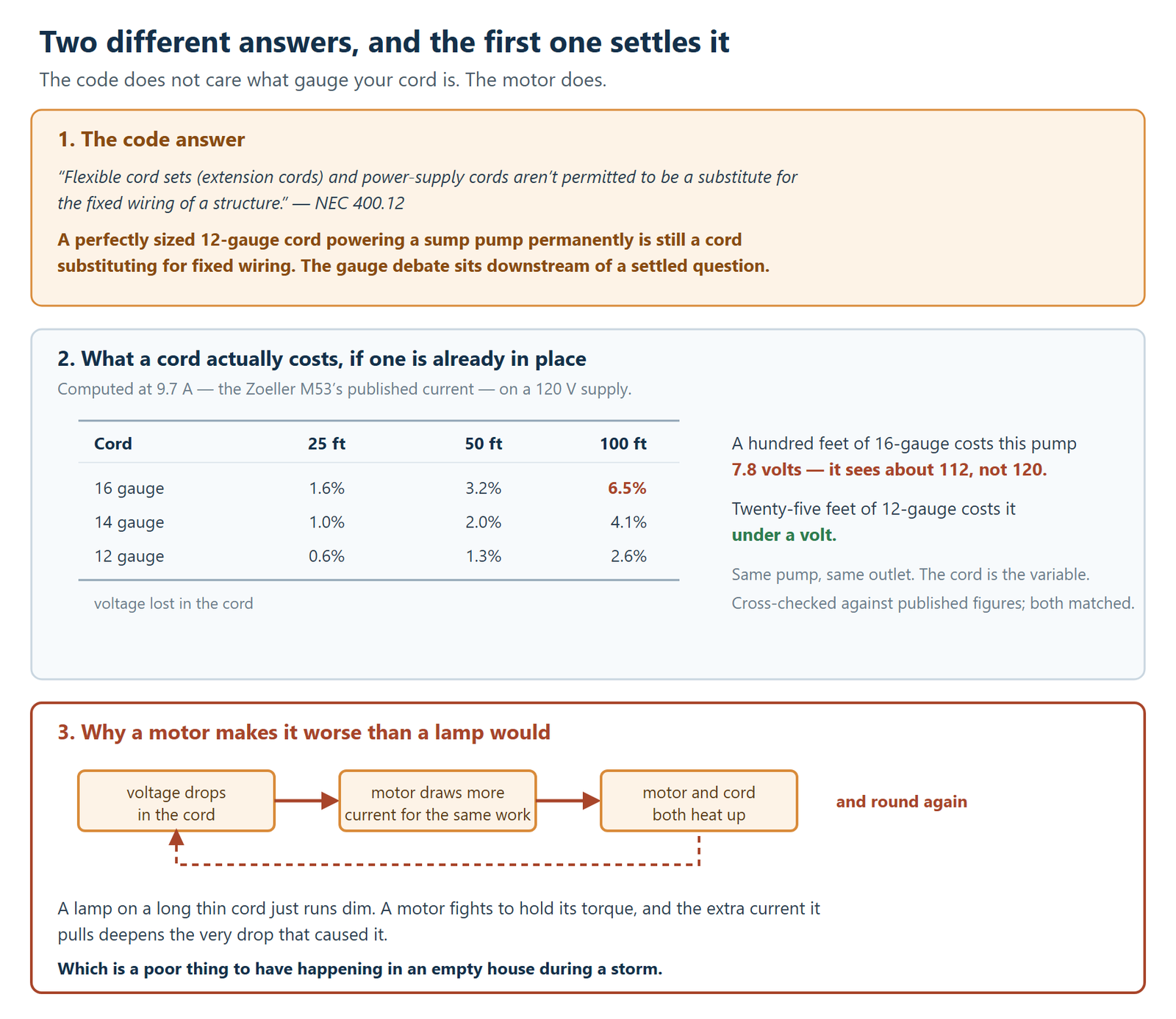
“Flexible cord sets (extension cords) and power-supply cords aren’t permitted to be a substitute for the fixed wiring of a structure.”
That is the whole question, answered without reference to length or gauge. A sump pump is permanent equipment. The thing feeding it permanently is the building’s wiring, and an extension cord is not that.
The same section rules out three more things, and they describe what people actually do:
- Cords attached to building surfaces — stapled along a joist to keep them tidy
- Cords concealed by walls, floors or ceilings — run up through a hole to an outlet on the floor above
- Cords where they are subject to physical damage — across a basement floor where things get stored and moved
If your cord is neatly stapled up out of the way, it is more clearly non-compliant, not less.
What a cord costs, if one is on there now
Nobody rips a cord out mid-storm. So here is the arithmetic, computed at 9.7 amps — the published running current of a common 1/3-class sump pump — on a 120-volt supply.
| Cord | 25 ft | 50 ft | 100 ft |
|---|---|---|---|
| 16 gauge | 1.6% | 3.2% | 6.5% |
| 14 gauge | 1.0% | 2.0% | 4.1% |
| 12 gauge | 0.6% | 1.3% | 2.6% |
Voltage lost in the cord itself.
A hundred feet of 16-gauge leaves that pump seeing about 112 volts instead of 120. Twenty-five feet of 12-gauge costs it under a volt.
Same pump, same outlet, same water. The cord is the only variable, and it spans a seven-fold range.
Why a motor makes it worse than a lamp would
A lamp on a long thin cord simply runs dim. It draws less current at lower voltage and nothing bad happens.
A motor does the opposite. It has work to do — a fixed head of water to lift — so when the voltage falls it draws more current to hold its torque. That extra current heats the motor and the cord.
And it deepens the drop that caused it, because voltage lost in a cord is proportional to the current flowing through it. It is a loop that tightens rather than settling.
Which is a poor thing to have running in an empty house during a storm.
Why this matters more on a sump pump than on most things
It is the appliance you are least likely to be standing next to. A sump pump does its real work during heavy rain, often overnight, often when nobody is home. Its failure is discovered as water on the floor rather than as a tripped breaker you notice.
And a cord adds a connection that can come out. A plug knocked loose while somebody shifts boxes is one of the most common findings in a flooded basement, and nothing announces it. A pump hard-wired or plugged into a dedicated receptacle beside the pit has one fewer thing to go wrong.
The manufacturers say so too. Pump makers routinely prohibit extension cords outright — the same prohibition appears on grinder pumps, where it sits alongside a warning about overloaded supply wires.
The actual answer
A dedicated receptacle near the pit, on a circuit sized for the pump, installed by an electrician.
That is not a dodge. There is no compliant way to make a cord permanent, so the only useful advice is the one that ends the question.
And check the pump’s own cord length before you buy a replacement. Factory cords run from about 8 feet to 25, and choosing one that reaches your outlet is the simplest way to never need this article. The cord on the pump is not an extension cord — it is part of the listed appliance.
When this needs a pro
All of the electrical side. A receptacle in a damp basement serving equipment that runs unattended is exactly the sort of work that gets inspected.
Whether the receptacle needs GFCI protection, which varies between code editions and jurisdictions and is a genuine question rather than a formality — ask, rather than assume either way.
Anything involving the pit itself, which should be sealed and fastened down and is not a casual thing to open.
What you can do yourself: follow the cord from the pump and see what it actually plugs into. If there is an extension cord in the chain, you have found something worth putting on the list — and if it is stapled to a joist, put it nearer the top.
FAQ
Can I use an extension cord for a sump pump?
Not as a permanent arrangement. NEC 400.12 does not permit cord sets to substitute for a structure’s fixed wiring, and that applies regardless of the cord’s gauge or length. The answer is a dedicated receptacle near the pit.
What gauge extension cord for a sump pump?
The gauge question sits downstream of the code answer, but if one is temporarily in place, heavier and shorter is better. At 9.7 amps, 100 feet of 16-gauge loses 6.5% of the voltage while 25 feet of 12-gauge loses 0.6%.
Does low voltage damage a sump pump?
It can. A motor answers lower voltage by drawing more current to maintain torque, which heats both the motor and the cord — and the extra current deepens the voltage drop that caused it.
Why do pump manufacturers prohibit extension cords?
Because of the voltage drop and the risk of overloading the supply wires. The same prohibition appears across pump types, and using one can affect warranty coverage.
Is it OK to use an extension cord for a sump pump temporarily?
It is a judgement call rather than a compliant option. If it is genuinely short-term, the shortest and heaviest cord you have is the least bad version, and the receptacle work should be arranged rather than postponed indefinitely.
Does a sump pump need its own circuit?
It is the arrangement to aim for. A pump sharing a circuit with other loads can trip on the combined draw, and a sump pump is the one appliance whose failure you discover after the fact rather than during.