On this page
Last Updated on September 30, 2026 by Muhammad Toqeer
No — each pump needs its own. But the more useful answer is the one nobody gives: those valves have to sit below the point where the two discharge pipes meet.
Fit two perfectly good check valves in the wrong place and the running pump does not push water outside. It pushes it down through the idle pump and back into the pit.
Where the valves sit decides everything
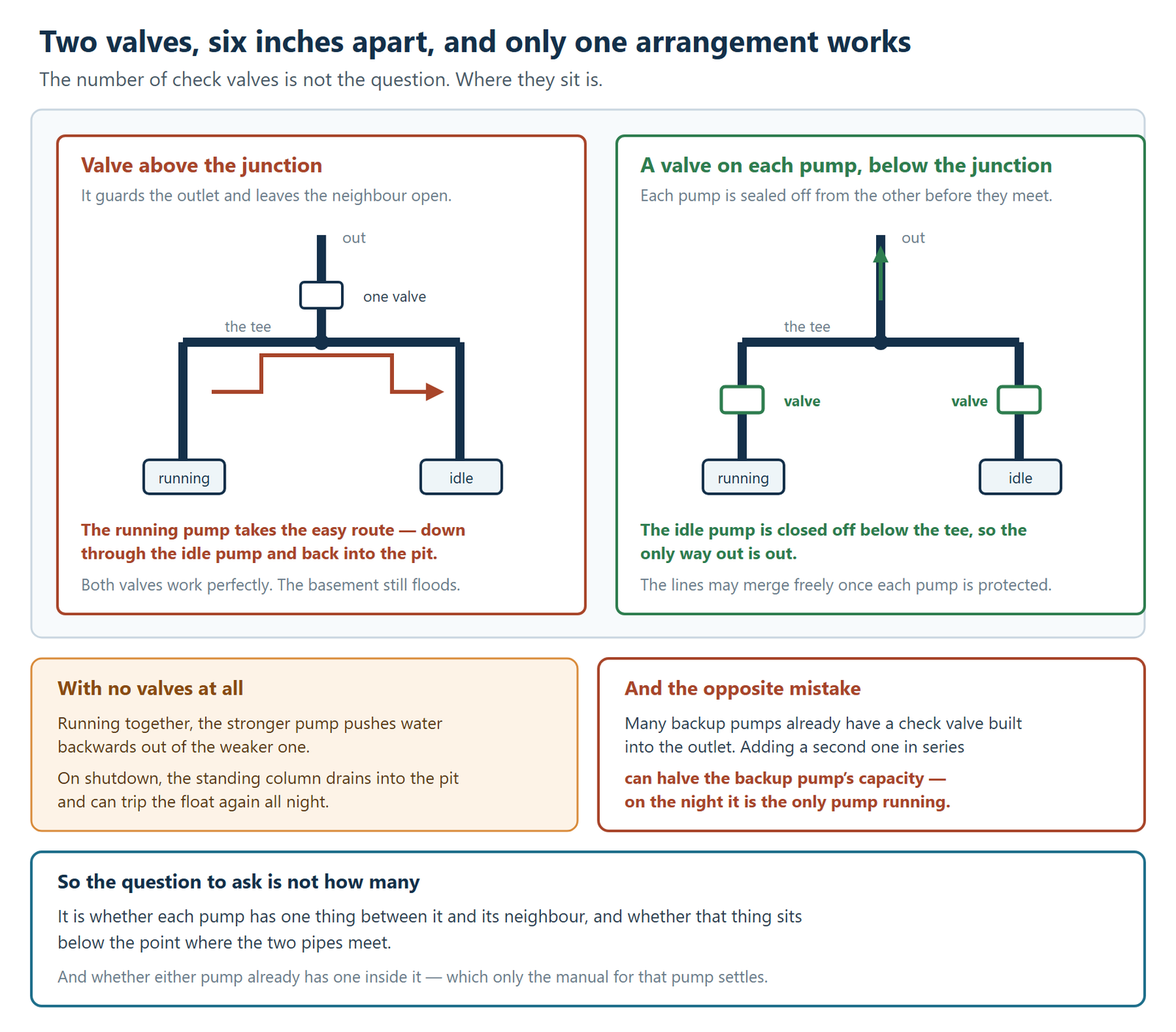
Picture the usual arrangement: a primary pump and a battery backup in the same pit, their discharge pipes joining at a tee, one line going outside.
A check valve only blocks flow in one direction, at the point where it is fitted. So the question is what is on each side of it.
Put one valve above the tee and it does exactly its job — it stops water in the outside line draining back down. But it does nothing about the path between the two pumps. When the primary runs, the water reaches the tee and finds two ways to go: up, against the standing column in the discharge line, or down the other branch, through the idle pump, into the pit. It takes the easier one.
Both valves can be in perfect condition and the basement still floods.
Put a valve on each pump, below the tee, and the idle pump is sealed off before the pipes ever meet. The running pump has one route and it is the right one. After that, the lines can merge freely.
What happens with no valves at all
Two separate failures, and they show up at different times.
Both pumps running together. The stronger one pushes water backwards out of the weaker one’s discharge port. You have two pumps and the output of less than one.
One pump shutting off. The column of water standing in the shared line has nowhere to be held, so it drains back into the pit. That refill can trip the float and start the whole thing again, repeatedly, all night.
The second is the one people notice, because it sounds like a pump that will not stop rather than a plumbing arrangement that cannot work.
The opposite mistake, which is just as common
Many backup pumps already have a check valve built into the outlet.
If yours does, adding another one in series above it is not extra safety — it is a restriction. A second valve can cut that pump’s capacity substantially, because it now has to push through two spring-loaded flaps instead of one.
And that loss arrives at the worst possible moment: the backup pump only runs when the primary has failed or the power is out, which is exactly when you need every gallon of it.
This is why the manufacturer’s instructions decide it. Whether your pump has an internal valve is not something to infer from looking at it, and the two pumps in your pit may not be the same in this respect.
How to check yours without touching anything
Look at where the two pipes become one. That junction is the reference point for everything else.
Then look below it, on each branch. Is there a valve body on each pump’s pipe before the join? A check valve is usually an obvious inline housing, often with an arrow on it showing flow direction.
If there is one valve and it is above the junction, you have the arrangement in the left half of the diagram above.
If there is a valve on each branch below the junction, that is the correct shape — and the remaining question is whether either pump also has an internal one, which sends you to the manuals.
Check the arrows point the same way, away from the pumps. A check valve fitted backwards blocks the pump entirely, which is a different and much more obvious fault.
Is a second pump even the right answer?
Worth asking before any of this. A second pump in the pit is usually there for one of two reasons: capacity, or redundancy.
If it is capacity — the primary cannot keep up — the arrangement is worth revisiting, because a single pump matched to the actual inflow at the actual lift is simpler than two pumps arguing over one pipe.
If it is redundancy, which is the usual and better reason, then the plumbing above is the whole point. A backup that cannot discharge because of a valve six inches too high is not redundancy at all.
When this needs a pro
Any change to the discharge pipework. It is plumbing on a system that protects the basement, and getting the junction wrong is exactly the failure this page describes.
Anything electrical, including a backup system’s controller, charger or battery.
A pit where you cannot see the arrangement clearly. The lid should be gas-tight and fastened down, so getting a proper look is a job in itself rather than a glance.
What you can do yourself: find where the two pipes join, look below it on each branch, and check the arrows. Three observations, no tools — and they tell whoever you call exactly what they are walking into.
FAQ
Can two sump pumps share one check valve?
No. Each pump needs its own, because a single shared valve leaves the path between the two pumps open. When one runs, water goes down through the idle pump and back into the pit rather than outside.
Where should the check valves go with two pumps?
On each pump’s discharge, below the tee or wye where the two lines join. A valve above the junction protects the outside line but not the route into the neighbouring pump. After each pump has its own valve, the lines can merge freely.
What happens if two sump pumps have no check valves?
Two things. Running together, the stronger pump pushes water backwards out of the weaker one. And when a pump stops, the standing column in the discharge drains back into the pit, which can trip the float and cycle the pump repeatedly.
Do I need a check valve if my backup pump has one built in?
Usually not, and adding one can hurt. A second valve in series makes the backup pump push through two flaps and can cut its capacity substantially — at the moment it is the only pump running. Check the manual for that specific pump.
How do I know if my check valve is installed backwards?
Most have a directional arrow on the body, which should point away from the pump. A backwards valve blocks the pump completely, so the symptom is dramatic rather than subtle.
Is two sump pumps better than one bigger one?
It depends why the second one is there. For redundancy against failure or power loss it is the right approach, provided the discharge is plumbed correctly. For raw capacity, one pump properly matched to the inflow and lift is usually simpler.


