On this page
Last Updated on September 29, 2026 by Muhammad Toqeer
The gauge on your pressure tank sits upstream of the softener. It reads 40 or 50 and reports that the well side is healthy — which it is. The softener is allowed to take up to 15 psi out of that before the water reaches the house, and the gauge never sees it happen.
Put a softener’s legal drop together with the climb to a second-floor shower and a system where nothing has failed can still deliver less pressure than the code requires at the fixture.
Follow the pressure, stage by stage
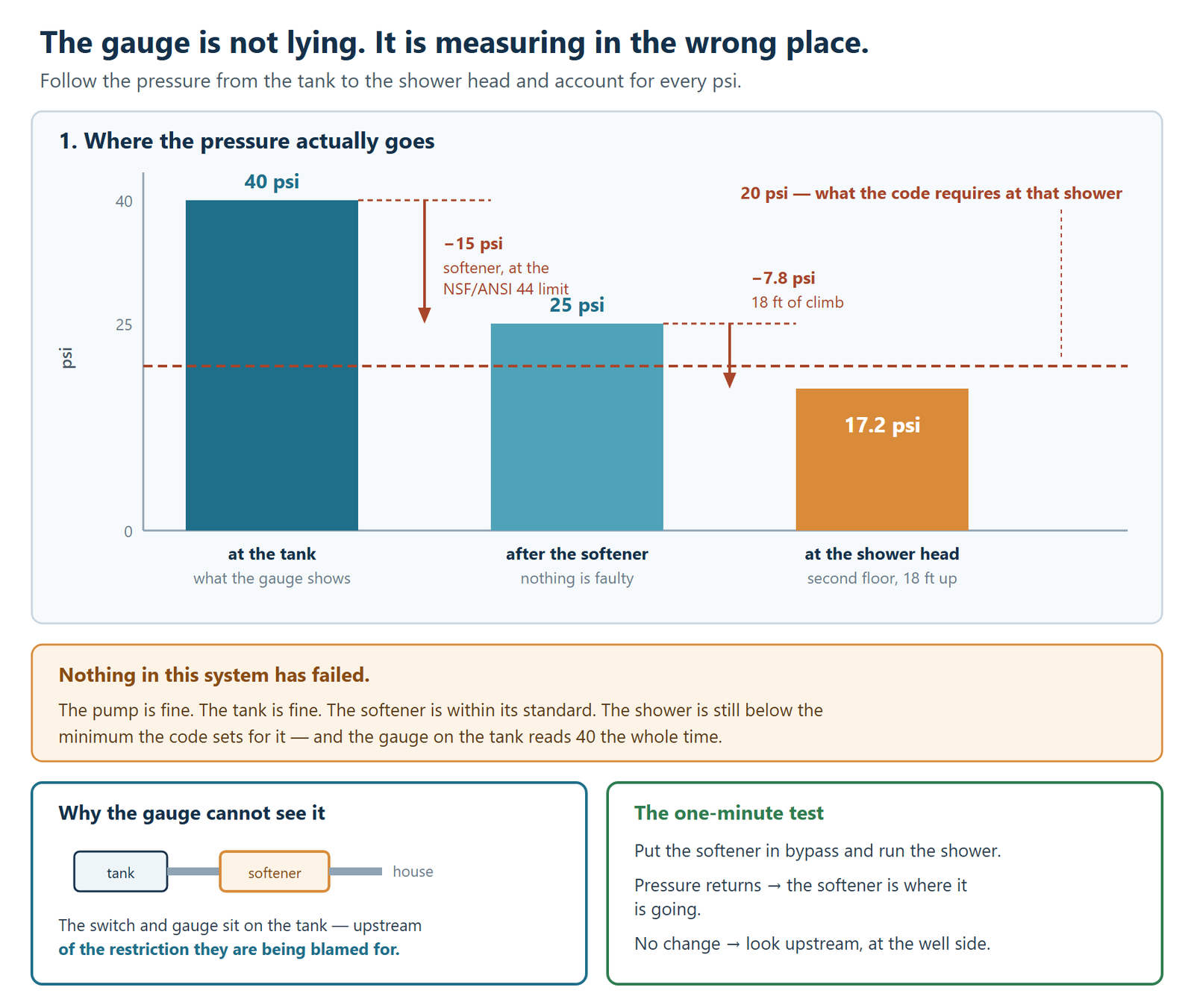
A standard well runs a 40/60 pressure switch — the pump starts at 40 psi and stops at 60. Just before the pump restarts, the tank is at 40, and 40 is what the gauge shows.
Subtract the softener. The governing standard, NSF/ANSI 44, sets the ceiling:
The pressure drop of a water softener must not exceed 15 psi at the manufacturer’s rated service flow.
A softener taking 15 psi is not broken. It is a compliant softener at its limit. That leaves 25 psi entering the house.
Subtract the climb. Water costs 0.433 psi per foot of rise. Eighteen feet to a second-floor shower takes 7.8 psi, leaving 17.2 psi at the head.
Now the comparison that matters. The residential code lists a shower with a mixing valve at 2.5 gpm and 20 psi of flow pressure at the fixture.
17.2 against 20 required. The shower is below minimum, the gauge says 40, and nothing in the system has failed.
The same sum with a healthier softener
A correctly sized softener typically drops 5 to 10 psi, not 15:
| Softener drop | At the shower head | Against 20 psi |
|---|---|---|
| 5 psi | 27.2 psi | Comfortable |
| 10 psi | 22.2 psi | Just clears |
| 15 psi | 17.2 psi | Below minimum |
The softener’s drop is the entire margin. That is the finding, and it is why this feels like a well problem when it is not one.
Why the gauge cannot see it
A softener is installed downstream of the pressure tank. The pressure switch and the gauge are mounted on the tank.
So the controller is measuring the system at a point before the restriction. It sees 40 to 60 psi, decides everything is fine, and it is correct about everything it can see.
This is why the symptom is so disorienting. The number says the well side is healthy. The shower says otherwise. Both are telling the truth about different places.
The one-minute test
Put the softener in bypass and run the shower.
Every softener has a bypass — usually a lever or two valves on the control head.
- Pressure comes back → the softener is where it is going. Whether that is a fault or simply its allowed drop is the next question.
- Nothing changes → the softener is not your problem. Work through the well-side causes instead.
Do it while somebody runs the shower, not with the house still. The drop across a softener rises with flow — the faster water moves through the resin bed, the more pressure it costs. A static gauge reading will not reproduce the complaint, which is another reason this gets misdiagnosed.
If the softener is where it is going
Three possibilities, and only one of them is a fault.
It is fouled or exhausted. Iron or hardness build-up in the resin, a clogged inlet screen or a blocked sediment pre-filter ahead of it. This is water-treatment work and it is the first thing to have checked.
It is undersized. The design guidance is 10 gpm per square foot of resin bed for continuous flow and 15 gpm/ft² at peak. Push a small unit past that and the drop climbs. A unit sized for the house peak flow, rather than the smallest one that fits, is the fix.
It is fine, and 15 psi is simply what it takes. This is the case nobody writes about. Nothing to repair, nothing to clean — the system was designed with no margin.
What to do about the third case
The usual answer is to raise the pressure switch, from 40/60 to 50/70 for example, so the house starts from a higher number and the softener’s drop lands somewhere survivable.
Three things have to be true before that is safe, and all three are worth asking about rather than assuming:
The pump has to be able to deliver it. A higher cut-out asks for more head, and published shut-off heads differ a great deal between pumps. Not every pump has 70 psi in it at your well’s depth.
The tank pre-charge has to move with it. The pre-charge is set relative to cut-in, so changing the switch without changing the tank produces a new problem in place of the old one.
The plumbing has to take it. Higher standing pressure is harder on supply lines and appliance inlet hoses, and there is a code ceiling at 80 psi static.
It is live-voltage work on the device protecting your pump. Ask for it; do not attempt it.
And the option people reach for first
A booster pump is usually the wrong answer here and it is worth saying why. The restriction is the softener. A booster cannot push more water through a restriction than the restriction passes — it would be treating the symptom on the far side of the thing causing it.
When this needs a pro
Anything inside the softener. Resin, valves, injectors and brine draw are the water-treatment trade’s work.
Any change to the pressure switch. Line voltage, in a damp place, on the device protecting the pump.
Sizing a replacement softener, which depends on hardness, iron content, household size and peak flow together.
What you can do yourself: read the gauge, bypass the softener, run the shower, and note whether it changes. That single test decides which trade you are calling, and it takes a minute.
FAQ
Can a water softener cause low water pressure?
Yes, and not only when it is faulty. NSF/ANSI 44 allows a softener to drop up to 15 psi at its rated service flow, so a healthy, compliant unit can take a substantial bite out of the pressure reaching the house.
Why does my well pressure gauge read fine but the shower is weak?
Because the gauge is on the pressure tank, upstream of the softener. It reports the well side accurately and cannot see any pressure lost after it — the softener, the pipe run, or the climb to an upstairs fixture.
How much pressure does a water softener take?
A correctly sized one typically drops 5 to 10 psi, and the standard permits up to 15 psi at rated flow. The drop rises with flow rate, so it is worst when several fixtures are running.
How do I test whether my softener is causing the pressure drop?
Put it in bypass and run a shower. If the pressure returns, the softener is where it is going. If nothing changes, the cause is upstream on the well side.
Should I raise my well pressure switch because of the softener?
It is often the right answer, but it depends on the pump having the head to deliver the higher pressure, the tank pre-charge being reset to match, and the plumbing tolerating it. It is live-voltage work and a job to hand over.
Will a booster pump fix low pressure caused by a softener?
Usually not. The softener is a restriction, and a booster cannot push more water through a restriction than it passes. Addressing the softener or the switch setting deals with the cause rather than the symptom.


