On this page
Last Updated on September 28, 2026 by Muhammad Toqeer
Close every valve in the house, let the pump run, and watch the gauge. If the pressure climbs past your cut-out and the pump keeps going, the switch is at fault. If it climbs and then levels out below cut-out, the switch is innocent — and replacing it will change nothing.
Almost every guide on this problem opens by adjusting or replacing the switch. That is the right move about half the time.
Do this first. A pump that will not shut off is running continuously, and that is how it destroys itself. Switch the breaker off, then diagnose. Everything below is a 240-volt circuit in a damp place; the parts that need the cover off with power on are called out, and they are the ones to hand over.
Why the hurry
This is not a fault you get to think about over a weekend.
A submersible motor is cooled by the water moving past it. A jet pump relies on the water it is moving to carry heat away. Take the flow away and the heat has nowhere to go — which is why the standard reference on this symptom warns that a jammed or wrongly set switch “will cause the pump to run continuously and is likely to burn-up the pump motor.”
A cheap fault becomes a pump replacement in the time it takes to finish reading about it. Kill the breaker.
The test that splits the problem in two
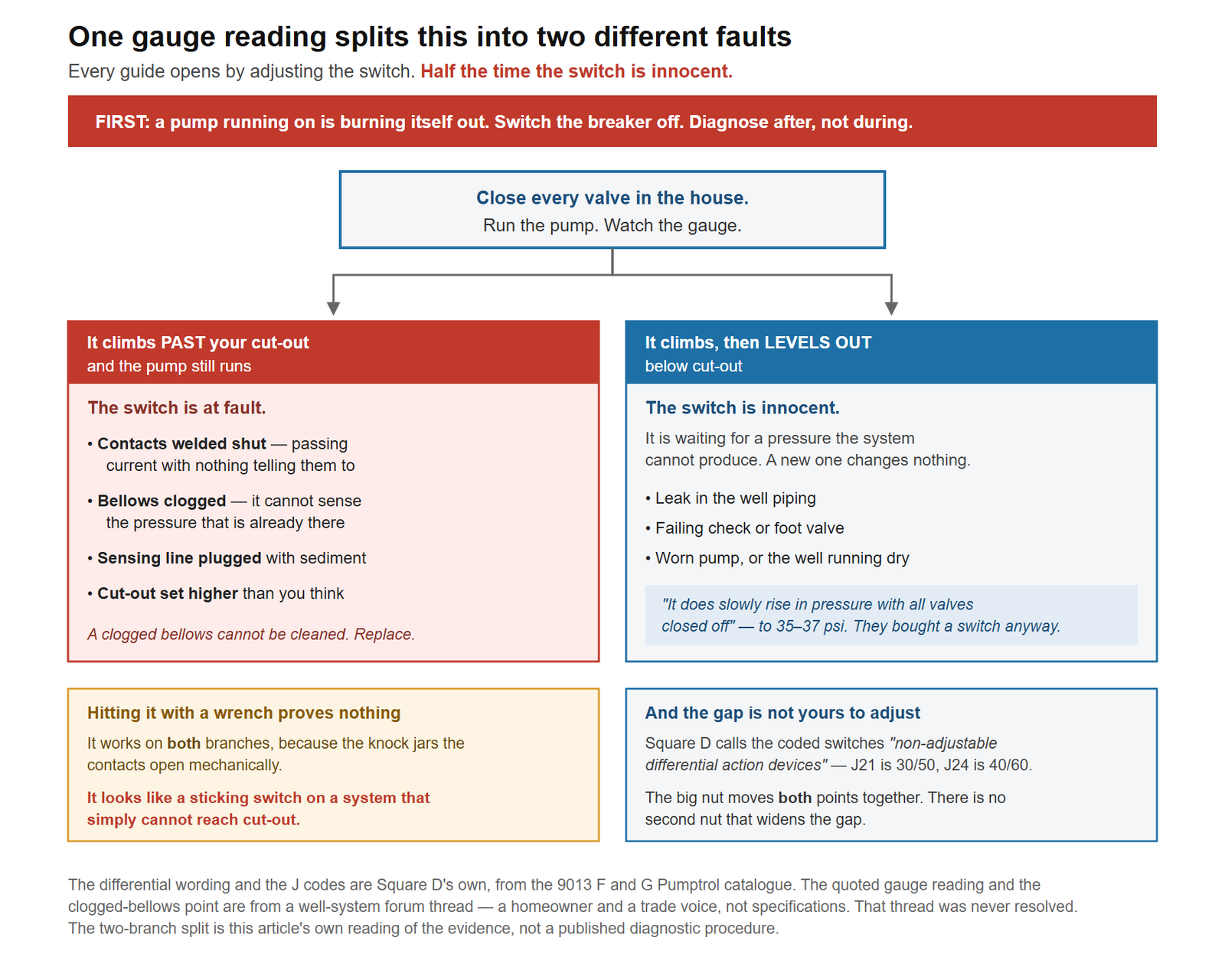
You need two things: your cut-out figure, and a gauge you can watch. The cut-out is printed on the switch — a 30/50 switch cuts out at 50 psi, a 40/60 at 60.
Close everything. Turn the breaker back on. Watch the needle.
It matters that the house is shut. With a tap open the pump may never reach cut-out simply because you are drawing water as fast as it arrives, and you will diagnose the wrong branch.
If the pressure climbs past cut-out — the switch is at fault
The system is making the pressure. The switch is being told to open and is not doing it.
The contacts are welded shut
What it looks like: pressure well past cut-out, pump still running, and often a switch that has been cycling hard for months beforehand.
Contacts arc every time they open under load. Enough of that and they fuse. This is the opposite failure of the burnt contacts that stop a pump starting — same wear, same part, opposite result.
One-minute test: kill the breaker, and with the power off look at the contacts under the cover. Welded contacts are usually visibly blackened or fused together rather than sitting as two clean surfaces.
Does it mean replacement? Yes. Contacts are not a serviceable item. And fix the cycling too, or the new switch goes the same way — rapid cycling is what burns them in the first place.
The bellows is clogged
What it looks like: identical to welded contacts from outside. The switch simply never senses the pressure that is sitting right there.
Inside the switch is a bellows or diaphragm that the water pushes against. A tradesman on Terry Love’s forum described the failure exactly:
“the bellow in the switch has a small hole to the bellows that can get clogged up and can’t really clean them”
Does it mean replacement? Yes, and that is the useful part — this is the one failure here you should not spend an evening trying to clean out. It is a sealed part with a small orifice, and it is a new switch.
The sensing line into the switch is plugged
What it looks like: the same again — and this one is worth checking before you buy anything, because the switch may be perfectly good.
The switch sits on a short nipple or a small tube teed into the plumbing. On iron-heavy or sedimenty water that passage silts up solid, and a switch that cannot see pressure behaves exactly like a switch that has failed. The standard reference puts it plainly: “Sediment or debris-clogged pressure sensor or switch pressure sensing tubing can cause improper switch performance.”
One-minute test: power off, water off and the system depressurised, then take the switch off its nipple and look through it. A clear passage lets light through. If you can, blow air through the tube.
Does it mean replacement? Only the nipple, which is a plumbing part. This is the cheapest outcome on this page, which is why it is worth checking before the switch gets condemned.
The cut-out is set higher than you believe
What it looks like: the pump does eventually stop, just far above where you expected.
Switches get adjusted by previous owners and by anyone chasing weak pressure. What is printed on the label is the factory setting, not necessarily today’s.
And a correction worth having, because the internet’s standard advice is to start turning nuts: on most residential switches the gap between cut-in and cut-out is not adjustable at all. Square D’s own catalogue describes the coded switches as:
“non-adjustable differential action devices”
That code is the J in the part number — J21 is 30/50, J24 is 40/60. The large nut shifts both points together; there is no second nut that widens the gap. If somebody has told you to open up the differential on one of these, they are describing a different switch.
If you do change the setting, the tank’s pre-charge has to move with it, or you have swapped one fault for another — the rule and the worked example are on the system guide.
If it levels out below cut-out — the switch is innocent
The needle climbs, slows, and settles somewhere short of cut-out. The pump keeps running because it is waiting for a pressure the system cannot produce.
Nothing on the switch will fix this, and this is where money gets wasted. A homeowner on Terry Love’s forum had a 1988 deep well pump that would not shut off. They lowered the setting from 40 to 35 psi, added air to the tank, and replaced the entire pressure switch — with the identical fault afterwards. Their own observation had already contained the answer:
“it does slowly rise in pressure with all valves closed off”
— to 35–37 psi, and then it levelled out. The pump could not get past that. The switch had never been the problem.
What to look at instead, roughly in order:
- A leak between the pump and the house. The pump is keeping up with a hole rather than filling a tank.
- A failing check valve or foot valve, letting water fall back as fast as it is lifted. In that thread, a 1.5-year-old foot valve at 162.5 feet was the suspect: “Either a bad check valve or the pipe has a hole in it.”
- A pump that has lost capacity, or a well that is not delivering.
These are the causes covered in full elsewhere — the same gauge behaviour, read as a pressure problem rather than a shut-off problem.
And if the tank is waterlogged, the pump is refilling a vessel with no air cushion, which looks like continuous running and is its own repair — including whether the tank is worth replacing.
About hitting it with a wrench
It is the classic move, and people report that it works. That thread’s title was literally “I can’t get pressure switch to shut off pump without having to hit switch with wrench.”
It works on both branches, which is exactly why it tells you nothing. The knock jars the contacts open mechanically. On a welded switch that is a temporary release; on a system that simply cannot reach cut-out, it looks like a sticking switch and is not.
Treat it as a symptom, not a diagnosis — and note that if you are reaching for a wrench to stop your pump, the pump has been running on for a while already.
How long should a switch last?
Worth knowing before you conclude you bought a bad one.
Square D publishes a mechanical life of 300,000 operating cycles for these switches. Set that against how often the motor is allowed to start — Franklin permits 100 starts per 24 hours for a 1 HP single-phase motor, and 300 for anything up to ¾ HP:
| Starts per day | Mechanical life works out at |
|---|---|
| 100 | about 8 years |
| 300 | about 2.7 years |
That is arithmetic rather than a manufacturer’s service-life claim, and it is a mechanical figure — the contacts are an electrical wear part and burn out well before the mechanism wears out. But it makes the point: a switch failing after two or three years is usually reporting how hard the system has been cycling, not poor quality.
When this needs a pro
Any measurement with the cover off and the power on. Line voltage, damp location.
A pump that will not reach cut-out. Deciding between a pipe leak, a failed foot valve and a worn pump means testing at the wellhead, and usually pulling the pump.
Anything at the well itself — a foot valve at 160 feet is a rig, not an afternoon.
And a switch that fails again soon after replacement. The switch was the casualty, not the cause. Something is cycling it to death, and that is the thing to find.
FAQ
Why won’t my well pump shut off?
Either the switch cannot open, or the system cannot reach the pressure at which it would. Close every valve and watch the gauge: past cut-out and still running points at the switch; levelling out below cut-out points at a leak, a failed check valve, a worn pump or a low well.
Can a bad pressure switch cause a pump to run constantly?
Yes — welded contacts, a clogged bellows or a plugged sensing line will all do it. But so will a system that cannot make cut-out pressure, and that fault is not fixed by a new switch.
How do I know if my pressure switch is bad or my pump is?
The gauge with every valve closed. If the pressure sails past your cut-out setting and the pump keeps running, the switch is not opening. If it stalls below cut-out, the switch is waiting correctly and the pressure is the problem.
Can I adjust my pressure switch to make it shut off sooner?
The large nut moves both cut-in and cut-out together. On Square D’s coded switches the gap between them is factory-set and not adjustable. And if the pump cannot reach the current cut-out, lowering it hides the fault rather than fixing it.
Why does hitting the pressure switch make the pump stop?
The impact jars the contacts open. It happens whether the switch has failed or the pump simply cannot reach cut-out, so it is not a diagnosis — and needing to do it means the pump has been running on.
Is it bad to let a well pump run continuously?
Yes. The water moving through the pump is what carries its heat away, so a pump that runs without shutting off overheats, and a continuously running pump is a common way to turn a cheap fault into a new pump.


