On this page
Last Updated on September 27, 2026 by Muhammad Toqeer
Switch the pump off before you read any further. Then go and look at the wellhead, because the answer splits in two there and the lists have almost nothing in common.
A jet pump sits above ground and has a prime it can lose. A submersible sits underwater and cannot lose one. Roughly half of the advice you will find on this problem cannot apply to the pump you own.
Why off, and why now
Not a formality. Franklin Electric — whose motors are in most American residential wells — describes what happens when a pump runs with nothing to push against:
“With no check valve, a leaking check valve, or drilled check valve, the unit starts under a zero head condition. This causes an uplifting or upthrust on the impeller-shaft assembly in the pump. This upward movement carries across the pump-motor coupling and creates an upthrust condition in the motor. Repeated upthrust can cause premature failure of both the pump and the motor.”
That is a named mechanism with a named consequence, and it is the reason a cheap fault becomes an expensive one while you stand there listening to it. Turn it off at the breaker, then diagnose.
Which pump do you have?
Ten seconds at the wellhead settles it.
A pump you can see and touch, usually near the pressure tank — that is a jet pump. It draws water up a suction pipe.
Only a capped pipe coming out of the ground — the pump is hanging down the well on the end of that pipe. That is a submersible.
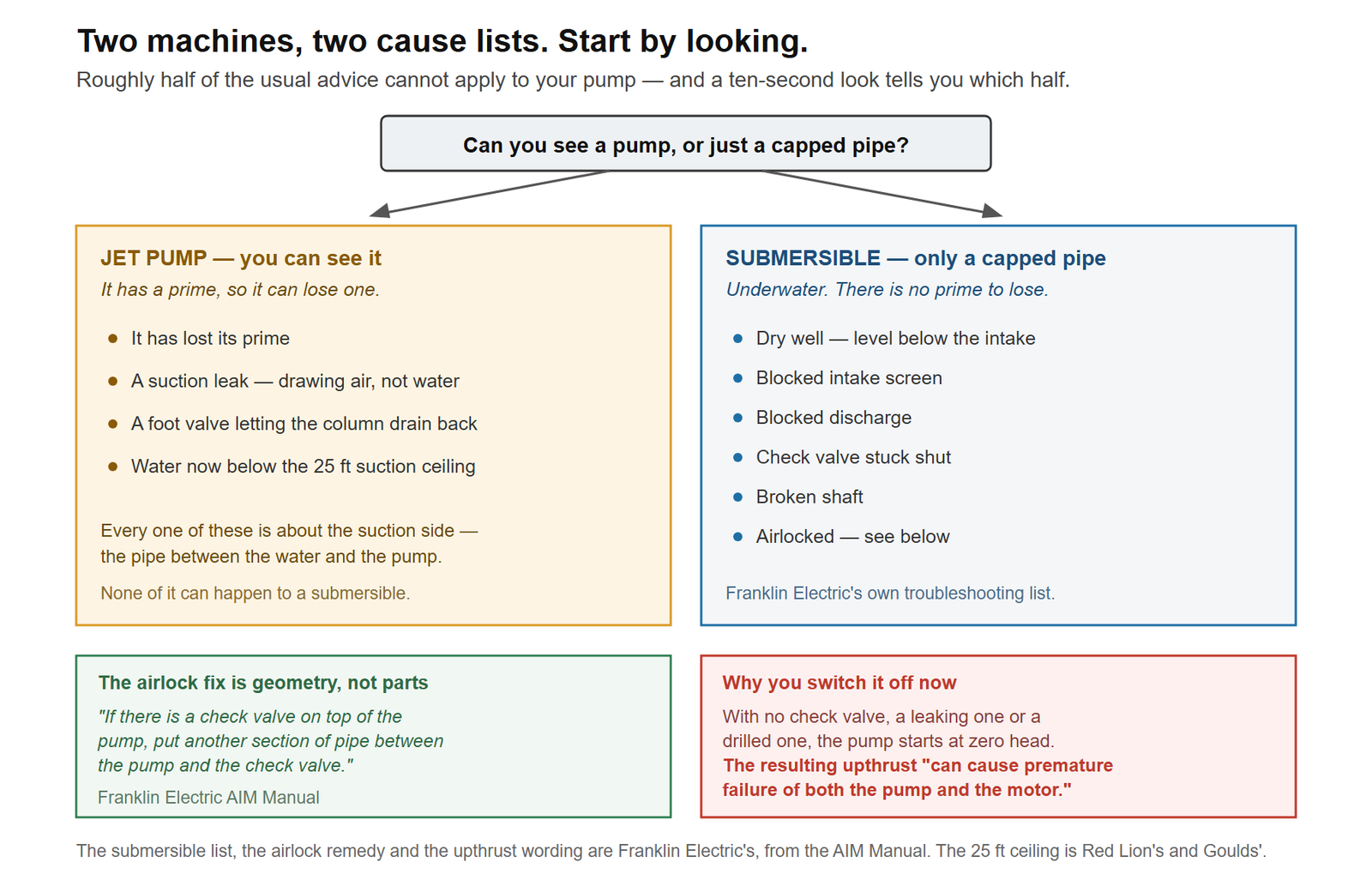
If you are not sure what you are looking at, the system guide sets out both arrangements.
If it is a jet pump
Every cause here is on the suction side — the pipe between the water and the pump. That is the whole vulnerability of the design.
It has lost its prime
The pump body and suction line have to be full of water before it can move any. Lose that column and the impeller spins in air.
One-minute test: open the priming plug on top of the pump. If it is not full to the top, there is your answer.
Fix: refill it and restart. If it loses prime again, priming was the symptom rather than the fault — something below is letting the column drain back, which is the next two causes.
A suction leak — it is drawing air, not water
A leak on the suction side does not drip. It is under vacuum, so it pulls air in rather than pushing water out, and there is nothing to see on the floor.
One-minute test: with the pump running, work along every suction joint with a bit of water or soapy film. A joint that sucks it in is your leak. Check the priming plug itself — it is a common one and it looks perfectly closed.
The foot valve is letting the column drain back
At the bottom of the suction pipe there is a foot valve whose only job is to hold the water column overnight. When it fails, the pump primes, works, and is empty again by morning.
One-minute test: prime it, run it, shut it off and come back in a few hours. Still primed means the valve holds. Empty means it does not.
The water has dropped below its reach
A shallow well jet pump is rated to about 25 feet of suction lift — Red Lion and Goulds both publish that — and it is a limit set by the atmosphere rather than the motor. If the water table has fallen, a pump that worked for years can simply stop reaching. The system guide explains why no amount of horsepower moves that number.
If it is a submersible
None of the above applies. The pump is under the water; there is no suction pipe, no prime and no foot valve to lose. Franklin’s own troubleshooting table gives the causes, and the solutions are theirs:
| What it is | Franklin’s solution |
|---|---|
| Dry well — the level has fallen below the intake | Wait for the well to recover; a protection device will time out and restart |
| Blocked intake | “Clear or replace pump intake screen.” |
| Blocked discharge | “Remove blockage in plumbing.” |
| Check valve stuck shut | “Replace check valve.” |
| Broken shaft | “Replace broken parts.” |
A dry well is the common one, and it is worth knowing that it is often temporary — heavy draw, a dry season, or a neighbour’s irrigation. If water returns after an hour of rest, the well recovered; the pump was never the problem.
A broken drop pipe belongs on this list too. If the pipe carrying water up has split, the pump is running and delivering — straight back down the well.
The check valve problem that catches both
Worth its own section, because it explains a symptom people find baffling: the pump runs, trips out after a few seconds, and delivers nothing.
Franklin’s remedy is geometry rather than parts:
“The pump may be airlocked. If there is a check valve on top of the pump, put another section of pipe between the pump and the check valve.”
Air trapped between the pump and a valve sitting right on top of it cannot get out, and the pump cannot push past it. Moving the valve further up gives the air somewhere to go.
The trade’s position on how many valves you should have is blunt. From Terry Love’s forum:
“The only check valve you should have on a submersible pump system is the one on the pump itself.”
More than one, and they fight each other — air gets trapped between them at pressure and they stop opening. Franklin adds a distance to the related fault: if the lowest check valve sits more than 30 feet above the standing water level, a vacuum forms in the discharge pipe and the next start slams water into a closed valve.
This is the second time this silo has found a check valve in the wrong place causing a problem people blame on the pump — it also causes short cycling that a new tank will not fix.
When this needs a pro
Anything that means pulling the pump. A submersible on a few hundred feet of pipe and wire is not a solo job, and most of the submersible list above ends there.
Diagnosing a dry well properly. Whether the level has dropped temporarily or permanently is a well driller’s question, and the answer decides whether you wait or spend.
Any work inside the pressure switch with power on. Line voltage, often 240 V, in a damp place.
And if you have already run it dry for a while, say so to whoever services it. Franklin’s upthrust passage is the reason: the damage from running with nothing to push against is real, and it is to the pump and the motor both.
If the pump has lost its ability to prime for good, the replacement is chosen on flow at your pressure and lift, and a dedicated priming port is worth having.
FAQ
Why does my well pump run but no water comes out?
It depends on which pump you have. A jet pump has almost certainly lost its prime or is drawing air through a suction leak. A submersible cannot lose prime — its causes are a dry well, a blocked intake or discharge, a stuck check valve, a broken shaft, or an airlock.
Can a submersible pump lose its prime?
No. It sits underwater, so its impeller is always flooded. If someone tells you to prime a submersible, they have the wrong machine in mind.
Should I keep trying the pump to see if water comes back?
No. Franklin Electric warns that starting under a zero-head condition causes upthrust that “can cause premature failure of both the pump and the motor”. Switch it off and diagnose it.
My pump primes fine but loses it overnight. What is that?
The foot valve at the bottom of the suction pipe. Its job is to hold the water column when the pump stops, and when it fails the pump empties itself between uses.
The pump runs for a few seconds then trips out with no water. Why?
It may be airlocked. Franklin’s remedy is to add a section of pipe between the pump and the check valve if the valve sits directly on top of the pump, so trapped air has somewhere to go.


